


doi: 10.1128/JCM.41.1.453-455.2003.
Identification of Balamuthia mandrillaris by PCR assay using the mitochondrial 16S rRNA gene as a target
Affiliations
- PMID: 12517892
- PMCID: PMC149639
- DOI: 10.1128/JCM.41.1.453-455.2003
Item in Clipboard
Identification of Balamuthia mandrillaris by PCR assay using the mitochondrial 16S rRNA gene as a target
J Clin Microbiol.
2003 Jan.
Abstract
Balamuthia mandrillaris is an opportunistic pathogen that causes granulomatous amebic meningoencephalitis in animals, including humans. Based on sequence analysis of mitochondrial small-subunit-rRNA genes, we developed primers that amplify a Balamuthia-specific PCR product. These primers will be useful for retrospective analyses of fixed tissues and possible identification of Balamuthia in vivo.
Figures
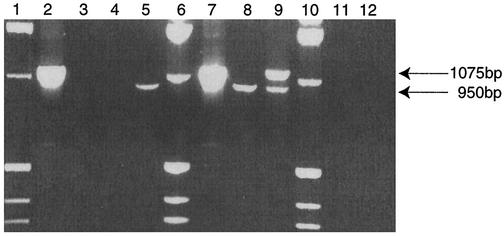
B. mandrillaris multiplex rns PCR. Amplification was performed in 50-μl reaction mixtures with 2.5 mM MgCl2; cycle conditions were 40 cycles of 1 min at 94°C, 2 min at 48°C, and 3 min at 72°C followed by a 15-min final extension at 72°C. Lanes 1, 6, and 10, 1-kb marker; lane 2, Balamuthia DNA with Balamuthia-specific primers; lane 3, Balamuthia DNA with Acanthamoeba-specific primers; lane 4, Acanthamoeba DNA with Balamuthia-specific primers; lane 5, Acanthamoeba DNA with Acanthamoeba-specific primers; lanes 7 to 9, Acanthamoeba and Balamuthia DNA with Balamuthia-specific primers (lane 7), with an Acanthamoeba-specific primer set (lane 8), and with both genus-specific primers sets (lane 9); lane 11, human DNA with both specific primer sets, lane 12, negative control. Amplicons produced by these mitochondrial 16S genus-specific primer sets are indicated on the right.
References
-
- Booton, G. C., D. J. Kelly, Y.-W. Chu, D. V. Seal, E. Houang, D. S. C. Lam, T. J. Byers, and P. A. Fuerst. 2002. 18S ribosomal DNA typing and tracking of Acanthamoeba species isolates from corneal scrape specimens, contact lenses, lens cases, and home water supplies of Acanthamoeba keratitis patients in Hong Kong. J. Clin. Microbiol. 40:1621-1625. - PMC - PubMed
-
- Booton, G. C., J. R. Carmichael, G. S. Visvesvara, T. J. Byers, and P. A. Fuerst. Genotyping of Balamuthia mandrillaris based on nuclear 18S and mitochondrial 16S rRNA genes. Am. J. Trop. Med. Hyg., in press. - PubMed
-
- Canfield, P. J., L. Vogelnest, M. L. Cunningham, and G. S. Visvesvara. 1997. Amoebic meningoencephalitis caused by Balamuthia mandrillaris in an orangutan. Aust. Vet. J. 75:97-100. - PubMed
-
- Fredricks, D. N., and D. A. Relman. 1999. Application of polymerase chain reaction to the diagnosis of infectious diseases. Clin. Infect. Dis. 29:475-488. - PubMed
-
- Gordon, S. M., J. P. Steinberg, M. H. DuPuis, P. E. Kozarsky, J. F. Nickerson, and G. S. Visvesvara. 1992. Culture isolation of Acanthamoeba species and leptomyxid amebas from patients with amebic meningoencephalitis, including two patients with AIDS. Clin. Infect. Dis. 15:1024-1030. - PubMed
Publication types
MeSH terms
Substances
Grants and funding
LinkOut - more resources
Full Text Sources
Molecular Biology Databases
