Comparative Study
. 2003 Jan 7;100(1):217-22.
doi: 10.1073/pnas.262668999. Epub 2002 Dec 23.

Identification of vaccinia virus epitope-specific HLA-A*0201-restricted T cells and comparative analysis of smallpox vaccines

Affiliations
Comparative Study

Identification of vaccinia virus epitope-specific HLA-A*0201-restricted T cells and comparative analysis of smallpox vaccines

Ingo Drexler et al. Proc Natl Acad Sci U S A. .

Abstract

Despite worldwide eradication of naturally occurring variola virus, smallpox remains a potential threat to both civilian and military populations. New, safe smallpox vaccines are being developed, and there is an urgent need for methods to evaluate vaccine efficacy after immunization. Here we report the identification of an immunodominant HLA-A*0201-restricted epitope that is recognized by cytotoxic CD8(+) T cells and conserved among Orthopoxvirus species including variola virus. This finding has permitted analysis and monitoring of epitope-specific T cell responses after immunization and demonstration of the identified T cell specificity in an A*0201-positive human donor. Vaccination of transgenic mice allowed us to compare the immunogenicity of several vaccinia viruses including highly attenuated, replication-deficient modified vaccinia virus Ankara (MVA). MVA vaccines elicited levels of CD8(+) T cell responses that were comparable to those induced by the replication-competent vaccinia virus strains. Finally, we demonstrate that MVA vaccination is fully protective against a lethal respiratory challenge with virulent vaccinia virus strain Western Reserve. Our data provide a basis to rationally estimate immunogenicity of safe, second-generation poxvirus vaccines and suggest that MVA may be a suitable candidate.


Figures
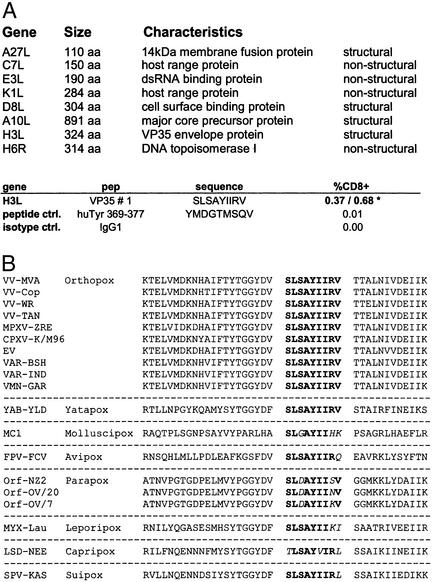
Figure 1
Figure 1
Identification of HLA-A*0201-restricted peptide epitope VP35#1. (A) Vaccinia virus polypeptides selected for analysis of peptides with highest probability for HLA-A*0201 binding are shown. Incubation of splenocytes from vaccinated HHD mice with peptide VP35#1 results in specific secretion of IFN-γ. T cell response is depicted as percentage of cytokine-secreting CD8+ cells (%CD8+). An irrelevant HLA-A*0201-binding peptide (huTyr 369) was used as a negative control. The numbers marked by an asterisk refer to results from two independent experiments. (B) Alignment of VP35#1-peptide sequences derived from poxvirus gene products homologous to vaccinia virus H3L protein: vaccinia virus strains MVA (VV-MVA), Copenhagen (VV-Cop), WR (VV-WR), and Tian Tan (VV-Tan); monkeypox virus Zaire-96-I-16 (MPXV-ZRE); camelpox virus M-96 (CPXV-K/M96); ectromelia virus Naval (EV); variola major viruses Bangladesh-1975 (VAR-BSH) and India-1967 (VAR-IND); variola minor virus Garcia-1966 (VMN-GAR); yaba-like disease virus (YAB-YLD); molluscum contagiosum virus 1 (MC1); fowlpox virus (FPV-FCV); orf viruses NZ2 (Orf-NZ2), OV/20 (Orf-OV/20), and OV/7 (Orf-OV/7); myxoma virus Lausanne (MYX-LAU); lumpy skin disease virus Neethling 2490 (LSD-NEE); and swinepox virus 17077-99 (SPV-KAS).
Figure 2
Figure 2
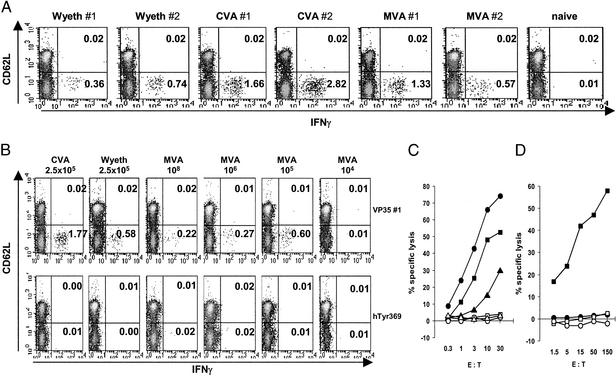
HLA-A*0201-restricted epitope-specific cellular immunogenicity of various smallpox vaccines. (A and B) Peptide-specific intracellular cytokine release of splenocytes from vaccinated HHD mice. Mice were immunized i.p. with 2.5 × 10⁵ PFU of CVA or Wyeth or 108 IU of MVA (A) or i.m. with 2.5 × 10⁵ PFU of CVA or Wyeth or 108, 106, 105, and 104 IU of MVA (B). #1 and #2 refer to individual mice analyzed. Splenocyte preparations were analyzed for the presence of VP35#1 peptide-specific, activated (CD62Llow) CD8+ T cells. The magnitude of the induced T cell response is depicted as percentages of cytokine-secreting CD8+ T cells within the live CD8+ cell population. (C) Specific lysis of peptide-pulsed human target cells by VP35#1-specific CTLs from vaccinated HHD mice. Effector CTLs were generated by single i.p. immunization of HHD mice with MVA (■ and □), CVA (● and ○), or Wyeth (▴ and ▵). CTLs were assayed for cytotoxicity at the indicated E/T ratio against T2 targets pulsed with either VP35#1 (filled symbols) or influenza M1 peptide (open symbols). (D) Processing and presentation of peptide epitope VP35#1 after heterologous expression of the vaccinia virus H3L gene. Human A375/H3L (■ and □) or control A375 (● and ○) cells were tested against A*0201-restricted murine CTLs specific for VP35#1 (filled symbols) or human tyrosinase 369–377 epitopes (open symbols) as effector cells at the indicated E/T ratio.
Figure 3
Figure 3
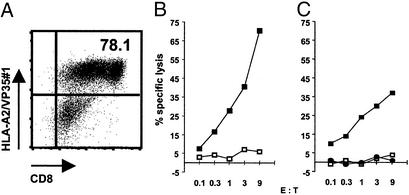
Isolation and expansion of human CD8+ VP35#1-specific T cells from peripheral blood and lysis of VP35#1-presenting human target cells. Human HLA-A*0201+ PBMCs were stimulated with autologous dendritic cells pulsed with VP35#1. T cells were stained with HLA-A2/VP35#1 multimers after two in vitro stimulations and multimer-guided sorting (A). Numbers in the upper right quadrant represent the percentage of multimer-binding CD8+ T cells gated on propidium iodide-negative PBMCs. T2 targets pulsed with either the VP35#1 peptide (■) or HIV-1 RT 476–484 peptide (□) at 1 μM (B) or human A375/H3L (■), A375/LV (□), or A375 cells (●) (C) were tested against the human A*0201-restricted, VP35#1-specific T cells as effector cells at the indicated E/T ratio.
Figure 4
Figure 4
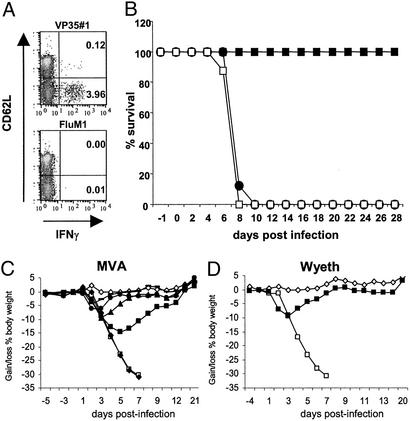
Analysis of VP35#1-peptide vaccine-induced immunity and protection in mouse challenge models. (A) Induction of HLA-A*0201-restricted VP35#1 peptide-specific CD8+ T cell responses after peptide immunization. HHD mice were immunized once with VP35#1 peptide-CpG-ODN. Splenocytes were stimulated with VP35#1 or influenza M1 peptide and stained for intracellular cytokines. Cells were analyzed by flow cytometry for the presence of VP35#1 peptide-specific, activated (CD62Llow) CD8+ T cells. The magnitude of the induced T cell response is depicted as percentages of cytokine-secreting CD8+ T cells within the live CD8+ cell population. (B) Protective efficacy of VP35#1/CpG-ODN vaccination in HLA-A*0201-transgenic mice. HHD mice (n = 8) were immunized i.m. with 107 (■) IU of MVA or s.c. with 0.3 mg of VP35#1 peptide plus 10 nM CpG-ODN 1668 (●). Mock-vaccinated (□) mice served as control. Two (peptide) or 3 (MVA) weeks after vaccination animals were challenged with 2.5 × 10⁶ PFU of WR and monitored daily for a 4-week period. The survival (%) of the animals was plotted. (C and D) Protective efficacy of vaccination in BALB/c mice. Groups of mice (n = 10) were immunized i.m. with 104 (♦), 105 (■), 106 (▴), 107 (●), or 108 IU of MVA (−) (C) or 105 PFU of Wyeth (■) (D). Three weeks after vaccination animals were challenged intranasally with 1 × 10⁶ PFU of WR. Individual animal weights were monitored daily and are expressed as means for each group. Mock-vaccinated (□) and mock-challenged (⋄) mice served as control.

References

    1. Lane H C, Montagne J L, Fauci A S. Nat Med. 2001;7:1271–1273. - PubMed
    1. Gani R, Leach S. Nature. 2001;414:748–751. - PubMed
    1. Fenner F, Henderson D A, Arita I, Jezek Z, Ladnyi I. Smallpox and Its Eradication. Geneva: W.H.O.; 1988.
    1. Birmingham K, Kenyon G. Nat Med. 2001;7:1167. - PubMed
    1. Rosenthal S R, Merchlinsky M, Kleppinger C, Goldenthal K L. Emerg Infect Dis. 2001;7:920–926. - PMC - PubMed

Publication types

MeSH terms