


MTID: a database of Sleeping Beauty transposon insertions in mice
- PMID: 12519952
- PMCID: PMC165492
- DOI: 10.1093/nar/gkg045
MTID: a database of Sleeping Beauty transposon insertions in mice
Abstract
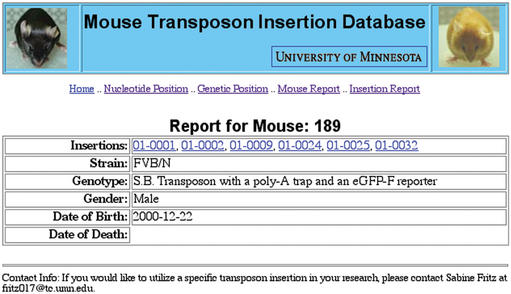
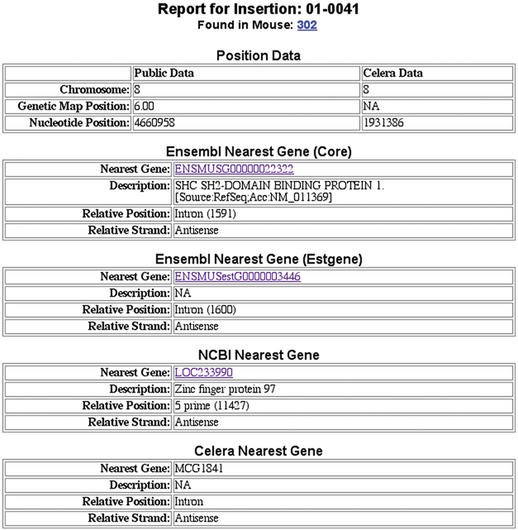
The Sleeping Beauty (SB) transposon system provides the first random insertional mutagen available for germline genetic screens in mice. In preparation for a large scale project to create, map and manage up to 5000 SB insertions, we have developed the Mouse Transposon Insertion Database (MTID; http://mouse.ccgb.umn.edu/transposon/). Each insertion's genomic position, as well as the distance between the insertion and the nearest annotated gene, are determined by a sequence analysis pipeline. Users can search the database using a specified nucleotide or genetic map position to identify the nearest insertion. Mouse reports describe insertions carried, strain, genotype and dates of birth and death. Insertion reports describes chromosome, nucleotide and genetic map positions, as well as nearest gene data from Ensembl, NCBI and Celera. The flanking sequence used to map the insertion is also provided. Researchers will be able to identify insertions of interest and request mice or frozen sperm that carry the insertion.
Figures
References
-
- Cooley L., Kelley,R. and Spradling,A. (1988) Insertional mutagenesis of the Drosophila genome with single P elements. Science, 239, 1121–1128. - PubMed
-
- Lindblad-Toh K., Lander,E.S., McPherson,J.D., Waterston,R.H., Rodgers,J. and Birney,E. (2001) Progress in sequencing the mouse genome. Genesis., 31, 137–141. - PubMed
-
- Dupuy A.J., Fritz,S. and Largaespada,D.A. (2001) Transposition and gene disruption in the male germline of the mouse. Genesis, 30, 82–88. - PubMed
