Effect on hip fractures of increased use of hip protectors in nursing homes: cluster randomised controlled trial
- PMID: 12521969
- PMCID: PMC139934
- DOI: 10.1136/bmj.326.7380.76
Effect on hip fractures of increased use of hip protectors in nursing homes: cluster randomised controlled trial
Abstract
Objective: To assess the effects of an intervention programme designed to increase use of hip protectors in elderly people in nursing homes.
Design: Cluster randomised controlled trial with 18 months of follow up.
Setting: Nursing homes in Hamburg (25 clusters in intervention group; 24 in control group).
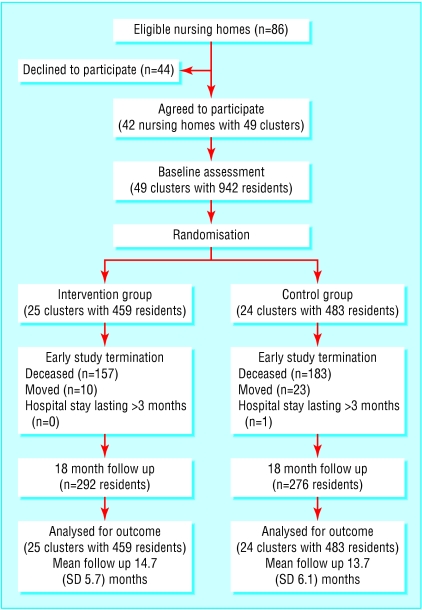
Participants: Residents with a high risk of falling (459 in intervention group; 483 in control group).
Intervention: Single education session for nursing staff, who then educated residents; provision of three hip protectors per resident in intervention group. Usual care optimised by brief information to nursing staff about hip protectors and provision of two hip protectors per cluster for demonstration purposes.
Main outcome measure: Incidence of hip fractures.
Results: Mean follow up was 15 months for the intervention group and 14 months for the control group. In total 167 residents in the intervention group and 207 in the control group died or moved away. There were 21 hip fractures in 21 (4.6%) residents in the intervention group and 42 hip fractures in 39 (8.1%) residents in the control group (relative risk 0.57, absolute risk difference -3.5%, 95% confidence interval -7.3% to 0.3%, P=0.072). After adjustment for the cluster randomisation the proportions of fallers who used a hip protector were 68% and 15% respectively (mean difference 53%, 38% to 67%, P=0.0001). There were 39 other fractures in the intervention group and 38 in the control group.
Conclusion: The introduction of a structured education programme and the provision of free hip protectors in nursing homes increases the use of protectors and may reduce the number of hip fractures.
Figures
Comment in
-
Effectiveness of hip protectors. Results may not be generalisable to the community.BMJ. 2003 Apr 26;326(7395):930; author reply 930. doi: 10.1136/bmj.326.7395.930. BMJ. 2003. PMID: 12714480 Free PMC article. No abstract available.
-
Effectiveness of hip protectors. Some clarifications would be useful.BMJ. 2003 Apr 26;326(7395):930; author reply 930. BMJ. 2003. PMID: 12715801 No abstract available.
-
Effectiveness of hip protectors. Effectiveness of studied hip protector was uncertain.BMJ. 2003 Apr 26;326(7395):930; author reply 930. BMJ. 2003. PMID: 12715802 No abstract available.
-
A structured education programme increased hip protector use and may reduce hip fractures in nursing homes.Evid Based Nurs. 2003 Oct;6(4):114-5. Evid Based Nurs. 2003. PMID: 14577397 No abstract available.
References
-
- Cumming RG. Nursing home residence and risk of hip fracture. Am J Epidemiol. 1996;143:1191–1194. - PubMed
-
- Parker MJ, Gillespie LD, Gillespie WJ. Hip protectors for preventing hip fractures in the elderly. Cochrane Database Syst Rev 2002;4:CD001255. - PubMed
-
- Dalichau G, Grüner H, Müller-Alten L. SGB XI - Pflegeversicherung. Kommentar und Rechtssammlung [ SGB XI—Statutory care insurance. Comment and collection of statutes]. Starnberg: RS Schulz; 2002.
Publication types
MeSH terms
LinkOut - more resources
Full Text Sources
Medical