


Predictors of end stage lung disease in a cohort of patients with scleroderma
- PMID: 12525384
- PMCID: PMC1754426
- DOI: 10.1136/ard.62.2.146
Predictors of end stage lung disease in a cohort of patients with scleroderma
Abstract
Objectives: To estimate the incidence of severe lung disease in patients with scleroderma and identify the combination(s) of features present at first assessment which would be useful to predict future risk of severe lung disease.
Methods: Data were analysed on 561 patients with disease onset occurring on or after 1 January 1982 and disease duration of less than five years before the first assessment. Detailed clinical and laboratory assessments were undertaken at the initial visit. End stage lung disease was defined as pulmonary hypertension requiring continuous ambulatory iloprost, or pulmonary fibrosis requiring continuous oxygen, or death from a scleroderma related lung disease. Patient status was determined at 31 December 1997. The best subset of predictors was identified by Cox regression analysis.
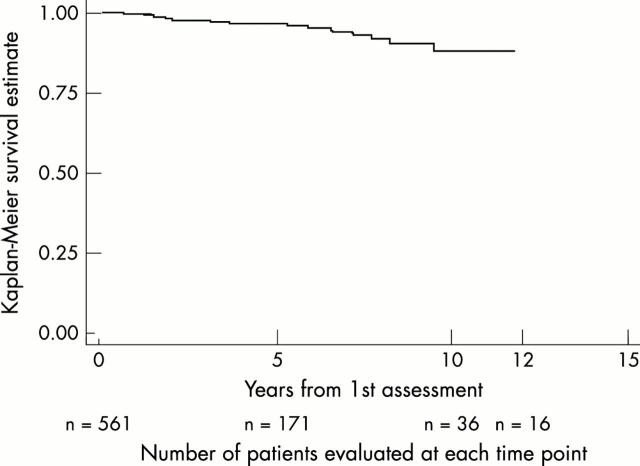
Results: In all, 24 patients reached end stage lung disease. The cumulative incidences were 4%, 6%, and 12% at five, seven, and 14 years respectively. As expected, the lung function tests at baseline, including being in the lowest third of either diffusing lung capacity (hazard ratio (HR) = 18.2, 95% confidence interval (CI) 3.5 to 93.8) or of forced vital capacity (HR=4.1, 95% CI 1.1 to 15.2), were highly significant predictors of end stage lung disease. Interestingly, apart from the presence of proteinuria, none of the other baseline variables, including the extent of skin disease and serological markers, were predictive of severe lung disease.
Conclusion: End stage lung disease was infrequent in this large cohort, but the cumulative incidence increased importantly with time. The risk can be predicted from baseline assessment of pulmonary function. In particular, those with normal pulmonary function at baseline are at very low risk.
Figures
Comment in
-
Predictors of end stage lung disease in systemic sclerosis.Ann Rheum Dis. 2003 Feb;62(2):97-9. doi: 10.1136/ard.62.2.97. Ann Rheum Dis. 2003. PMID: 12525376 Free PMC article. No abstract available.
References
Publication types
MeSH terms
Substances
Grants and funding
LinkOut - more resources
Full Text Sources
Medical
Research Materials
