


Comment
doi: 10.1073/pnas.0437775100.
Epub 2003 Jan 13.
From a pump to a pore: how palytoxin opens the gates
Affiliations
- PMID: 12525688
- PMCID: PMC141003
- DOI: 10.1073/pnas.0437775100
Item in Clipboard
Comment
From a pump to a pore: how palytoxin opens the gates
Proc Natl Acad Sci U S A.
.
No abstract available
Figures
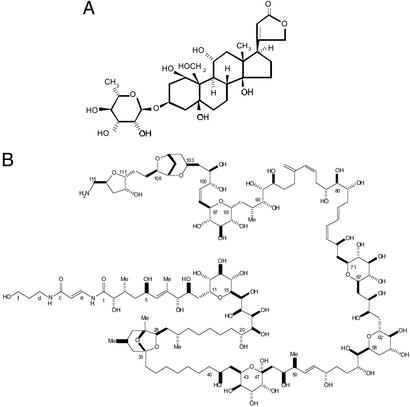
Structures of ouabain (A) and palytoxin (B). [B modified with permission from ref. (Copyright 1982, American Chemical Society).]
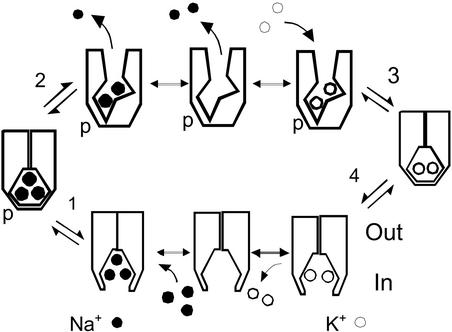
The Na/K pump cycle. Each cartoon of the pump is drawn with the cytoplasmic side facing downward. When binding sites are open to the cytoplasmic side, the pump has a high affinity for sodium. When binding sites are open to the extracellular side, the pump has a high affinity for potassium. From the cytoplasmic side, three sodium ions can bind when binding sites are not occupied by potassium, and the pump then autophosphorylates (39) and closes its cytoplasmic gate (reaction 1). Therewith, the extracellular gate can open (reaction 2), releasing one sodium ion, and the last two sodium ions can dissociate and be replaced by potassium ions. When two potassium ions are bound, the extracellular gate can close and the pump dephosphorylates (reaction 3). Therewith, the cytoplasmic gate can open and potassium ions can be replaced by sodium ions on the cytoplasmic side (reaction 4).
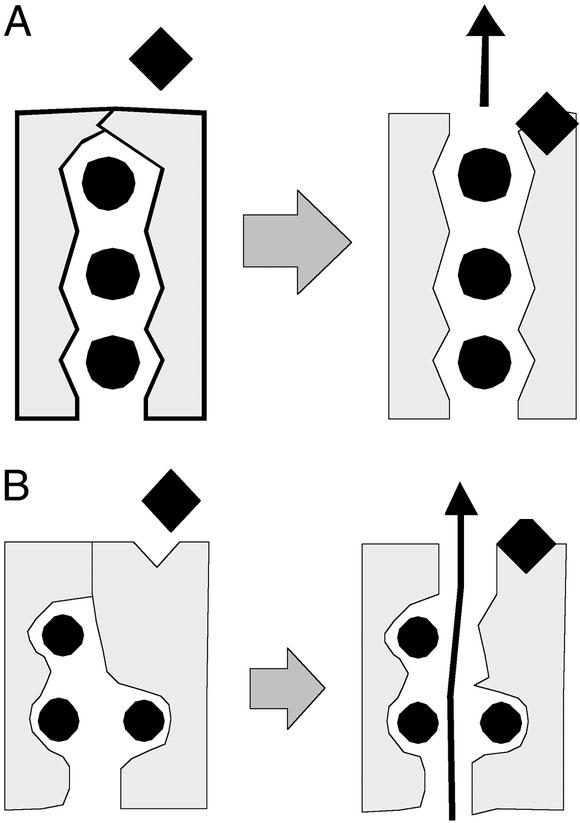
Cartoons of the permeation pathways of an ion channel (A) and the Na/K pump (B) when their gates are opened by a toxin. The ion diffusion pathway of the channel is selective, whereas that of the Na/K pump is not.
Comment on
-
Na+/K+-pump ligands modulate gating of palytoxin-induced ion channels.Proc Natl Acad Sci U S A. 2003 Jan 21;100(2):501-5. doi: 10.1073/pnas.0135849100. Epub 2002 Dec 23. Proc Natl Acad Sci U S A. 2003. PMID: 12518045 Free PMC article.
References
-
- Hille B. Ion Channels of Excitable Membranes. Sunderland, MA: Sinauer; 2001.
-
- Rash L D, Hodgson W C. Toxicon. 2002;40:225–254. - PubMed
-
- Garcia M L, Gao Y, McManus O B, Kaczorowski G J. Toxicon. 2001;39:739–748. - PubMed
-
- Escoubas P, Diochot S, Corzo G. Biochimie. 2000;82:893–907. - PubMed
-
- Cestele S, Catterall W A. Biochimie. 2000;82:883–892. - PubMed
Publication types
MeSH terms
Substances
LinkOut - more resources
Full Text Sources
Other Literature Sources
