. 2003 Jan 15;546(Pt 2):501-9.
doi: 10.1113/jphysiol.2002.027573.

Streptomycin and intracellular calcium modulate the response of single guinea-pig ventricular myocytes to axial stretch

Affiliations

Streptomycin and intracellular calcium modulate the response of single guinea-pig ventricular myocytes to axial stretch

Alexandra Belus et al. J Physiol. .

Abstract

We tested the hypothesis that both stretch-activated channels (SACs) and intracellular calcium ([Ca(2+)](i)) are important in the electrical response of single guinea-pig ventricular myocytes to axial stretch. Myocytes were attached to carbon fibre transducers and stretched, sarcomere length increased by approximately 9 %, and there was a prolongation of the action potential duration. Streptomycin, a blocker of SACs, had no effect upon the shortening, [Ca(2+)](i) transients or action potentials of electrically stimulated, unstretched myocytes, at a concentration of 50 microM, but at 40 microM, prevented any stretch-induced increase in action potential duration. Under action potential clamp, stretch elicited a current with a linear current-voltage relationship that was inward at membrane potentials negative to its reversal potential of -30 mV, in 10 of 24 cells tested, and was consistent with the activation of non-specific, cationic SACs. This current was not seen in any stretched cells that were exposed to 40 microM streptomycin. However, exposure of cells to 5 microM BAPTA-AM, in order to reduce [Ca(2+)](i) transients, also abolished stretch-induced prolongation of the action potential. We conclude that both SACs and [Ca(2+)](i) are important in the electrical response of cardiac myocytes to stretch, and propose that stretch-induced changes in electrical activity and [Ca(2+)](i) may be linked by inter-dependent mechanisms.


Figures
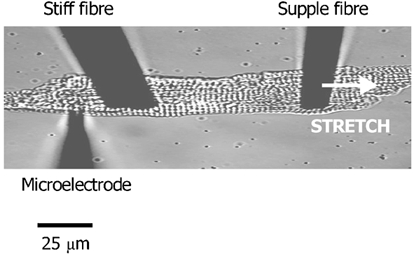
Figure 1
Figure 1. Technique to simultaneously stretch a guinea-pig ventricular myocyte and record electrical activity
The microelectrode is used to record membrane potential or currents. It is placed behind the stiff fibre to protect the site of impalement during stretch. The supple fibre is used to stretch the cell and its displacement during stimulation is a measure of active force development (increased resting force caused by the stretch cannot be measured in this configuration). Increased sarcomeric spacing is used as the index of stretch.
Figure 2
Figure 2. Effect of axial stretch on the action potential and active force of a guinea-pig ventricular myocyte
Action potential configuration (A) and active tension (B) before (○) and after (•) a stretch that increased sarcomere length from 1.85 to 2.11 μm. Stretch prolonged the action potential and increased active force.
Figure 6
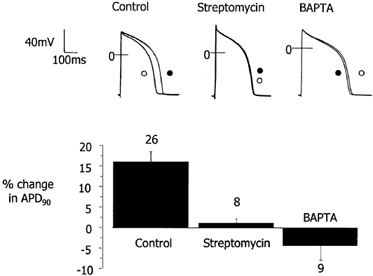
Figure 6. Comparison of mean effects of stretch on the action potential of guinea-pig ventricular myocytes in the presence and absence of streptomycin or BAPTA
Representative experimental records of action potentials before (○) and after (•) an axial stretch in the presence or absence (Control) of 40 μm streptomycin or the [Ca2+]i buffer BAPTA (upper panel). Mean percentage changes in action potential duration at 90 % repolarisation (APD90; lower panel). In control conditions, stretch prolongs the action potential; this effect is not seen in the presence of 40 μm streptomycin. In the presence of BAPTA there is a tendency for stretch to shorten the action potential. In control cells changes in APD90 were significantly different from zero, streptomycin and BAPTA (P < 0.05, one-way ANOVA and multiple comparison corrected t tests). Numbers refer to the number of cells.
Figure 3
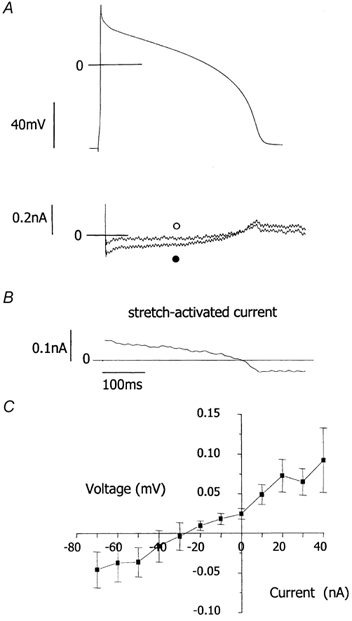
Figure 3. Stretch-activated membrane currents in guinea-pig ventricular myocytes under action potential clamp
A, upper panel, free action potentials were recorded then used as the waveform to voltage clamp each myocyte. Lower panel, compensation currents (which have a reverse polarity to ionic currents) recorded under action potential clamp before (○) and after (•) a stretch that increased sarcomere length from 1.77 to 2.00 μm. Following decay of large capacitive currents, compensation currents at short sarcomere length are very small. B, stretch-induced current. C, mean current-voltage relationship for the stretch-activated current from 10 cells, having a current of greater than 5 pA at +30 mV. Stretch increased sarcomere length from 1.82 ± 0.01 to 1.98 ± 0.01 μm. The current-voltage relationship was achieved by plotting current (B) against clamp voltage (A, upper panel).
Figure 4
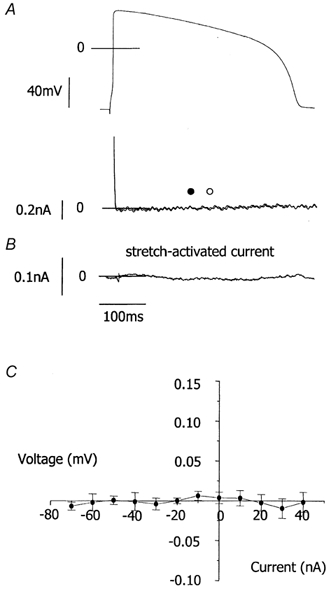
Figure 4. Effect of 40 μm streptomycin on stretch-activated currents in guinea-pig ventricular myocytes under action potential clamp
A, upper panel, voltage clamp waveform. Lower panel, compensation currents (which have a reverse polarity to ionic currents) recorded under action potential clamp before (○) and after (•) a stretch that increased sarcomere length from 1.80 to 1.95 μm in the presence of 40 μm streptomycin. B, stretch-induced current. C, mean current-voltage relationship for the stretch-activated current from 8 cells. Stretch increased sarcomere length from 1.80 ± 0.01 to 1.96 ± 0.04 μm. The current-voltage relationship was achieved as in Fig. 3. Stretch-activated currents were not seen in the presence of streptomycin.
Figure 5
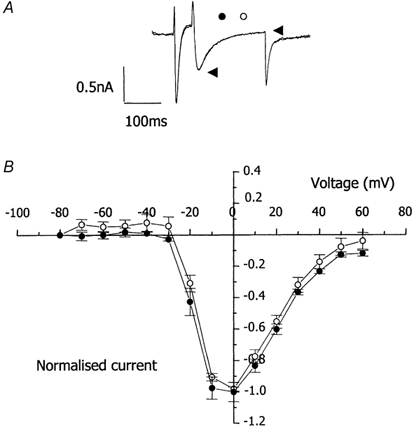
Figure 5. Effect of axial stretch on L-type Ca2+ current in guinea-pig cardiac myocytes
A, membrane currents in a single myocyte voltage clamped at −80 mV, step depolarised to −40 mV for 100 ms to inactivate Na+ currents, then further depolarised to 0 mV for 200 ms to activate L-type Ca2+ current (ICa,L). Amplitude of ICa,L measured as the difference between peak inward current (left arrowhead) and current at the end of the pulse (right arrowhead). Records show superimposed traces of membrane current before (○) and after (•) a stretch that increased sarcomere length from 1.77 to 1.90 μm. B, mean current-voltage relationship for ICa,L from 12 cells before (○) and after (•) stretch that increased sarcomere length from 1.83 ± 0.02 to 2.01 ± 0.01 μm. Current was normalised to maximum pre-stretch ICa,L (0.94 ± 0.11 nA). Stretch did not modify ICa,L.
Figure 7
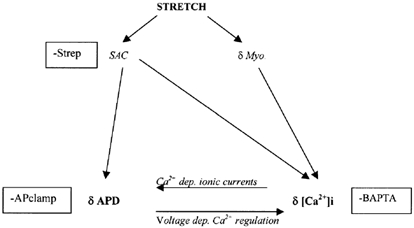
Figure 7. Possible interactions between stretch-induced changes in Ca2+ handling and electrical activity in ventricular myocytes
Upon stretch, activation of stretch-activated channels (SACs) and changes in diastolic and systolic myofilament Ca2+ sensitivity (δMyo.) lead to alterations in action potential configuration (δAPD) and intracellular Ca2+ (δ[Ca2+]i). There follows interaction between changes in electrical activity and [Ca2+]i because of the voltage dependence of some calcium-regulating mechanisms (e.g. the Na+-Ca2+ exchanger) and the Ca2+ dependence of certain ionic membrane currents (e.g. L-type calcium current, delayed rectifier K+ current and Na+-Ca2+ exchanger current). This pathway would be interrupted (-) by streptomycin by its action on SACs, by BAPTA via its action on [Ca2+]i and by action potential clamp (APclamp) via its stabilisation of action potential configuration.

References

    1. Allen D, Kurihara S. The effects of muscle length on intracellular calcium transients in mammalian cardiac muscle. J Physiol. 1982;327:79–94. - PMC - PubMed
    1. Alvarez B, Perez N, Ennis I, Camilion de Hurtagon M, Cingolani H. Mechanisms underlying the increase in Ca2+ transient that follow stretch of cardiac muscle: possible explanation of the Anrep effect. Circ Res. 1999;85:716–722. - PubMed
    1. Babuty D, Lab M. Heterogeneous changes of monophasic action potential induced by sustained stretch in atrium. J Cardiovasc Electrophysiol. 2001;12:323–329. - PubMed
    1. Belus A, White E. Effects of antibiotics on the contraction and Ca2+ transients of rat cardiac myocytes. Eur J Pharmacol. 2001;412:121–126. - PubMed
    1. Bett GCL, Sachs F. Activation and inactivation of mechanosensistive currents in the chick heart. J Membr Biol. 2000a;173:237–254. - PubMed

Publication types

LinkOut - more resources