Comparative Study
. 2003 Jan;13(1):73-80.
doi: 10.1101/gr.762503.

Strategies and tools for whole-genome alignments

Affiliations
Comparative Study

Strategies and tools for whole-genome alignments

Olivier Couronne et al. Genome Res. 2003 Jan.

Abstract

The availability of the assembled mouse genome makes possible, for the first time, an alignment and comparison of two large vertebrate genomes. We investigated different strategies of alignment for the subsequent analysis of conservation of genomes that are effective for assemblies of different quality. These strategies were applied to the comparison of the working draft of the human genome with the Mouse Genome Sequencing Consortium assembly, as well as other intermediate mouse assemblies. Our methods are fast and the resulting alignments exhibit a high degree of sensitivity, covering more than 90% of known coding exons in the human genome. We obtained such coverage while preserving specificity. With a view towards the end user, we developed a suite of tools and Web sites for automatically aligning and subsequently browsing and working with whole-genome comparisons. We describe the use of these tools to identify conserved non-coding regions between the human and mouse genomes, some of which have not been identified by other methods.


Figures
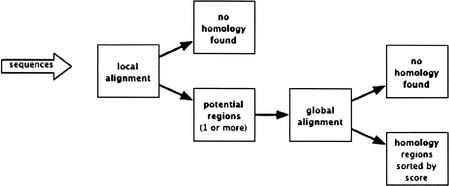
Figure 1.
Figure 1.
General scheme of the pipeline. The pipeline processes individual contigs, supercontigs, or long fragments of assemblies.
Figure 2.
Figure 2.
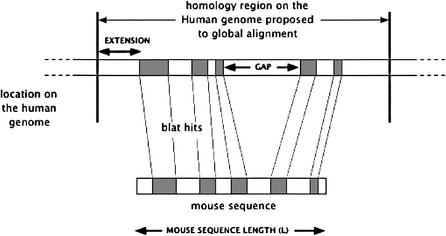
Heuristic for selecting anchors to determinate candidate regions for global alignment.
Figure 3.
Figure 3.
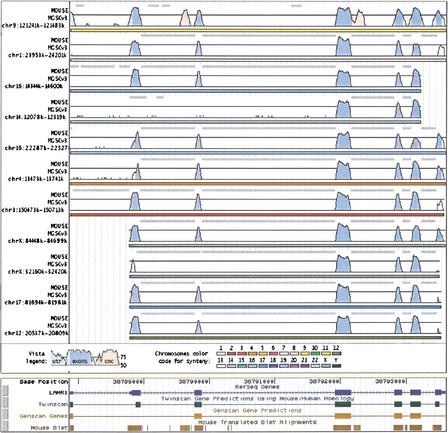
Location at chr3:38787874–38793594 on the human genome, June 2002 (hg12/ncbi30) where LAMR1 gene is covered by the alignments of sequences from different mouse chromosomes.
Figure 4.
Figure 4.
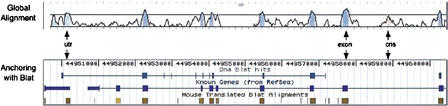
The global alignment of the mouse finished sequence NT_002570 against the region found by BLAT anchors revealed conserved coding and non-coding elements not found by the BLAT program. The anchoring scheme is sensitive enough to provide the global alignment with the correct homology candidate. The location found for this mouse finished contig on the human genome, June 2002 (hg12/ncbi30) is chr20:42974590–42993423.
Figure 5.
Figure 5.
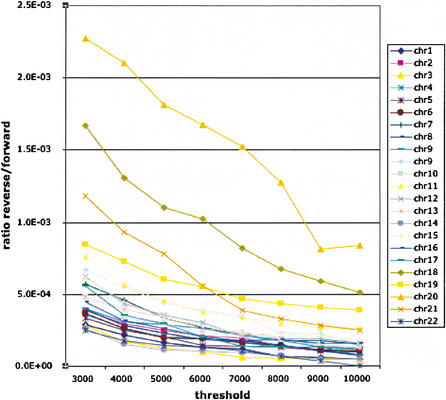
The ratio of the number of nucleotides on each human chromosome covered by alignments of the random mouse sequence and the number of nucleotides covered by the real mouse sequence for each chromosome. Threshold definition is described in the alignment section of Waterston et al. (2002).
Figure 6.
Figure 6.
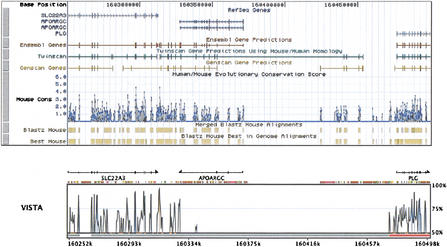
Apolipoprotein(a) region. The expressed gene is confined to a subset of primates, as most mammals lack apo(a). Shown are the coverage in this region by the mouse sequence utilizing Blastz and that obtained by the method presented here. Our method is the only one to predict that apo(a) has no homology in the mouse, as has been shown experimentally.
Figure 7.
Figure 7.
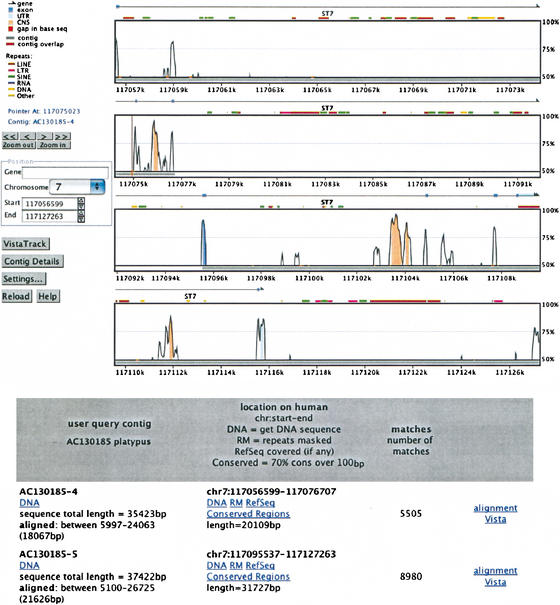
Results of an on-line submission of a draft unannotated platypus sequence to the genome alignment Web server. The gene has been correctly identified. Note the general lack of conservation in non-coding regions, except for a few highly conserved islands. The submission was done directly with the GenBank accession number () and was completed in less than 30 sec.

References

    1. Altschul S.F., Gish, W., Miller, W., Myers, E.W., and Lipman, D.J. 1990. Basic local alignment search tool. J. Mol. Biol. 215: 403-410. - PubMed
    1. Aparicio S., Chapman, J., Stupka, E., Putnam, N., Chia, J.M., Dehal, P., Christoffels, A., Rash, S., Hoon, S., Smit, A., et al. 2002. Whole-genome shotgun assembly and analysis of the genome of Fugu rubripes. Science 297: 1301-1310. - PubMed
    1. Bailey J.A., Gu, Z., Clark, R.A., Reinert, K., Samonte, R.V., Schwartz, S., Adams, M.D., Myers, E.W., Li, P.W., Eichler, E.E., et al. 2002. Recent segmental duplication in the human genome. Science 297: 1003-1007. - PubMed
    1. Batzoglou S., Pachter, L., Mesirov, J.P., Berger, B., and Lander, E.S. 2000. Human and mouse gene structure: Comparative analysis and application to exon prediction. Genome Res. 10: 950-958. - PMC - PubMed
    1. Bray, N., Dubchak, I., and Pachter, L. 2003. AVID: A global alignment program. Genome Res. (this issue). - PMC - PubMed

Publication types