


Study on the mechanism of epidermal growth factor-induced proliferation of hepatoma cells
- PMID: 12532446
- PMCID: PMC4611326
- DOI: 10.3748/wjg.v9.i2.271
Study on the mechanism of epidermal growth factor-induced proliferation of hepatoma cells
Abstract
Aim: Many growth factors, such as epidermal growth factor (EGF), are associated with the carcinogenesis. EGF plays its role in the proliferation of hepatoma cells through binding with EGF receptor (EGFR) and a series of signal transduction. But the postreceptor pathway is still not clear. In the present experiment, we studied the effect of tyrosine kinase, protein kinase C, Na(+)/H(+) exchange, calmodulin and voltage-dependent Ca(2+) channel on EGF-induced hepatoma cell proliferation.
Methods: Hepatoma cell line SMMC7721 was cultured in RPMI1640 serum-free medium. In order to study the effect of thyrosine kinase, protein kinase C, Na(+)/H(+) exchange, calmodulin and voltage-dependent Ca(2+) channel on human heptoma cell proliferation induced by epidermal growth factor (EGF), DNA synthesis rate of hepatoma cells was measured by the method of (3)H-TdR incorporation.
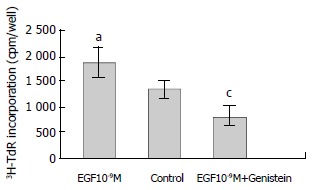
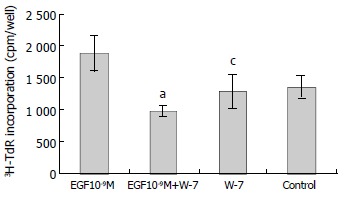
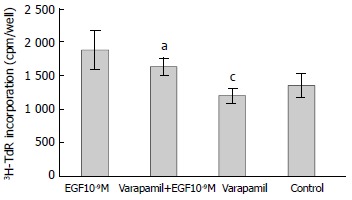
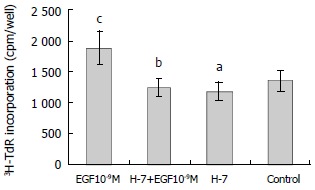
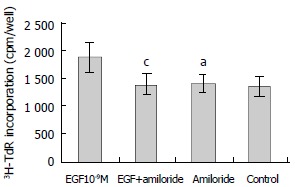
Results: EGF (10(-9) M) stimulated the proliferation of heptoma cells significantly ((3)H-TdR incorporation was 1 880+/-281 cpm/well, P<0.05), and this effect was significantly inhibited by tyrosine kinase inhibitor genistein ((3)H-TdR incorporation was 808+/-209 cpm/well, P<0.001). Calmodulin inhibitor W-7, protein kinase C inhibitor H-7 and Na(+)/H(+) exchange inhibitor amiloride individually had significant inhibiting effect on EGF-induced proliferation of hepatoma cells ((3)H-TdR incorporation was 978+/-87.3 cpm/well, 1 241+/-147 cpm/well, 1 380+/-189 cpm/well, respectively, P<0.001, P<0.01, P<0.05), but they all had no effect on the basal level proliferation of cultured hepatoma cells ((3)H-TdR incorporation was 1 284+/-260 cpm/well, 1 179+/-150 cpm/well, 1 392+/-152 cpm/well, respectively, (3)H-TdR incorporation of the control was 1 353+/-175 cpm/well, P>0.05). Voltage-dependent Ca(2+) channel inhibitor verapamil had no inhibition on EGF-induced proliferation of hepatoma cells ((3)H-TdR incorporation was 1 637+/-133 cpm/well, P>0.05), it also had no effect on the basal level proliferation of cultured hepatoma cells ((3)H-TdR incorporation was 1 196+/-112 cpm/well, P>0.05).
Conclusion: Our data suggest that tyrosine kinase, Ca(2+)-calmodulin-dependent pathway, protein kinase C and Na(+)/H(+) exchange play a critical role in EGF-induced proliferation of hepatoma cells and that the effect of EGF is independent of voltage-dependent Ca(2+) channel.
Figures
References
-
- Diehl AM, Rai RM. Liver regeneration 3: Regulation of signal transduction during liver regeneration. FASEB J. 1996;10:215–227. - PubMed
-
- Fausto N, Laird AD, Webber EM. Liver regeneration. 2. Role of growth factors and cytokines in hepatic regeneration. FASEB J. 1995;9:1527–1536. - PubMed
-
- Michalopoulos GK, DeFrances MC. Liver regeneration. Science. 1997;276:60–66. - PubMed
-
- Yan JP, Jia JB, Ma XH, Wu XR, Zhao YC, Han DW. Immunohistochemical study on expression of epidermal growth factor receptor at hepatocyte nuclei in experimental rat liver cirrhosis. Huaren Xiaohua Zazhi. 1998;6:15–16.
-
- Kong YG, Zhen J, Lu GJ, Xu SB, Chen YF. The effects of EGF on the growth of human hepatoma cells and the regulatory action of somatostatin on EGF receptors. Zhonghua Xiaohua Zazhi. 1995;15:129–132.
MeSH terms
Substances
LinkOut - more resources
Full Text Sources
Medical
Research Materials
Miscellaneous
