


Seasonal dynamics of Anaplasma phagocytophila in a rodent-tick (Ixodes trianguliceps) system, United Kingdom
- PMID: 12533283
- PMCID: PMC2873734
- DOI: 10.3201/eid0901.020169
Seasonal dynamics of Anaplasma phagocytophila in a rodent-tick (Ixodes trianguliceps) system, United Kingdom
Abstract
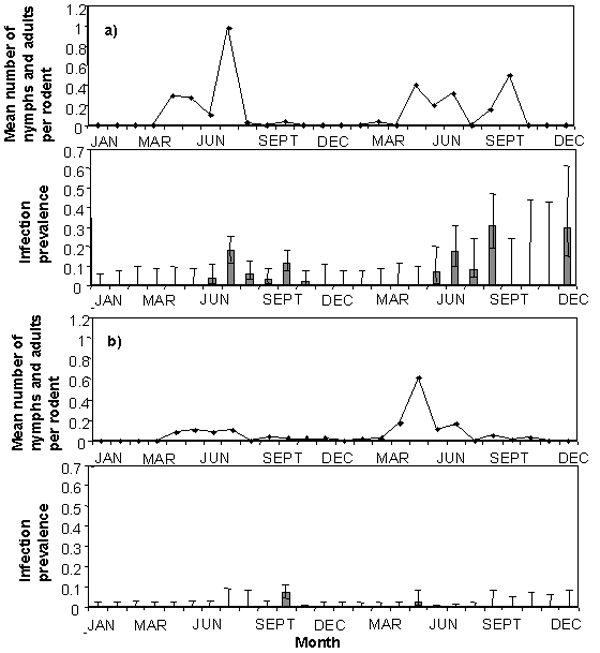
We investigated the reservoir role of European wild rodents for Anaplasma phagocytophila using polymerase chain reaction (PCR) analysis of blood collected from individually tagged rodents captured monthly over 2 years. The only tick species observed in the woodland study site was Ixodes trianguliceps, and ruminant reservoir hosts were not known to occur. A. phagocytophila infections were detected in both bank voles and wood mice but were restricted to periods of peak nymphal and adult tick activity. Most PCR-positive rodents were positive only once, suggesting that rodent infections are generally short-lived and that ticks rather than rodents may maintain the infection over winter. Bank voles were more likely to be PCR positive than wood mice, possibly because detectable infections are longer lived in bank voles. This study confirms that woodland rodents can maintain A. phagocytophila in Great Britain in the absence of other reservoir hosts and suggests that I. trianguliceps is a competent vector.
Figures
References
-
- Dumler JS, Barbet AF, Bekker CPJ, Dasch GA, Palmer GH, Ray SC, et al. Reorganisation of the genera of the families Rickettsiaceae and Anaplasmataceae in the order Rickettsiales: unification of some species of Ehrlichia with Anaplasma, Cowdria with Ehrlichia and Ehrlichia with Neorickettsia, descriptions of six new combinations and designations of Ehrlichia equi and ‘HGE agent’ as subjective synonyms of Ehrlichia phagocytophila. Int J Syst Evol Microbiol. 2001;51:2145–65. - PubMed
-
- Woldehiwet Z, Scott GR. Tick-borne (pasture) fever. In: Woldehiwet Z, Ristic M. editors. Rickettsial and chlamydial diseases of domestic animals. Oxford: Pergamon Press; 1993. p 233–54.
-
- Macleod J, Gordon WS. Studies on tick-borne fever in sheep I: transmission by the tick Ixodes ricinus and description of the disease produced. Parasitology. 1933;25:273–83. 10.1017/S0031182000019442 - DOI
-
- Hudson JR. The recognition of tick-borne fever as a disease of cattle. Br Vet J. 1950;106:3–17.
Publication types
MeSH terms
Substances
Associated data
- Actions
Grants and funding
LinkOut - more resources
Full Text Sources
Molecular Biology Databases