


Effectiveness of collaborative care depression treatment in Veterans' Affairs primary care
- PMID: 12534758
- PMCID: PMC1494801
- DOI: 10.1046/j.1525-1497.2003.11109.x
Effectiveness of collaborative care depression treatment in Veterans' Affairs primary care
Abstract
Objective: To compare collaborative care for treatment of depression in primary care with consult-liaison (CL) care. In collaborative care, a mental health team provided a treatment plan to the primary care provider, telephoned patients to support adherence to the plan, reviewed treatment results, and suggested modifications to the provider. In CL care, study clinicians informed the primary care provider of the diagnosis and facilitated referrals to psychiatry residents practicing in the primary care clinic.
Design: Patients were randomly assigned to treatment model by clinic firm.
Setting: VA primary care clinic.
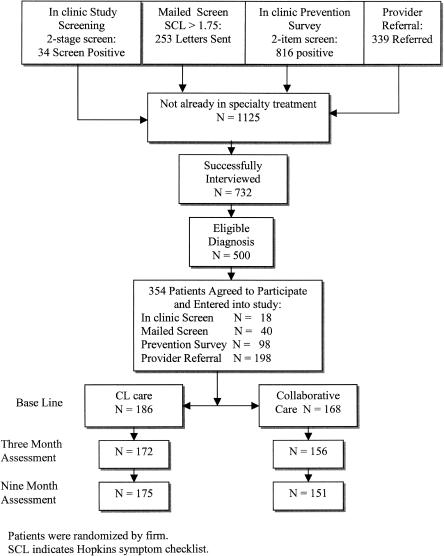
Participants: One hundred sixty-eight collaborative care and 186 CL patients who met criteria for major depression and/or dysthymia.
Measurements: Hopkins Symptom Checklist (SCL-20), Short Form (SF)-36, Sheehan Disability Scale.
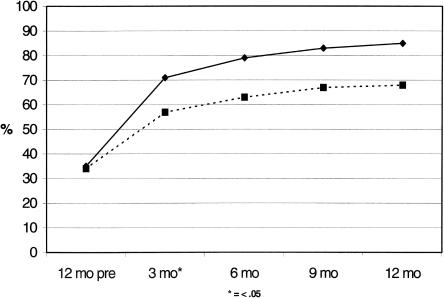
Main results: Collaborative care produced greater improvement than CL in depressive symptomatology from baseline to 3 months (SCL-20 change scores), but at 9 months there was no significant difference. The intervention increased the proportion of patients receiving prescriptions and cognitive behavioral therapy. Collaborative care produced significantly greater improvement on the Sheehan at 3 months. A greater proportion of collaborative care patients exhibited an improvement in SF-36 Mental Component Score of 5 points or more from baseline to 9 months.
Conclusions: Collaborative care resulted in more rapid improvement in depression symptomatology, and a more rapid and sustained improvement in mental health status compared to the more standard model. Mounting evidence indicates that collaboration between primary care providers and mental health specialists can improve depression treatment and supports the necessary changes in clinic structure and incentives.
Figures
Comment in
-
Collaborative care speeds recovery from depression.Evid Based Ment Health. 2003 Nov;6(4):116. doi: 10.1136/ebmh.6.4.116. Evid Based Ment Health. 2003. PMID: 14585789 No abstract available.
References
-
- Kazis LE, Ren XS, Lee A, et al. Health status in VA patients: results from the Veterans Health Study. Am J Med Qual. 1999;14:28–38. - PubMed
-
- Hays RD, Wells KB, Sherbourne CD, Rogers W, Spritzer K. Functioning and well-being outcomes of patients with depression compared with chronic general medical illnesses. Arch Gen Psychiatry. 1995;52:11–9. - PubMed
-
- Ormel J, VonKorff M, Ustun TB, Pini S, Korten A, Oldehinkel T. Common mental disorders and disability across cultures. Results from the WHO Collaborative Study on Psychological Problems in General Health Care. JAMA. 1994;272:1741–48. - PubMed
-
- Wells KB, Golding JM, Burnam MA. Chronic medical conditions in a sample of the general population with anxiety, affective, and substance use disorders. Am J Psychiatry. 1989;146:1440–6. - PubMed
-
- Katon W. The epidemiology of depression in medical care. Int J Psychiatry Med. 1987;17:93–110. - PubMed
Publication types
MeSH terms
LinkOut - more resources
Full Text Sources
Medical
Research Materials
Miscellaneous