


Pet allergen control measures for allergic asthma in children and adults
- PMID: 12535446
- PMCID: PMC8689577
- DOI: 10.1002/14651858.CD002989
Pet allergen control measures for allergic asthma in children and adults
Abstract
Background: Although pet removal has been recommended in guidelines on the management of allergic asthma, pet ownership remains high in families where one or more members have an allergy to pet dander. Allergen control measures such as air filtration units placed in the homes of pet-allergic asthmatics have been used as a means of reducing allergen exposure.
Objectives: To determine the clinical efficacy of pet allergen control measures in the homes of people with pet-allergic asthma.
Search strategy: An electronic search of the Cochrane Controlled Trials Register was carried out. No restriction was placed on language of publication.
Selection criteria: Randomised controlled trials comparing an active allergen reduction measure with control were considered for analysis. Participants had stable pet-allergic asthma.
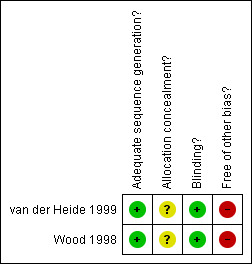
Data collection and analysis: 34 references were identified by electronic searching, but only three appeared suitable for potential inclusion in the review. Two met the inclusion criteria for the analysis. Both examined the effectiveness of air filtration units. Two reviewers extracted data independently. A limited amount of data were usable for a meta-analysis.
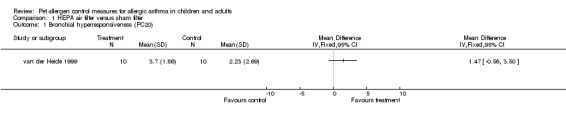
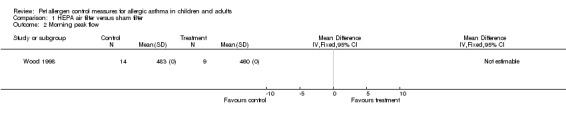
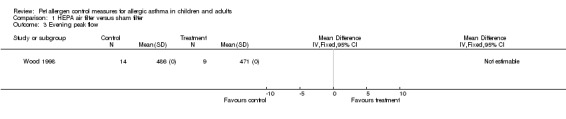
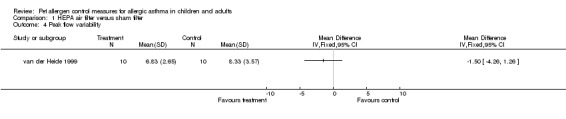
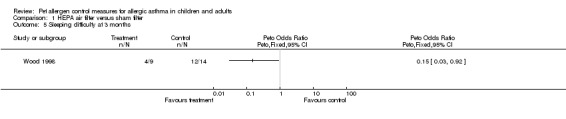
Main results: Both trials were small (n=22 and n=35). No significant differences were detected between active intervention and control on the primary and secondary outcome measures reported in the studies. Data on absence from school or work were not reported in either study. No meta-analysis could be performed due to lack of common outcomes.
Reviewer's conclusions: The available trials are too small to provide evidence for or against the use of airfiltration units to reduce allergen levels in the management of pet-allergic asthma. Adequately powered trials are needed. There are no trials of other allergen reduction measures, such as pet washing or possibly pet removal.
Conflict of interest statement
None known.
Figures
References
References to studies included in this review
van der Heide 1999 {published data only}
-
- Heide S, Aaldsen WMC, KauffmanHF, Dubois AEJ, Monchy JGR. Clinical effects of air cleaners in homes of asthmatic children sensitized to pet allergen. Journal of Allergy and Clinical Immunology 1999;104(2):447‐51. - PubMed
Wood 1998 {published data only}
-
- Wood RA, Johnson EF, Natta ML, Hua Chen P, Eggleston PA. A placebo‐controlled trial of a HEPA air cleaner in the treatment of cat allergy. American Journal of Respiratory and Critical Care Medicine 1998;158:115‐20. - PubMed
References to studies excluded from this review
Antonicelli 1991 {published data only}
-
- Antonicelli L, Bilo MB, Pucci S, Schou C, Bonifazi F. Efficacy of an air‐cleaning device equipped with a high efficiency particulate air filter in house dust mite respiratory allergy. Allergy 1991;46:594‐600. - PubMed
Bjornsdottir 2003 {published data only}
-
- Bjornsdottir US, Jakobinudottir S, Runarsdottir V, Juliusson S. The effect of reducing levels of cat allergen (Fel d 1) on clinical symptoms in patients with cat allergy. Annals of Allergy, Asthma, & Immunology 2003;91(2):189‐94. - PubMed
Boquete 1997 {published data only}
-
- Boquete M, Cortada Macias JM, Gonzalez JJG, Ibero M, Cocera CM. Effectiveness of air purification with HEPA filter in domestic environmental control [Eficacia de un purificador de aire con filtro HEPA en el control ambinetal domiciliario]. Revista Espanola de Alergologia e Immunologia Clinica 1997;12(4):258‐64.
Carter 2001 {published data only}
-
- Carter MC, Perzanowski MS, Raymond A, Platts‐Mills TA. Home intervention in the treatment of asthma among inner‐city children. Journal of Allergy & Clinical Immunology 2001;108(5):732‐7. - PubMed
De Blay 2003 {published data only}
-
- Blay F, Fourgaut G, Hedelin G, Vervloet D, Michel FB, Godard P, et al. Medical indoor environment counselor (MIEC): role in compliance with advice on mite allergen avoidance and on mite allergen exposure. Allergy: European Journal of Allergy and Clinical Immunology 2003;58(1):27‐33. - PubMed
Francis 2003 {published data only}
-
- Francis H, Fletcher G, Anthony C, Pickering C, Oldham L, Hadley E, et al. Clinical effects of air filters in homes of asthmatic adults sensitized and exposed to pet allergens. Clinical & Experimental Allergy 2003;33:101‐5. - PubMed
Gore 2003 {published data only}
-
- Gore RB, Bishop S, Durrell B, Curbishley L, Woodcock A, Custovic A. Air filtration units in homes with cats: can they reduce personal exposure to cat allergen?. Clinical & Experimental Allergy 2003;33(6):765‐9. - PubMed
Karlsson 2004 {published data only}
-
- Karlsson AS, Andersson B, Renstrom A, Svedmyr J, Larsson K, Borres MP. Airborne cat allergen reduction in classrooms that use special school clothing or ban pet ownership. Journal of Allergy & Clinical Immunology 2004;113(6):1172‐7. - PubMed
-
- Karlsson AS, Benstrom A, Hedren M, Larsson K. Allergen avoidance does not alter airborne cat allergen levels in classrooms. Allergy 2004;59(6):661‐7. - PubMed
Reisman 1990 {published data only}
-
- Reisman RE, Mauriello PM, Davis GB, Georgitis JW, DeMasi JM. A double‐blind study of the effectiveness of a high‐efficiency particulate air(HEPA) filter in the treatment of patients with perennial allergic rhinitis and asthma. Journal of Allergy and Clinical Immunology 1990;85:1050‐9. - PubMed
Sabbah 2000 {published data only}
-
- Sabbah A. The role of air purifiers in the prevention of respiratory allergy [L'intérêt des purificateurs d'air dans la prévention de l'allergie respiratoire]. Allergie et Immunologie 2000;32(6):242‐5. - PubMed
van der Heide 1997 {published data only}
-
- Heide S, Kauffman HF, Dubois AE, Monchy JG. Allergen reduction measures in houses of allergic asthmatic patients: effects of air‐cleaners and allergen‐impermeable mattress covers. European Respiratory Journal 1997;10:1217‐23. - PubMed
Villaveces 1977 {published data only}
-
- Villaveces JW, Rosengren H, Evans J. Use of laminar air flown portable filter in asthmatic children. Annals of allergy 1977;38(6):400‐4. - PubMed
References to ongoing studies
Rolfsjord 2005 {unpublished data only}
-
- Air cleaners for children and adolescents with asthma and dog allergy. Ongoing study Starting date of trial not provided. Contact author for more information.
Additional references
ATS 1962
-
- American thoracic society committee on diagnostic standards. Definitions and classification of chronic bronchitis, asthma and pulmonary emphysema. American Review of Respiratory Disease 1962;85:762‐8.
Avner 1997
-
- Avner DB, Perzanowski MS, Platts‐Mills TA, Woodfolk JA. Evaluation of different techniques for washing cats: quantitation of allergen removed from the cat and the effect on airborne Fel d 1. Journal of Allergy & Clinical Immunology 1997;100(3):307‐12. - PubMed
Balfour Lynn 1999
Bjornsson 1996
-
- Bjornsson E, Janson C, Hakansson L, Enander I, Venge P, Boman G. Eosinophil peroxidase: a new serum marker of atopy and bronchial hyper‐responsiveness. Respiratory Medicine 1996;90(1):39‐46. - PubMed
BTS 1997
-
- British Thoracic Society. Asthma in adults and schoolchildren. Thorax 1997;52(Suppl 1):2‐8.
Custovic 1998
Eriksson 1996
-
- Eriksson NE, Holmen A. Skin prick tests with standardized extracts of inhalant allergens in 7099 adult patients with asthma or rhinitis: cross‐sensitizations and relationships to age, sex, month of birth and year of testing. Journal of Investigational Allergology & Clinical Immunology 1996;6:36‐46. - PubMed
Gotzsche 2008
Hodson 1999
-
- Hodson T, Custovic A, Simpson A, Chapman M, Woodcock A, Green R. Washing the dog reduces dog allergen levels, but the dog needs to be washed twice a week. Journal of Allergy & Clinical Immunology 1999;103(4):581‐5. - PubMed
Huss 1992
-
- Huss K, Squire EN, Carpenter GB, Smith LJ, Huss RW, Salata K, et al. Effective education of adults with asthma who are allergic to dust mites. Journal of Allergy & Clinical Immunology 1992;89:836‐43. - PubMed
Jadad 1996
-
- Jadad AR, Moore RA, Carroll D, Jenkinson C, Reynolds JM, Gavaghan DJ, et al. Assessing the quality of reports of randomized controlled trials: Is blinding necessary?. Controlled Clinical Trials 1996;134:1‐12. - PubMed
Jones 2003
-
- Jones PW. An introduction to systematic reviews in respiratory medicine. Respiratory Medicine 2003;97:97‐103. - PubMed
Lonnkvist 1999
-
- Lonnkvist K, Hallden G, Dahlen SE, Enander I, Hage‐Hamsten M, Kumlin M, et al. Markers of inflammation and bronchial reactivity in children with asthma, exposed to animal dander in school dust. Pediatric Allergy & Immunology 1999;10(1):45‐52. - PubMed
Pearce 1999
Perzanowski 1997
-
- Perzanowski MS, Wheatley LM, Avner DB, Woodfolk JA, Platts‐Mills TA. The effectiveness of Allerpet/c in reducing the cat allergen Fel d 1. Journal of Allergy & Clinical Immunology 1997;100(3):428‐30. - PubMed
Prodigy
-
- Prodigy. http://www.prodigy.nhs.uk/.
Roost 1999
-
- Roost HP, Kunzli N, Schindler C, Jarvis D, Chinn S, Perruchoud AP, et al. Role of current and childhood exposure to cat and atopic sensitization. Journal of Allergy & Clinical Immunology 1999;104(5):941‐7. - PubMed
SIGN 1998
-
- The Scottish Intercollegiate Guidelines Network (SIGN). Primary Care Management of Asthma. http://www.sign.ac.uk/ 1998.
von Mutius 2001
-
- Mutius E. Is asthma really linked to atopy?. Clinical and Experimental Allergy 2001;31:1651‐2. - PubMed
Wanger 1999
-
- Wanger JS, Dockhorn RJ. Correlation of cat‐hair (Fel D1) prick skin test to airway response using a live‐cat‐room challenge model. Allergy & Asthma Proceedings 1999;20(6):371‐6. - PubMed
Publication types
MeSH terms
Substances
LinkOut - more resources
Full Text Sources
Other Literature Sources
Medical
Miscellaneous
