


Review
doi: 10.1128/IAI.71.2.591-596.2003.
Archaea and their potential role in human disease
Affiliations
- PMID: 12540534
- PMCID: PMC145348
- DOI: 10.1128/IAI.71.2.591-596.2003
Item in Clipboard
Review
Archaea and their potential role in human disease
Infect Immun.
2003 Feb.
No abstract available
Figures
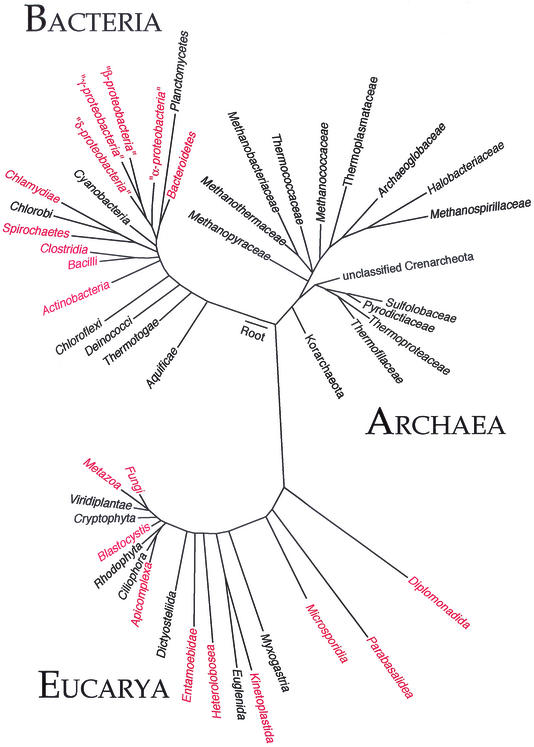
Universal phylogenetic tree based on comparison of small subunit rRNA sequences. Phyla or divisions of Eucarya and Bacteria in which known human pathogens exist are shown in red. Archaea branches denote families rather than phyla, except for the Korarchaeota. Note that pathogens exist within the Fusobacteria, Acanthamoebidae, Stramenophiles, and Mesomycetozoa; however, these divisions are not pictured. (Modified from reference with permission of the publisher.)
References
-
- Bhuiya, M. W., H. Sakuraba, C. Kujo, N. Nunoura-Kominato, Y. Kawarabayasi, H. Kikuchi, and T. Ohshima. 2000. Glutamate dehydrogenase from the aerobic hyperthermophilic archaeon Aeropyrum pernix K1: enzymatic characterization, identification of the encoding gene, and phylogenetic implications. Extremophiles 4:333-341. - PubMed
-
- Boetius, A., K. Ravenschlag, C. J. Schubert, D. Rickert, F. Widdel, A. Gieseke, R. Amann, B. B. Jorgensen, U. Witte, and O. Pfannkuche. 2000. A marine microbial consortium apparently mediating anaerobic oxidation of methane. Nature 407:623-626. - PubMed
Publication types
MeSH terms
LinkOut - more resources
Full Text Sources
Other Literature Sources
