


Error reduction and performance improvement in the emergency department through formal teamwork training: evaluation results of the MedTeams project
- PMID: 12546286
- PMCID: PMC1464040
- DOI: 10.1111/1475-6773.01104
Error reduction and performance improvement in the emergency department through formal teamwork training: evaluation results of the MedTeams project
Abstract
Objective: To evaluate the effectiveness of training and institutionalizing teamwork behaviors, drawn from aviation crew resource management (CRM) programs, on emergency department (ED) staff organized into caregiver teams.
Study setting: Nine teaching and community hospital EDs.
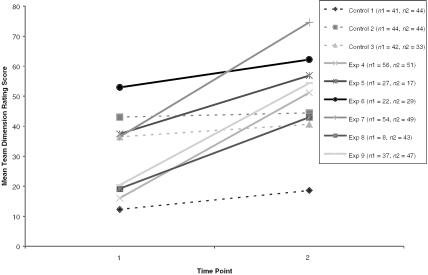
Study design: A prospective multicenter evaluation using a quasi-experimental, untreated control group design with one pretest and two posttests of the Emergency Team Coordination Course (ETCC). The experimental group, comprised of 684 physicians, nurses, and technicians, received the ETCC and implemented formal teamwork structures and processes. Assessments occurred prior to training, and at intervals of four and eight months after training. Three outcome constructs were evaluated: team behavior, ED performance, and attitudes and opinions. Trained observers rated ED staff team behaviors and made observations of clinical errors, a measure of ED performance. Staff and patients in the EDs completed surveys measuring attitudes and opinions.
Data collection: Hospital EDs were the units of analysis for the seven outcome measures. Prior to aggregating data at the hospital level, scale properties of surveys and event-related observations were evaluated at the respondent or case level.
Principal findings: A statistically significant improvement in quality of team behaviors was shown between the experimental and control groups following training (p = .012). Subjective workload was not affected by the intervention (p = .668). The clinical error rate significantly decreased from 30.9 percent to 4.4 percent in the experimental group (p = .039). In the experimental group, the ED staffs' attitudes toward teamwork increased (p = .047) and staff assessments of institutional support showed a significant increase (p = .040).
Conclusion: Our findings point to the effectiveness of formal teamwork training for improving team behaviors, reducing errors, and improving staff attitudes among the ETCC-trained hospitals.
Figures
References
-
- Ajzen I, Fishbein M. Understanding Attitudes and Predicting Social Behavior. Englewood Cliffs NJ: Prentice-Hall; 1980.
-
- Bloom BS, Hastings JT, Madaus GF. Handbook of Formative and Summative Evaluation of Student Learning. New York: McGraw-Hill; 1971.
-
- Clauser BE, Clyman SG, Swanson DB. “Components of Rater Error in a Complex Performance Assessment.”. Journal of Educational Measurement. 1999;36(1):29–45.
-
- Cook TD, Campbell DT. Quasi-Experimentation: Design and Analysis Issues for Field Settings. Chicago: Rand McNally; 1979.
-
- DeVellis RF. Scale Development. Newbury Park CA: Sage; 1991. Theory and Applications.
Publication types
MeSH terms
LinkOut - more resources
Full Text Sources
