


Double dissociation of social functioning in frontotemporal dementia
- PMID: 12552042
- PMCID: PMC2701364
- DOI: 10.1212/01.wnl.0000041497.07694.d2
Double dissociation of social functioning in frontotemporal dementia
Abstract
Background: Efforts to characterize changes in social functioning in frontotemporal dementia (FTD) have failed to elicit clear dissociation between frontal and temporal variants of the disease based on behavioral measures.
Methods: This study obtained premorbid and current first-degree relative ratings using an established measure of interpersonal functioning, the Interpersonal Adjectives Scales, to measure personality change in 16 patients with frontal variant (FLV) and 13 with temporal variant (TLV) FTD, and in a control group of 16 patients with AD.
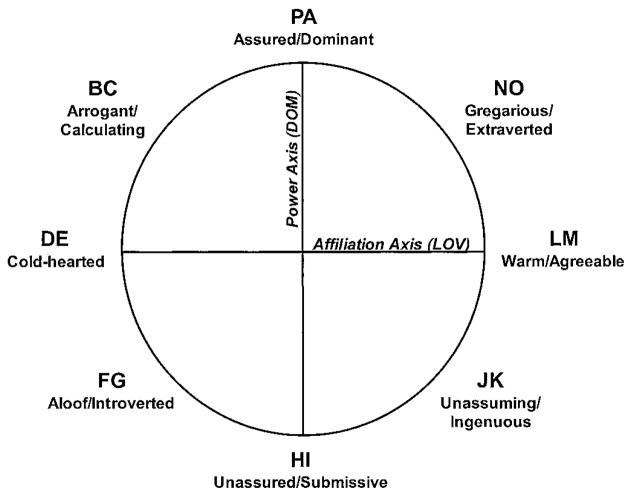
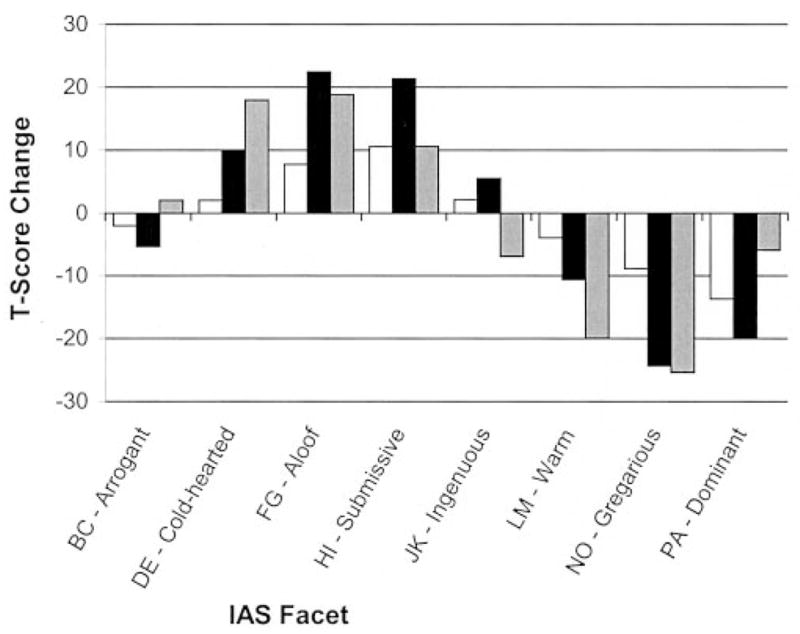
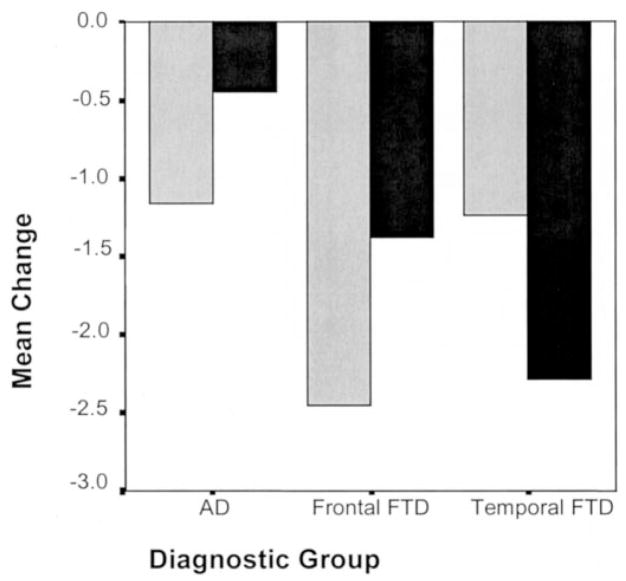
Results: All three groups showed significant change over time in multiple domains, including increased introversion (FG) and submissiveness (HI). However, patients with both FTD subtypes evidenced significantly greater increases in overall interpersonal pathology vector length [VL] than did patients with AD, who remained within the normal range on all scores. Patients with FLV showed a 2 SD increase in submissiveness (HI), but their cold-heartedness (DE) change scores were not significantly different from those of patients with AD. Conversely, the TLV cold-heartedness (DE) score increased 2 SD compared to minimal change for the AD and FLV groups, yet change in submissiveness (HI) did not differentiate between AD and TLV groups.
Conclusions: The Interpersonal Adjectives Scales differentiated both FTD groups from patients with AD on the basis of both degree and direction of personality change. Also, the two subtypes of FTD showed distinctly different patterns of change in social functioning: patients with temporal variant shifted toward severe interpersonal coldness with mild loss of dominance, whereas patients with frontal variant showed the opposite pattern.
Figures
References
-
- Neary D, Snowden JS, Gustafson L, et al. Frontotemporal lobar degeneration: a consensus on clinical diagnostic criteria. Neurology. 1998;51:1546–1554. - PubMed
-
- Edwards-Lee T, Miller BL, Benson DF, et al. The temporal variant of frontotemporal dementia. Brain. 1997;120:1027–1040. - PubMed
-
- Gregory CA, Hodges JR. Dementia of frontal type and the focal lobar atrophies. Int Rev Psychiatry. 1993;5:397–406.
MeSH terms
Grants and funding
LinkOut - more resources
Full Text Sources
Medical
