. 2003 Feb 4;100(3):986-91.
doi: 10.1073/pnas.0337412100. Epub 2003 Jan 27.

Small ubiquitin-related modifier-1 modification mediates resolution of CREB-dependent responses to hypoxia

Affiliations

Small ubiquitin-related modifier-1 modification mediates resolution of CREB-dependent responses to hypoxia

Katrina M Comerford et al. Proc Natl Acad Sci U S A. .

Abstract

Phosphorylation-dependent ubiquitination combined with proteasomal degradation of transcriptional regulators is a recently appreciated mechanism for control of a number of inflammatory genes. Far less is known about the counterregulatory mechanisms that repress transcriptional activity in these pathways during resolution. Here, we investigated the transient nature of hypoxia-induced tumor necrosis factor (TNF)alpha in T84 cells, a process we have previously shown to involve phosphorylation-dependent degradation of the cAMP-response element-binding protein (CREB). Initial studies indicate hypoxia-induced TNFalpha to be a transient event, the resolution of which is associated with the appearance of a higher molecular weight modified form of CREB. Gene array analysis of mRNA derived from hypoxic cells identified a time-dependent induction of small ubiquitin-related modifier (SUMO)-1 mRNA. In prolonged hypoxia, CREB is posttranslationally modified by SUMO-1. Furthermore, SUMO-1 overexpression stabilizes CREB in hypoxia and enhances CREB-dependent reporter gene activity. Site-directed mutagenesis of lysine residues K285 and K304 identifies them as SUMO acceptors in vivo and in vitro. Mutation of K304 also results in loss of CREB nuclear localization, implying a role for SUMO-1 modification at this site in the subcellular localization of CREB. Thus, in prolonged hypoxia, CREB is modified by association with SUMO-1. Furthermore, we hypothesize that such an event stabilizes and promotes nuclear localization of CREB and thus complements an endogenous resolution phase for hypoxia-induced inflammatory processes.


Figures
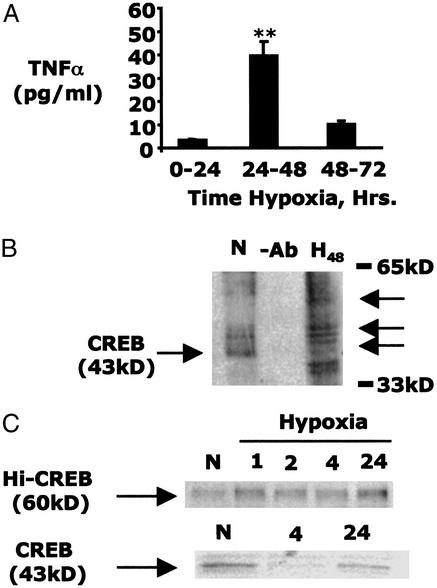
Figure 1
Figure 1
Hypoxia-induced TNFα is transient. (A) ELISA was used to measure temporally segmental, basolateral release of TNFα from T84 cells. Hypoxia-elicited TNFα release was transient and resolved between 48- and 72-h hypoxia (n = 3; P < 0.05). (B) On-bead biotinylation was used to investigate the impact of 48-h hypoxia on CREB expression and modification. Higher molecular weight modified forms of CREB, which evolve in hypoxia, are indicated (black arrows). (C) T84 cells exposed to increasing periods of hypoxia demonstrate decreased native 43-kDa CREB expression as previously described (Lower; ref. 6). During the same period, a higher molecular weight band (60 kDa) appears, which is recognized by the CREB antibody, implicating a modified form of CREB.
Figure 2
Figure 2
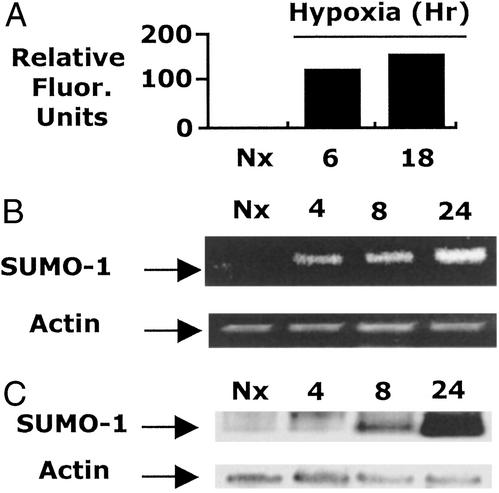
Expression of SUMO-1 mRNA in hypoxia. (A) mRNA microarray analysis was used to investigate global gene expression in T84 cells exposed to increasing periods of hypoxia. Although 96% of genes studied remained stable, the expression of SUMO-1 was increased in a time-dependent manner. (B) Microarray data were confirmed by RT-PCR analysis, which demonstrates a time-dependent increase in SUMO-1 mRNA in hypoxia. (C) Northern blot analysis was used directly to assess SUMO-1 expression in RNA derived from cells exposed to indicated periods of hypoxia.
Figure 3
Figure 3
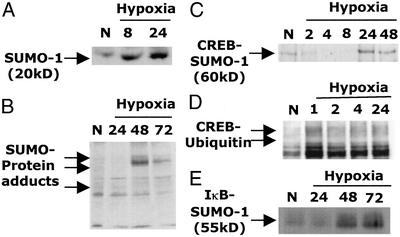
Hypoxia enhances protein SUMO-1 modification. (A) Western blot analysis was used to confirm hypoxia-elicited up-regulation of SUMO-1 protein expression. (B) Western blot analysis of whole-cell lysates was used to investigate SUMO-1 modification of proteins in 0- to 72-h hypoxia. Arrows indicate SUMO-1-modified proteins. (C) SUMO-1 modification of CREB in hypoxia was investigated by CREB immunoprecipitation and Western blot with an anti-SUMO-1 antibody. A band at ≈60 kDa increased with prolonged hypoxia, consistent with SUMO-1-modified CREB. (D) CREB ubiquitination in hypoxia was investigated by immunoprecipitation of CREB and Western blot with an anti-ubiquitin antibody. Bands consistent with ubiquitin-modified CREB were rapidly detected by 1 h of hypoxic exposure. (E) SUMO-1 modification of IκB in hypoxia was investigated by IκB immunoprecipitation and Western blot with an anti-SUMO-1 antibody. A band at ≈55 kDa increased with prolonged hypoxia, consistent with SUMO-1-modified IκB.
Figure 4
Figure 4
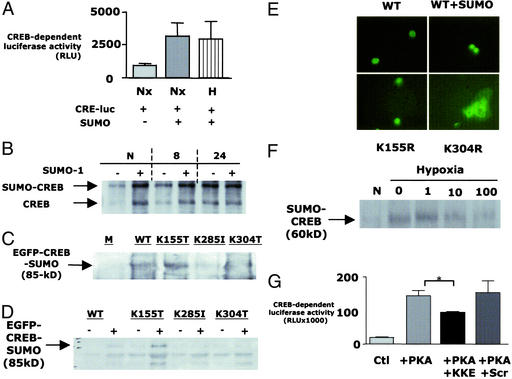
SUMO-1 stabilizes CREB through modification at a specific binding motif. (A) A CREB-dependent luciferase reporter assay was used to determine the impact of SUMO-1 overexpression on CREB activity in BAE cells. SUMO-1 overexpression significantly enhanced CREB-dependent activity under normoxic (N) and 48-h hypoxic (48) conditions. (B) Western blot analysis was used to investigate the impact of SUMO-1 overexpression on CREB levels in the nuclear lysates derived from normoxic and hypoxic cells. SUMO-1 overexpression increased the expression of SUMO-1-modified and nonmodified CREB in normoxia. SUMO-1 overexpression resulted in the stabilization of SUMO-1-modified but not nonmodified CREB in hypoxia. (C) Site-directed mutagenesis of lysines 285 and 304 but not 155 resulted in decreased EGFP-CREB SUMO modification in vivo. (D) Site-directed mutagenesis of lysines 285 and 304 but not 155 resulted in decreased EGFP-CREB SUMO modification in vitro. (E) Wild-type CREB is localized in the nuclear compartment and is enhanced by cotransfection with SUMO. Mutation of the SUMO acceptor residue (K304R) resulted in a loss of nuclear localization of EGFP-CREB, whereas mutation of the nonaccepting lysine residue (K155R) did not alter CREB nuclear localization. (F) Western blot analysis of CREB immunoprecipitates was used to investigate the impact of the KKKE-containing peptide on SUMO-1 modification of CREB in hypoxia. The bioactive peptide diminished SUMO-1 modification of CREB in a concentration-dependent manner. (G) A CREB-dependent luciferase reporter assay was used to investigate the impact of inhibition of CREB SUMO-1 modification on CREB activity. Cotransfection of CRE-luciferase and protein kinase A resulted in a significant increase in CREB-dependent activity, which was unaltered by pretreatment of cells with a scrambled control peptide but was significantly diminished by pretreatment with the KKKE-containing peptide.
Figure 5
Figure 5
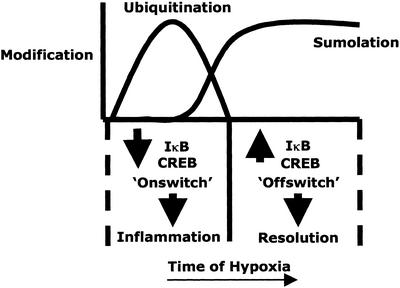
Model of the temporal posttranslational modifications of transcriptional regulators in hypoxia. In early periods of hypoxia, IκB and CREB are ubiquitinated rapidly in a phosphorylation-dependent manner, resulting in targeting of these molecules to proteasomal degradation. Such removal of anti-inflammatory regulators results in the induction of a proinflammatory phenotype. More prolonged periods of hypoxia lead to the induction of SUMO-1 expression and SUMO-lation of IκB and CREB. This late event depends on the transcription and translation of SUMO and leads to the stabilization of these regulators, consequently mediating an inhibition of the hypoxia-elicited inflammatory phenotype.

References

    1. Taylor C T, Colgan S P. Pharmacol Res. 1999;16:1498–1505. - PubMed
    1. Bunn H F, Poyton R O. Physiol Rev. 1996;76:839–885. - PubMed
    1. Taylor C T, Dzus A L, Colgan S P. Gastroenterology. 1998;114:657–668. - PubMed
    1. Taylor C T, Fueki N, Agah A, Hershberg R M, Colgan S P. J Biol Chem. 1999;274:19447–19454. - PubMed
    1. Karin M, Ben-Neriah Y. Ann Rev Immunol. 2000;18:621–663. - PubMed

Publication types

MeSH terms