


Haploinsufficiency of p18(INK4c) sensitizes mice to carcinogen-induced tumorigenesis
- PMID: 12556487
- PMCID: PMC141153
- DOI: 10.1128/MCB.23.4.1269-1277.2003
Haploinsufficiency of p18(INK4c) sensitizes mice to carcinogen-induced tumorigenesis
Abstract
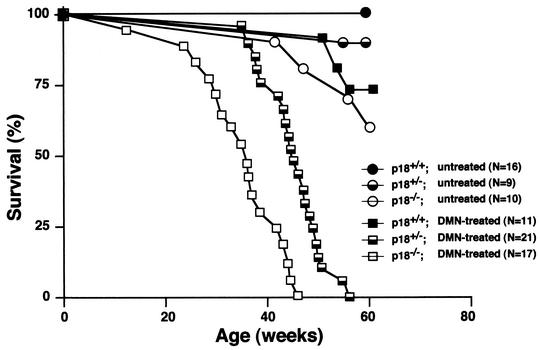
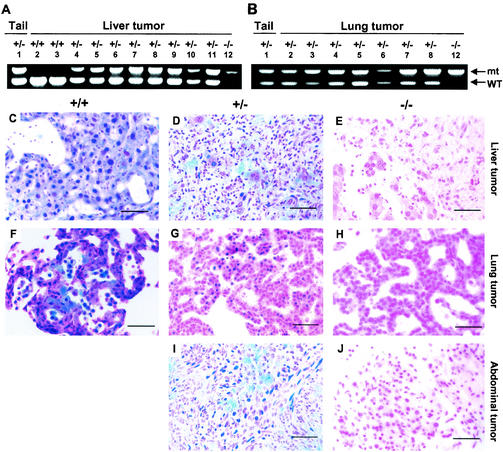
The INK4 family of cyclin-dependent kinase (CDK) inhibitors negatively regulates cyclin D-dependent CDK4 and CDK6 and thereby retains the growth-suppressive function of Rb family proteins. Mutations in the CDK4 gene conferring INK4 resistance are associated with familial and sporadic melanoma in humans and result in a wide spectrum of tumors in mice. Whereas loss of function of other INK4 genes in mice leads to little or no tumor development, targeted deletion of p18(INK4c) causes spontaneous pituitary tumors and lymphoma late in life. Here we show that treatment of p18 null and heterozygous mice with a chemical carcinogen resulted in tumor development at an accelerated rate. The remaining wild-type allele of p18 was neither mutated nor silenced in tumors derived from heterozygotes. Hence, p18 is a haploinsufficient tumor suppressor in mice.
Figures
References
-
- Bai, F., Y. Nakanishi, K. Takayama, X. H. Pei, H. Tokiwa, and N. Hara. 1998. Ki-ras mutation and cell proliferation of lung lesions induced by 1-nitropyrene in A/J mice. Mol. Carcinog. 22:258-264. - PubMed
-
- Clapp, N. K., A. W. Craig, and R. E. Toya, Sr. 1968. Pulmonary and hepatic oncogenesis during treatment of male RF mice with dimethyl-nitrosamine. J. Natl. Cancer Inst. 41:1213-1227. - PubMed
-
- Cook, W. D., and B. J. McCaw. 2000. Accommodating haploinsufficient tumor suppressor genes in Knudson's model. Oncogene 19:3434-3438. - PubMed
Publication types
MeSH terms
Substances
Grants and funding
LinkOut - more resources
Full Text Sources
Other Literature Sources
Molecular Biology Databases
