


doi: 10.1186/bcr548.
Epub 2002 Oct 11.
Expression profiling to predict outcome in breast cancer: the influence of sample selection
Affiliations
- PMID: 12559041
- PMCID: PMC154130
- DOI: 10.1186/bcr548
Item in Clipboard
Expression profiling to predict outcome in breast cancer: the influence of sample selection
Breast Cancer Res.
2003.
Abstract
Gene expression profiling of tumors using DNA microarrays is a promising method for predicting prognosis and treatment response in cancer patients. It was recently reported that expression profiles of sporadic breast cancers could be used to predict disease recurrence better than currently available clinical and histopathological prognostic factors. Having observed an overlap in those data between the genes that predict outcome and those that predict estrogen receptor-alpha status, we examined their predictive power in an independent data set. We conclude that it may be important to define prognostic expression profiles separately for estrogen receptor-alpha-positive and estrogen receptor-alpha-negative tumors.
Figures
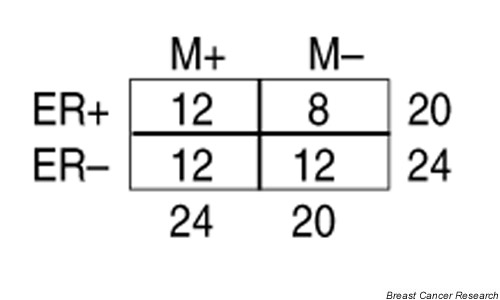
The distribution of clinical characteristics in our 44 sporadic breast tumors. Estrogen receptor-α status is denoted as ER+ and ER-. Clinical outcome for the patients is represented by M+ (distant recurrences within 6 years) and M- (no recurrences within a follow-up period of at least 5 years). Microarray data were generated as described by Gruvberger et al. [8].
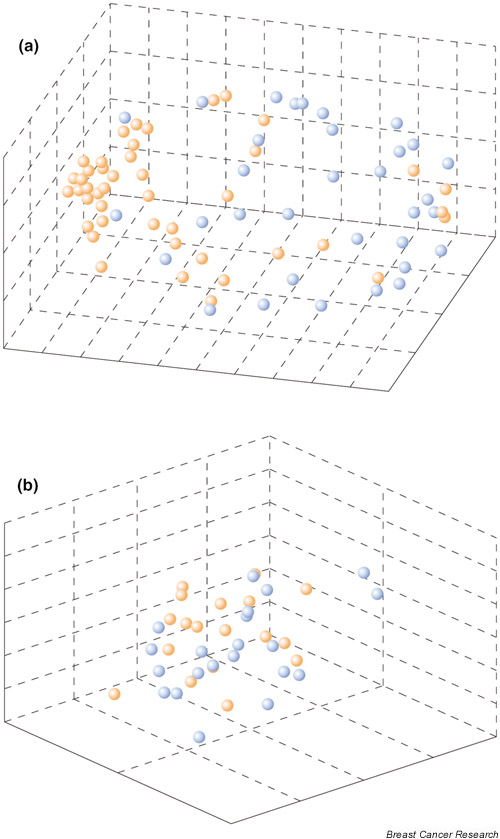
Multidimensional scaling (MDS) clustering of gene expression data from breast tumors using 58 out of 231 genes from the outcome predictor gene set identified by van 't Veer et al. [7] that were also included in our array analysis. These genes retain their predictive value in those data but not in our independent patient sample. (a) Fifty-eight primary breast tumors (training set) from the study by van't Veer et al. and (b) 44 from our array study are plotted. Tumors with a poor prognosis (distant recurrences within 6 years) are colored blue and tumors with a good prognosis (no recurrences within a follow-up period of 5–14 years) are orange. MDS displays the position of each tumor sample in a three-dimensional euclidean space, with the distance between the samples reflecting their approximate degree of correlation [11].
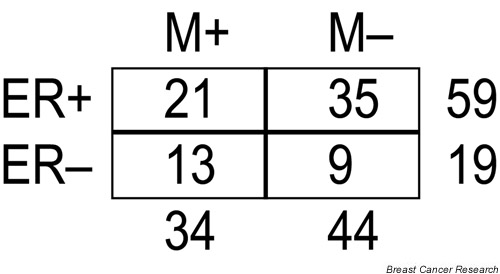
The distribution of clinical characteristics of the 78 sporadic breast tumors used in the training/validation set in the study by van 't Veer et al. [7]. Estrogen receptor-α status is denoted as ER+ and ER-. Clinical outcome for the patients is represented by M+ (distant recurrences within 5 years) and M- (no recurrences within a follow-up period of at least 5 years).
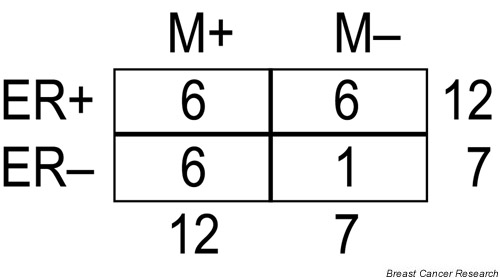
The distribution of clinical characteristics of the 19 sporadic breast tumors used as an independent test set in the study by van't Veer et al. [7]. Estrogen receptor-α status is denoted as ER+ and ER-. Clinical outcome for the patients is represented by M+ (distant recurrences within 5 years) and M- (no recurrences within a follow-up period of at least 5 years).
Comment in
-
Expression profiling predicts outcome in breast cancer.Breast Cancer Res. 2003;5(1):57-8. doi: 10.1186/bcr562. Epub 2002 Dec 4. Breast Cancer Res. 2003. PMID: 12559048 Free PMC article. No abstract available.
References
-
- Golub TR, Slonim DK, Tamayo P, Huard C, Gaasenbeek M, Mesirov JP, Coller H, Loh ML, Downing JR, Caligiuri MA, Bloomfield CD, Lander ES. Molecular classification of cancer: class discovery and class prediction by gene expression monitoring. Science. 1999;286:531–537. doi: 10.1126/science.286.5439.531. - DOI - PubMed
-
- Alizadeh AA, Eisen MB, Davis RE, Ma C, Lossos IS, Rosenwald A, Boldrick JC, Sabet H, Tran T, Yu X, Powell JI, Yang L, Marti GE, Moore T, Hudson J, Jr, Lu L, Lewis DB, Tibshirani R, Sherlock G, Chan WC, Greiner TC, Weisenburger DD, Armitage JO, Warnke R, Staudt LM, et al. Distinct types of diffuse large B-cell lymphoma identified by gene expression profiling. Nature. 2000;403:503–511. doi: 10.1038/35000501. - DOI - PubMed
-
- Bittner M, Meltzer P, Chen Y, Jiang Y, Seftor E, Hendrix M, Radmacher M, Simon R, Yakhini Z, Ben-Dor A, Sampas N, Dougherty E, Wang E, Marincola F, Gooden C, Lueders J, Glatfelter A, Pollock P, Carpten J, Gillanders E, Leja D, Dietrich K, Beaudry C, Berens M, Alberts D, Sondak V. Molecular classification of cutaneous malignant melanoma by gene expression profiling. Nature. 2000;406:536–540. doi: 10.1038/35020115. - DOI - PubMed
-
- Perou CM, Sorlie T, Eisen MB, van de Rijn M, Jeffrey SS, Rees CA, Pollack JR, Ross DT, Johnsen H, Akslen LA, Fluge O, Pergamenschikov A, Williams C, Zhu SX, Lonning PE, Borresen-Dale AL, Brown PO, Botstein D. Molecular portraits of human breast tumours. Nature. 2000;406:747–752. doi: 10.1038/35021093. - DOI - PubMed
-
- Khan J, Wei JS, Ringner M, Saal LH, Ladanyi M, Westermann F, Berthold F, Schwab M, Antonescu CR, Peterson C, Meltzer PS. Classification and diagnostic prediction of cancers using gene expression profiling and artificial neural networks. Nat Med. 2001;7:673–679. doi: 10.1038/89044. - DOI - PMC - PubMed
MeSH terms
Substances
LinkOut - more resources
Full Text Sources
Other Literature Sources
Medical
