. 2003 Mar 15;547(Pt 3):729-60.
doi: 10.1113/jphysiol.2002.034173. Epub 2003 Jan 24.

Properties of the human muscle nicotinic receptor, and of the slow-channel myasthenic syndrome mutant epsilonL221F, inferred from maximum likelihood fits

Affiliations

Properties of the human muscle nicotinic receptor, and of the slow-channel myasthenic syndrome mutant epsilonL221F, inferred from maximum likelihood fits

C J Hatton et al. J Physiol. .

Abstract

The mechanisms that underlie activation of nicotinic receptors are investigated using human recombinant receptors, both wild type and receptors that contain the slow channel myasthenic syndrome mutation, epsilonL221F. The method uses the program HJCFIT, which fits the rate constants in a specified mechanism directly to a sequence of observed open and shut times by maximising the likelihood of the sequence with exact correction for missed events. A mechanism with two different binding sites was used. The rate constants that apply to the diliganded receptor (opening, shutting and total dissociation rates) were estimated robustly, being insensitive to the exact assumptions made during fitting, as expected from simulation studies. They are sufficient to predict the main physiological properties of the receptors. The epsilonL221F mutation causes an approximately 4-fold reduction in dissociation rate from diliganded receptors, and a smaller increase in opening rate and mean open time. These are sufficient to explain the approximately 6-fold slowing of decay of miniature synaptic currents seen in patients. The distinction between the two binding sites was less robust, the estimates of rate constants being dependent to some extent on assumptions, e.g. whether an extra short-lived shut state was included or whether the EC50 was constrained. The results suggest that the two binding sites differ by roughly 10-fold in the affinity of the shut receptor for ACh in the wild type, and that in the epsilonL221F mutation the lower affinity is increased so the sites become more similar.


Figures

Figure 6
Figure 6. Kinetic schemes used for direct estimation of rate constants
A, scheme 1, binding of the agonist (A) to two non-equivalent binding sites, denoted a and b. Open states are denoted by *. Opening rate constants are denoted βx, shutting rate constants as αx, association rate constants as k+x and dissociation rate constants as k−x. The subscripts 1, 2 refer to the order (1st, 2nd) of binding. B, scheme 2, as scheme 1 except that an extra shut state is added to the right of the diliganded open state. Because transition into this extra ‘desensitised’ state does not involve binding, the rate constant into it is denoted βD and the rate constant for leaving it is denoted αD. C, simplified version of scheme 1, showing examples of the three types of activation seen in cell-attached patch recordings. Each class of activation is shown next to the open and shut states from which, we suggest, it arises.
Figure 7
Figure 7. Direct estimation of rate constants from individual patches, assuming independent binding sites (fixed forward rate)
A, wild type apparent open time and shut time distributions from channel activity evoked by 30 nm, 100 nm and 30 μm ACh (left to right). The solid line in each case shows the predicted HJC distribution for each patch, calculated from the fitted rate constants and resolution, and superimposed on the histogram of experimental observations. The dashed lines show the predicted ideal distributions with perfect resolution. B, apparent open and shut time distributions as in A but for the εL221F receptor recorded in the presence of 30 nm, 50 nm and 10 μm ACh (left to right).
Figure 8
Figure 8. Direct estimation of rate constants from individual patches, assuming independent binding sites (forward rate constrained by EC50)
A, wild type apparent open time and shut time distributions for the same three patches as shown in Fig. 7A. The solid lines are the HJC distributions calculated from the fitted rate constants for each patch superimposed on the histogram of experimental observations; the dashed lines show the predicted ideal distributions. B, as A but for the same three εL221F patches shown in Fig. 7B.
Figure 10
Figure 10. Effect of adding an extra shut state on direct estimation of rate constants from individual patches (fixed forward rate)
A, direct estimation of rate constants from a wild type patch in the presence of 100 μm ACh with either scheme 1 (top) or scheme 2 (extra shut state added, below). As before, HJC distributions of apparent open and shut times (solid lines) are shown superimposed on the histograms of experimental observations, dashed lines show the predicted ideal distributions calculated from the fitted rate constants (left and centre panels). The right hand column shows the conditional mean apparent open time plotted against adjacent shut time, as described in Methods and text. The diamonds with error bars (joined by solid lines) show the experimental data. The solid circles show the HJC predictions for the same shut time ranges that were used for the data, and the dashed line shows the continuous relationship between mean open time and adjacent shut time calculated from the rate constants fitted for scheme 1 (top right) or scheme 2 (lower right). B, as A but showing the results of direct estimation of rate constants from an εL221F patch exposed to 30 μm ACh, with either scheme 1 (upper panels) or scheme 2 (bottom panels).
Figure 11
Figure 11. Direct estimation of rate constants from multiple patches, scheme 1 assuming independent binding sites
A, results of simultaneous fitting of rate constants to three wild type patches (50 nm, 100 nm and 10 μm ACh respectively, left to right), association rates were neither fixed nor constrained by the EC50. Top row, apparent open times, second row, apparent shut times. The solid lines in each case show the predicted HJC distribution calculated (for the appropriate ACh concentration) from the single set of estimated rate constants found by fitting all three patches simultaneously. The dashed lines show the predicted ideal distributions. Third row, conditional HJC distributions (solid lines) of apparent open times adjacent to shut times in the range t < 0.1 ms superimposed on the experimentally observed open times adjacent to shut times in the same range. The dashed lines show the HJC distributions of all apparent open times. Bottom row, conditional mean apparent open time plots (see Methods and text). The diamonds with error bars (joined by solid lines) show the experimental data. The solid circles show the HJC predictions for the same shut time ranges that were used for the data and the dashed line shows the continuous relationship between mean open time and adjacent shut time calculated from the fitted rate constants. The arrows indicate the tcrit for each patch: experimentally observed shut times greater than this value may be underestimated because we do not know the number of channels in the patch and they are shown for illustrative purposes only. B, as A but shows the results of simultaneous fitting of rate constants to three εL221F patches (100 nm, 1 μm and 10 μm ACh respectively, left to right).
Figure 12
Figure 12. Direct estimation of rate constants from multiple patches, scheme 2 assuming independent binding sites (constrained by EC50)
A, results of simultaneous fitting of rate constants to the same three wild type patches shown in Fig. 11A (50 nm, 100 nm and 10 μm ACh respectively, left to right), unconstrained estimations of forward rates with scheme 2 resulted in unrealistically fast forward rates, consequently one of the forward rates in the fits shown was constrained by the EC50. Top row, apparent open times, second row, apparent shut times. The solid lines in each case show the predicted HJC distribution calculated from the estimation of rate constants from all three patches simultaneously, superimposed on the histogram of experimentally observed events for each patch in turn. The dashed lines show the predicted ideal distributions. Third row, conditional HJC distributions (solid lines) of apparent open times adjacent to shut times in the range t < 0.1 ms superimposed on the experimentally observed open times adjacent to shut times in the same range. The dashed lines show the HJC distributions of all apparent open times. Bottom row, conditional distributions of mean open time adjacent to specified shut time ranges plotted against apparent shut time. The solid lines show the observed correlation from experimental data, the dashed lines show the predicted correlation calculated from the rate constants by HJCFIT. The arrow indicates the tcrit for each patch, experimentally observed shut times greater than this value will be underestimated as we do not know the number of channels in the patch and they are shown for illustrative purposes only. B, as A but shows the results of simultaneous fitting of rate constants to the same three εL221F patches shown in Fig. 11B (100 nm, 1 μm and 10 μm ACh respectively, left to right), again with one of the forward rates constrained by the EC50 as for wild type data. C, as B but shows the results of fitting the same three εL221F patches with the binding and unbinding rates for the b site fixed to the mean wild type values, the remaining forward rates were constrained by the EC50.
Figure 1
Figure 1. Whole-cell responses to acetylcholine of HEK 293 cells transiently expressing human wild type and εL221F neuromuscular junction nicotinic acetylcholine receptors
A, typical whole-cell current responses recorded from lifted HEK 293 cells at −100 mV. Wild type (WT) human neuromuscular junction nicotinic ACh receptors produced large inward currents in response to focal application of ACh with a maximum around 200 μm. εL221F nicotinic receptors were more sensitive to ACh, reaching a maximum at around 50 μm. Vertical scale bar 5 nA, horizontal scale bar 100 ms. B, averaged log concentration-response curves for wild type (solid line, n = 5 cells) and εL221F (dashed line, n = 5 cells) nicotinic receptors. Responses were normalised with respect to their fitted maximum and are shown fitted with the Hill equation, constrained to be parallel and with a maximum fixed at 1. Error bars show s.d.m.
Figure 2
Figure 2. Steady state activations of wild type and εL221F nicotinic receptor channels activated by acetylcholine
A, continuous 1 s recordings of wild type (upper trace) and εL221F (lower trace) channel activity evoked by nanomolar concentrations of ACh. Activations of εL221F receptors are on average longer then activations of the wild type receptor. B, continuous 10 s recordings of wild type (upper trace) and εL221F (lower trace) channel activity evoked by micromolar concentrations of ACh. At these higher concentrations, channel activity occurs in clusters often lasting a second or more, separated by long silent periods (desensitised gaps). Note also that these silent periods are sometimes interrupted by brief channel openings. All records are shown filtered at 6.25 kHz.
Figure 3
Figure 3. Open period distributions from wild type nicotinic channels fit with mixtures of two or three exponential probability density functions
Examples of open period distributions of wild type nicotinic channels at low ACh concentration, showing best fits with mixtures of two (dashed line) or three (solid line) exponential probability density functions (pdfs).
Figure 4
Figure 4. Open period and shut time distributions for wild type and εL221F channels
A, distributions of the apparent open period and shut time lengths for wild type nicotinic receptor channels. Open periods were fitted with a mixture of three exponential probability density functions (pdfs) at low ACh concentrations (30 nm and 100 nm), tending towards two (at 10 μm) or one (at 30 μm) exponential pdf at higher concentrations. Shut time distributions were fitted with mixtures of 4 to 6 exponential pdfs. B, apparent open period and shut time distributions for εL221F nicotinic receptor channels. In contrast to wild type channels, open periods for εL221F channels were always fitted best by a mixture of 3 exponential pdfs, and shut times with mixtures of 4–6 pdfs.
Figure 5
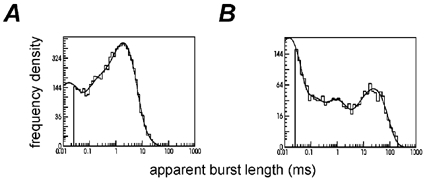
Figure 5. Burst length distributions for wild type and εL221F channels
A, example of the burst length distribution for wild type channels (100 nm ACh), fitted with a mixture of 4 exponentials with means (and areas) of 13 μs (20%), 140 μs (13%), 1.8 ms (63%) and 4.1 ms (4%). Overall mean burst length was 1.3 ms. B, example of the burst length distribution for εL221F channels (100 nm ACh), again fitted with a mixture of 4 exponentials with mean (and areas) of 14 μs (61%), 84 μs (10%), 763 μs (11%) and 23.8 ms (18%). Overall mean burst length was 4.6 ms.
Figure 13
Figure 13. Simulated synaptic currents
The curves show the current evoked by a 0.2 ms pulse of 1 mm ACh (the pulse is marked as an upward deflection in the line at the top). The calculations (done in the program SCALCS) used the rate constants from Table 3 (right column) for the wild type, and from Table 4 (middle column) for the εL221F receptor. The dashed line shows the predicted response for wild type receptors, and the solid line shows the predicted response of εL221F receptors.
Figure 9
Figure 9. Block of wild type nicotinic receptors by high concentrations of ACh
A, typical channel activity recorded at −100 mV in an outside-out patch from a HEK 293 cell expressing the human wild type neuromuscular junction nicotinic ACh receptors exposed to high concentrations (0.03–10 mm) of ACh. The apparent amplitude of single-channel activations decreases as ACh concentration increases. All records are shown filtered at 1 kHz. Horizontal scale bar 0.5 s, vertical scale bar 2 pA. B, plot of apparent single channel amplitude against log concentration, fitted with the Hill equation. Points show mean (±s.d.m.) from 11 patches, nHs.d.m.) = 0.986 ± 0.025; IC50c.v.m.) = 1.56 mm± 5.9%.
Figure 14
Figure 14. Sequence alignment of M1 and M2
Alignment of the M1 and the beginning of the M2 regions (shaded) of human α and ε subunits, with the mutation used here marked, and also the αN217K mutation (the numbering for the α subunit is that for isoform 1, and it is the same as for the mouse and Torpedoα1 subunit in the region shown).

References

    1. Akabas M, Karlin A. Identification of acetylcholine receptor channel-lining residues in the M1 segment of the α-subunit. Biochemistry. 1995;34:12496–12500. - PubMed
    1. Akk G, Sine S, Auerbach A. Binding sites contribute unequally to the gating of mouse nicotinic αD200N acetylcholine receptors. J Physiol. 1996;496:185–196. - PMC - PubMed
    1. Akk G, Steinbach JH. Structural elements near the C-terminus are responsible for changes in nicotinic receptor gating kinetics following patch excision. J Physiol. 2000;527:405–417. - PMC - PubMed
    1. Beeson D, Brydson M, Betty M, Jeremiah S, Povey S, Vincent A, Newsom-Davis J. Primary structure of the human muscle acetylcholine receptor cDNA cloning of the τ and ε subunits. Eur J Biochem. 1993;215:229–238. - PubMed
    1. Beeson D, Newsom-Davis J. Mutations affecting muscle acetylcholine receptors and their role in congenital myasthenic syndromes. In: Lehmann-Horn F, editor. Channelopathies. BV: Elsevier Science; 2000. pp. 85–112.

MeSH terms

LinkOut - more resources