. 2003 Feb 3;197(3):343-51.
doi: 10.1084/jem.20021652.

The poxvirus protein A52R targets Toll-like receptor signaling complexes to suppress host defense

Affiliations

The poxvirus protein A52R targets Toll-like receptor signaling complexes to suppress host defense

Mary T Harte et al. J Exp Med. .

Abstract

Toll-like receptors (TLRs) are crucial in the innate immune response to pathogens, in that they recognize and respond to pathogen associated molecular patterns, which leads to activation of intracellular signaling pathways and altered gene expression. Vaccinia virus (VV), the poxvirus used to vaccinate against smallpox, encodes proteins that antagonize important components of host antiviral defense. Here we show that the VV protein A52R blocks the activation of the transcription factor nuclear factor kappa B (NF-kappa B) by multiple TLRs, including TLR3, a recently identified receptor for viral RNA. A52R associates with both interleukin 1 receptor-associated kinase 2 (IRAK2) and tumor necrosis factor receptor-associated factor 6 (TRAF6), two key proteins important in TLR signal transduction. Further, A52R could disrupt signaling complexes containing these proteins. A virus deletion mutant lacking the A52R gene was attenuated compared with wild-type and revertant controls in a murine intranasal model of infection. This study reveals a novel mechanism used by VV to suppress the host immunity. We demonstrate viral disabling of TLRs, providing further evidence for an important role for this family of receptors in the antiviral response.


Figures
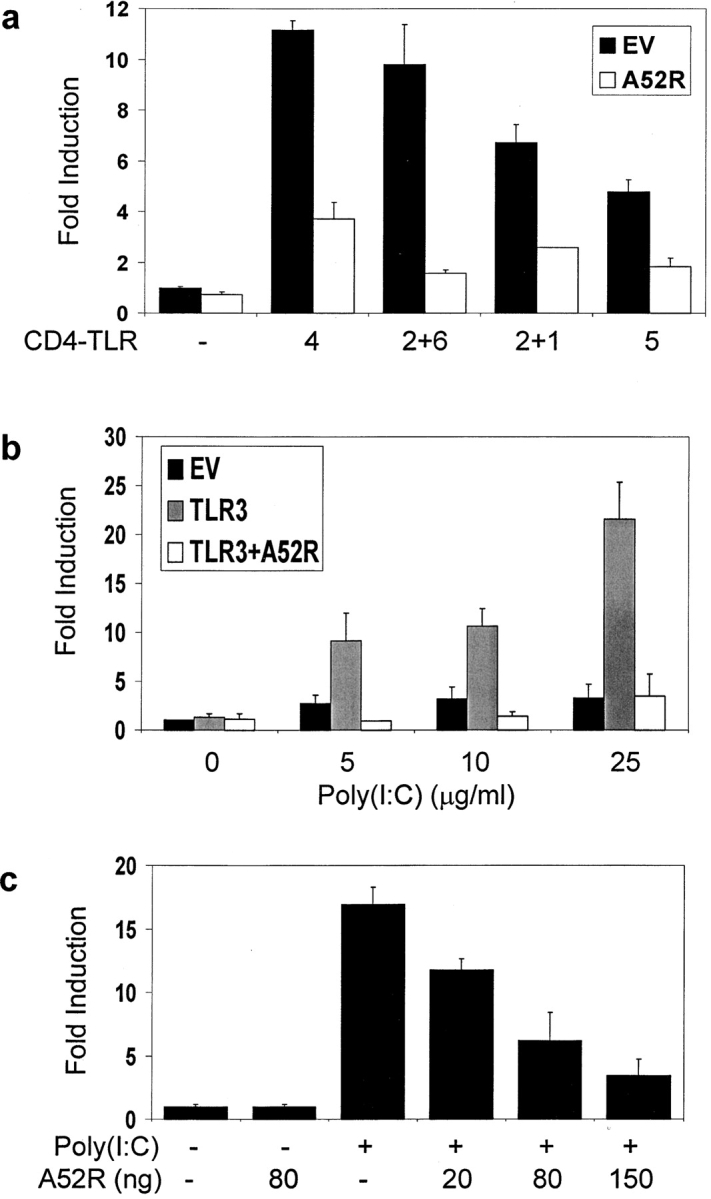
Figure 1.
Figure 1.
A52R inhibits NF-κB activation by multiple TLRs. (A) 293 cells were transfected with constitutively active CD4-TLRs (50 ng TLR4 or TLR5, or 25 ng each of TLR2 and TLR6 or TLR2 and TLR1) in the presence of 80 ng empty vector (EV) or plasmid encoding A52R, together with NF-κB reporter plasmid. (B) Cells were transfected with empty vector (EV), 0.5 ng TLR3, or 0.5 ng TLR3 plus 150 ng A52R. 6 h before harvesting cells were stimulated with 0–25 μg/ml poly(I:C). (C) Cells were transfected with 0.5 ng TLR3 and stimulated with 25 μg/ml poly(I:C) where indicated (+), in the presence of increasing amounts of A52R (20–150 ng). In all cases, luciferase activity was measured after 24 h.
Figure 2.
Figure 2.
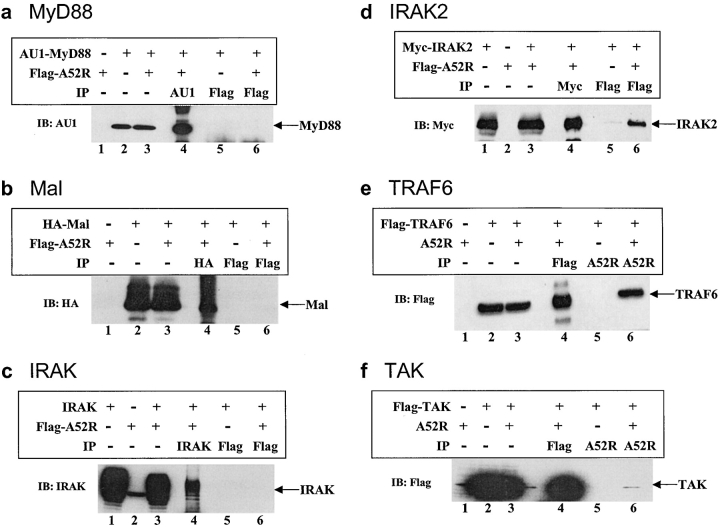
A52R immunoprecipitates with both IRAK2 and TRAF6. 293T cells were transfected with 4 μg A52R (either flag-tagged or untagged, as indicated) plus 4 μg of AU1-MyD88 (A), HA-Mal (B), IRAK (C), Myc-IRAK2 (D), Flag-TRAF6 (E), or Flag-TAK-1 (F). After 24 h lysates were subject to immunoprecipitation, and subsequent SDS-PAGE and immunoblotting with the antibodies indicated. Lysates were analyzed to ensure appropriate and equivalent expression of the proteins (lanes 1–3). To assess the efficiency of immunoprecipitation the immune complex (1/7th total lysate) was blotted with the same antibody used for immunoprecipitation (lane 4). Single transfection of each construct was also performed to act as a specificity control for the immunoprecipitating antibody (lane 5). The remainder of the immune complex was probed for the presence of associated protein (lane 6). The appearance of a band in lane 6 indicates an interaction. Representative of two (F) or three (A–E) independent experiments.
Figure 3.
Figure 3.
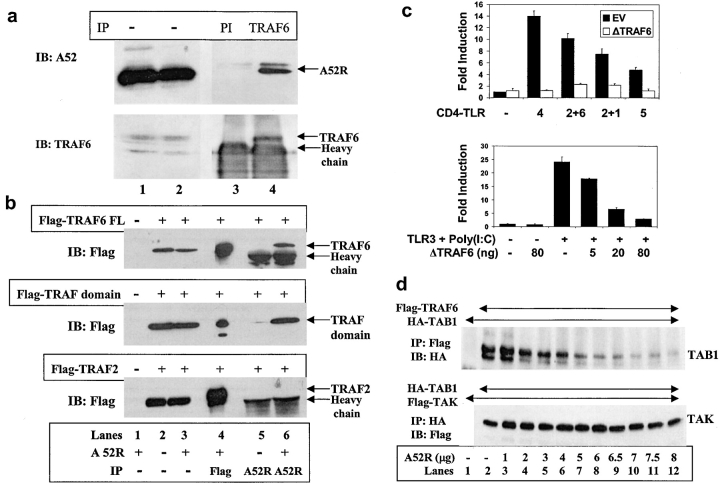
Analysis of the interaction of A52R with TRAF6. (A) A52R immunoprecipitates with endogenous TRAF6. Lysates from 293T cells transfected with A52R were immunoprecipitated with either preimmune serum (PI, lane 3) or anti-TRAF6 serum (lane 4), followed by immunoblotting with either A52R (top panel) or TRAF6 (bottom panel) antibody. Direct immunoblot of cell lysates confirmed equal expression of A52R and TRAF6 (lanes 1 and 2). (B) A52R immunoprecipitates with the TRAF6 TRAF domain, but not with TRAF2. 293T cells were transfected with A52R plus TRAF6 (top panel), ΔTRAF6 (residues 289–522 consisting of the TRAF domain of TRAF6, middle panel), or TRAF2 (bottom panel). Lysates were prepared and immunoprecipitated with A52R or Flag antibody as indicated, before immunoblot with Flag antibody. (C) Inhibition of TLR-induced NF-κB activation by ΔTRAF6. 293 cells were transfected with constitutively active CD4-TLRs as in Fig. 1, in the presence of 80 ng empty vector (EV) or plasmid encoding ΔTRAF6, together with NF-κB reporter plasmid (top panel). In the bottom panel, 293 cells were transfected with 0.5 ng TLR3 and stimulated with 25 μg/ml poly(I:C) where indicated (+). Luciferase activity was measured after 24 h. (D) A52R causes the dissociation of a TRAF6-TAB1–containing signaling complex but has no effect on a TAB1-TAK complex. A52R was cotransfected with either Flag-TRAF6 and HA-TAB1 (top panel) or HA-TAB1 and Flag-TAK1 (bottom r panel). Lysates were prepared and immunoprecipitated and immunoblotted as indicated. A52R can be seen to interfere with the TRAF6/TAB2 complex.
Figure 4.
Figure 4.
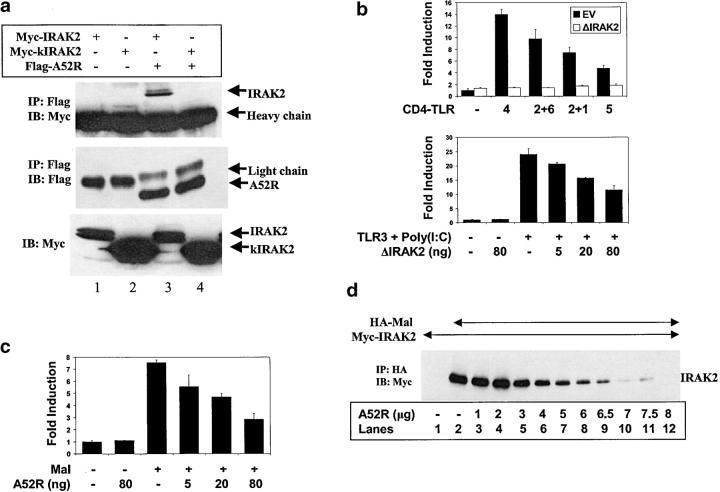
Role of IRAK2 in inhibition of TLR-induced NF-κB activation by A52R. (A) A52R requires the IRAK2 death domain for association. 293T cells were cotransfected with A52R and either IRAK2, or kIRAK2 (lacking the death domain and containing residues 97–590). Lysates were immunoprecipitated and immunoblotted as indicated. The band in lane 3, top panel, indicates interaction with full-length IRAK2. (B) Inhibition of TLR-induced NF-κB activation by kIRAK2. 293 cells were transfected with constitutively active CD4-TLRs, as in Fig. 1, in the presence of 80 ng empty vector (EV) or plasmid encoding kIRAK2 (ΔIRAK2), together with NF-κB reporter plasmid (top panel). In the bottom panel, 293 cells were transfected with 0.5 ng TLR3 and stimulated with 25 μg/ml poly(I:C) where indicated (+). Luciferase activity was measured after 24 h. (C) A52R inhibits the activation of NF-κB by Mal. 293 cells were transfected with 10 ng Mal where indicated (+), A52R, and NF-κB reporter plasmid. Luciferase activity was measured after 24 h. (D) A52R causes the dissociation of a Mal-IRAK2-containing complex. A52R was cotransfected with IRAK2 and Mal. The amount of IRAK2-Mal complex formed was assessed by immunoprecipitation using anti-HA antibody, followed by immunoblotting with anti-myc antibody. A52R can be seen to interfere with the Mal/IRAK2 complex.
Figure 5.
Figure 5.
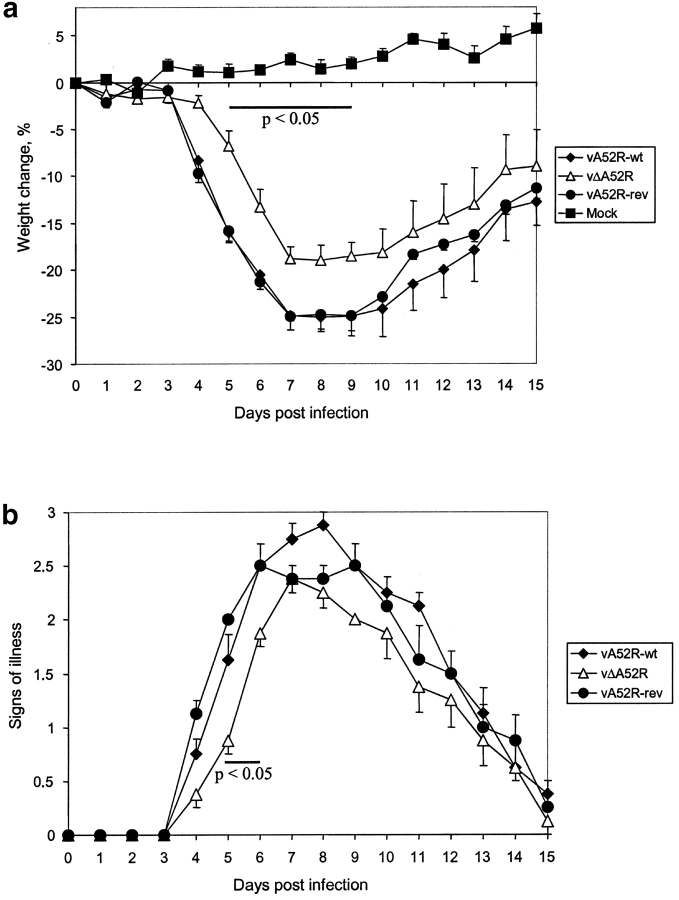
Gene A52R contributes to virus virulence. Groups of four female, Balb/c mice, 6-wk-old were infected intranasally with 104 PFU of vA52R-wt, vΔA52R, or vA52R-rev. Each day animals were weighed and the signs of illness scored. Data are presented as (A) the mean weight of each group of animals compared with the mean weight of the same group on day 0, and (B) the mean signs of illness score. Error bars = SEM. Horizontal bars represent days on which there was a statistically significant difference (P < 0.05. Student's t test) between the vΔA52R and both control groups.

References

    1. Akira, S., K. Takeda, and T. Kaisho. 2001. Toll-like receptors: critical proteins linking innate and acquired immunity. Nat. Immunol. 2:675–680. - PubMed
    1. Bowie, A., and L.A.J. O'Neill. 2000. The interleukin-1 receptor/Toll-like receptor superfamily: signal generators for pro-inflammatory interleukins and microbial products. J. Leukoc. Biol. 67:508–514. - PubMed
    1. Poltorak, A., X. He, I. Smirnova, M.-Y. Liu, C. Van Huffel, X. Du, D. Birdwell, E. Alejos, M. Silva, C. Galanos, et al. 1998. Defective LPS signalling in C3H/HeJ and C57BL/10ScCr mice: mutations in the Tlr4 gene. Science. 282:2085–2088. - PubMed
    1. Qureshi, S.T., L. Lariviere, G. Leveque, S. Clermont, K.J. Moore, P. Gros, and D. Malo. 1999. Endotoxin-tolerant mice have mutations in Toll-like receptor 4 (Tlr4). J. Exp. Med. 189:615–625. - PMC - PubMed
    1. Hayashi, F., K.D. Smith, A. Ozinsky, T.R. Hawn, E.C. Yi, D.R. Goodlett, J.K. Eng, S. Akira, D.M. Underhill, and A. Aderem. 2001. The innate immune response to bacterial flagellin is mediated by Toll-like receptor 5. Nature. 410:1099–1103. - PubMed

Publication types

MeSH terms