. 2003 Feb;15(2):561-76.
doi: 10.1105/tpc.007609.

Genomic analysis of the unfolded protein response in Arabidopsis shows its connection to important cellular processes

Affiliations

Genomic analysis of the unfolded protein response in Arabidopsis shows its connection to important cellular processes

Immaculada M Martínez et al. Plant Cell. 2003 Feb.

Abstract

We analyzed the breadth of the unfolded protein response (UPR) in Arabidopsis using gene expression analysis with Affymetrix GeneChips. With tunicamycin and DTT as endoplasmic reticulum (ER) stress-inducing agents, we identified sets of UPR genes that were induced or repressed by both stresses. The proteins encoded by most of the upregulated genes function as part of the secretory system and comprise chaperones, vesicle transport proteins, and ER-associated degradation proteins. Most of the downregulated genes encode extracellular proteins. Therefore, the UPR may constitute a triple effort by the cell: to improve protein folding and transport, to degrade unwanted proteins, and to allow fewer secretory proteins to enter the ER. No single consensus response element was found in the promoters of the 53 UPR upregulated genes, but half of the genes contained response elements also found in mammalian UPR regulated genes. These elements are enriched from 4.5- to 15-fold in this upregulated gene set.


Figures
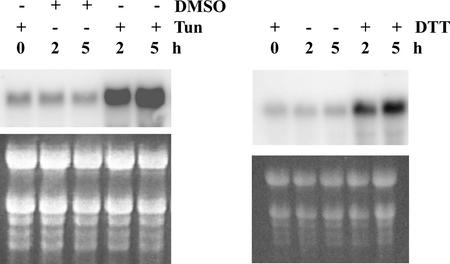
Figure 1.
Figure 1.
Expression of Arabidopsis BiP Genes after Treatment with Tunicamycin and DTT. Six-day-old Arabidopsis seedlings growing in liquid were treated with 5 μg/mL tunicamycin (Tun) or 10 mM DTT for 2 or 5 h. Control assays were performed at 0, 2, and 5 h. Tunicamycin was added to the 0-h control, and DMSO was added to the 2- and 5-h controls. Total RNA was fractionated on a formaldehyde-agarose gel, transferred onto a nylon membrane, and then hybridized with 32P-labeled AtBiP2 probe. Ethidium bromide staining under UV light was used to evaluate equal loading (bottom gels).
Figure 2.
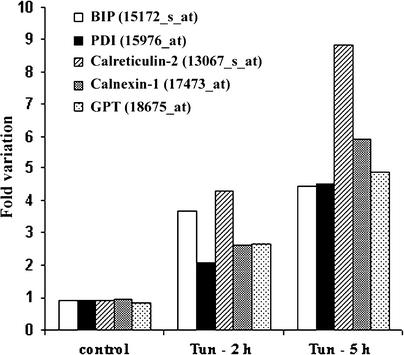
Figure 2.
Effect of Tunicamycin on the Expression of Known Arabidopsis UPR Genes as Shown by Affymetrix GeneChip Data. Fold variation in controls for each gene was calculated as the average of three conditions: 0 h treated with tunicamycin (Tun) and 2 and 5 h treated with DMSO. Affymetrix codes are shown in parentheses.
Figure 3.
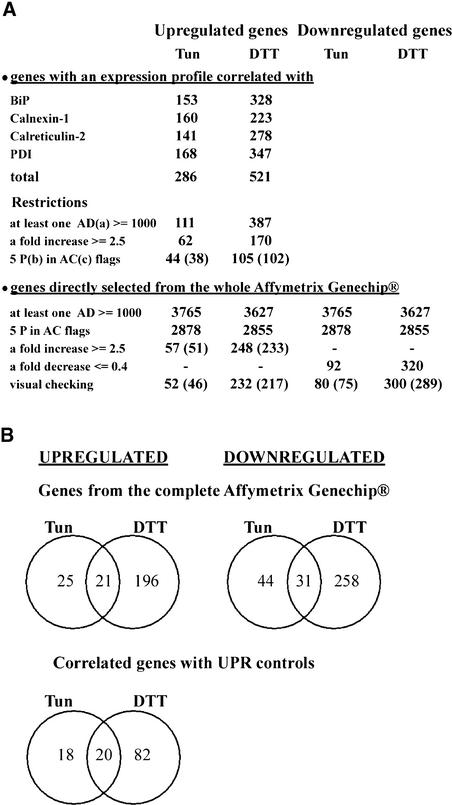
Figure 3.
Overview of the DNA Array Profiles of Upregulated and Downregulated Genes for the Tunicamycin and DTT Experiments. (A) Abundance of probe sets and independent genes (in parentheses) with different selection criteria. Pearson correlation (P = 0.95) was used to search genes with expression patterns similar to those of the four UPR control genes in Figure 2. AC, absolute call; AD, average difference; P, present; Tun, tunicamycin. (B) Venn diagrams of the numbers of overlapping and nonoverlapping induced or repressed genes on the array after treatment with tunicamycin (Tun) or DTT meeting the 1000-5P-2.5 or 1000-5P-0.4 restriction criteria.
Figure 4.
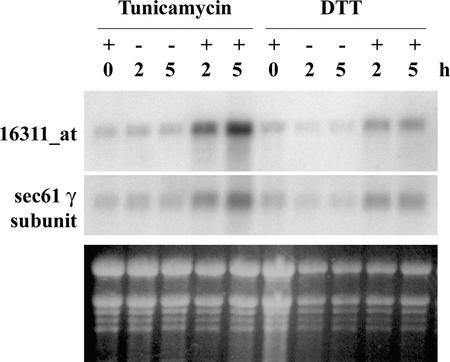
Figure 4.
RNA Gel Blot Analysis Confirms Two UPR Genes Identified by Expression Analysis. RNA gel blots were made with the same RNA samples that were used to collect the microarray data. Total RNA was fractionated on a formaldehyde-agarose gel, transferred onto a nylon membrane, and then hybridized with each 32P-labeled specific probe: the coding sequence of the γ-subunit of sec61 or the putative gene with Affymetrix code 16311_at. Ethidium bromide staining under UV light was used to evaluate loading (bottom gel).

References

    1. Bailey, T.L., and Elkan, C. (1994). Fitting a mixture model by expectation maximization to discover motifs in biopolymers. In Proceedings of the Second International Conference on Intelligent Systems for Molecular Biology. (Menlo Park, CA: AAAI Press), pp. 28–36. - PubMed
    1. D'Amico, L., Valsasina, B., Daminati, M.G., Fabbrini, M.S., Nitti, G., Bollini, R., Ceriotti, A., and Vitale, A. (1992). Bean homologs of the mammalian glucose-regulated proteins: Induction by tunicamycin and interaction with newly synthesized seed storage proteins in the endoplasmic reticulum. Plant J. 2, 443–455. - PubMed
    1. Denecke, J., Goldman, M.H., Demolder, J., Seurinck, J., and Botterman, J. (1991). The tobacco luminal binding protein is encoded by a multigene family. Plant Cell 3, 1025–1035. - PMC - PubMed
    1. de Virgilio, M., Kitzmuller, C., Schwaiger, E., Klein, M., Kreibich, G., and Ivessa, N.E. (1999). Degradation of a short-lived glycoprotein from the lumen of the endoplasmic reticulum: The role of N-linked glycans and the unfolded protein response. Mol. Biol. Cell 10, 4059–4073. - PMC - PubMed
    1. Di Cola, A., Frigerio, L., Lord, J.M., Ceriotti, A., and Roberts, L.M. (2001). Ricin A chain without its partner B chain is degraded after retrotranslocation from the endoplasmic reticulum to the cytosol in plant cells. Proc. Natl. Acad. Sci. USA 98, 14726–14731. - PMC - PubMed

Publication types

MeSH terms

LinkOut - more resources