


Incidence of enteric viruses in groundwater from household wells in Wisconsin
- PMID: 12571044
- PMCID: PMC143602
- DOI: 10.1128/AEM.69.2.1172-1180.2003
Incidence of enteric viruses in groundwater from household wells in Wisconsin
Abstract
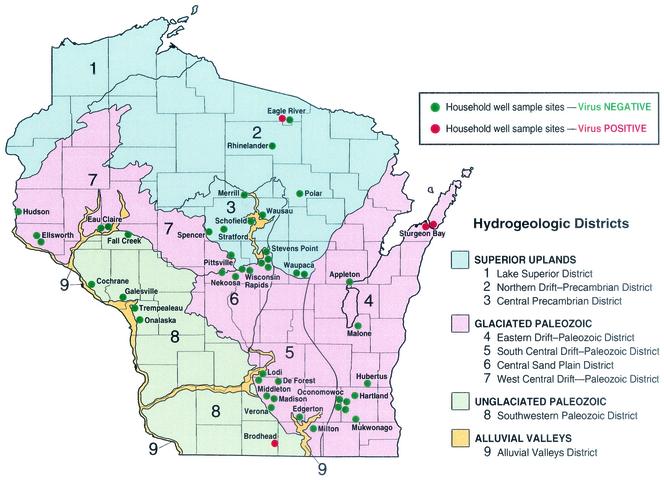
Recent studies on the contamination of groundwater with human enteric viruses have focused on public water systems, whereas little is known about the occurrence of viruses in private household wells. The objective of the present study was to estimate the incidence of viruses in Wisconsin household wells located near septage land application sites or in rural subdivisions served by septic systems. Fifty wells in seven hydrogeologic districts were sampled four times over a year, once each season. Reverse transcriptase PCR (RT-PCR), followed by Southern hybridization, was used to detect enteroviruses, rotavirus, hepatitis A virus (HAV), and Norwalk-like viruses (NLVs). In addition, cell culture was used to detect culturable enteroviruses. Companion water samples were collected for total coliforms, Escherichia coli, fecal enterococci, F-specific RNA coliphages, nitrate, and chloride analyses. Among the 50 wells, four (8%) were positive for viruses by RT-PCR. Three wells were positive for HAV, and the fourth well was positive for both rotavirus and NLV in one sample and an enterovirus in another sample. Contamination was transient, since none of the wells was virus positive for two sequential samples. Culturable enteroviruses were not detected in any of the wells. Water quality indicators were not statistically associated with virus occurrence, although some concordance was noted for chloride. The present study is the first in the United States to systematically monitor private household wells for virus contamination and, combined with data for public wells, provides further insight on the extent of groundwater contamination with human enteric viruses.
Figures
References
-
- Alhajjar, B. J., G. Chesters, and J. M. Harkin. 1990. Indicators of chemical pollution from septic systems. Ground Water 28:559-568.
-
- Alhajjar, B. J., S. L. Stramer, D. O. Cliver, and J. M. Harkin. 1988. Transport modeling of biological tracers from septic systems. Water Res. 22:907-915.
-
- American Public Health Association. 1995. Standard methods for the examination of water and wastewater, 19th ed. American Public Health Association, Washington, D.C.
Publication types
MeSH terms
Substances
LinkOut - more resources
Full Text Sources
Medical
