


UV resistance of Bacillus anthracis spores revisited: validation of Bacillus subtilis spores as UV surrogates for spores of B. anthracis Sterne
- PMID: 12571068
- PMCID: PMC143644
- DOI: 10.1128/AEM.69.2.1327-1330.2003
UV resistance of Bacillus anthracis spores revisited: validation of Bacillus subtilis spores as UV surrogates for spores of B. anthracis Sterne
Abstract
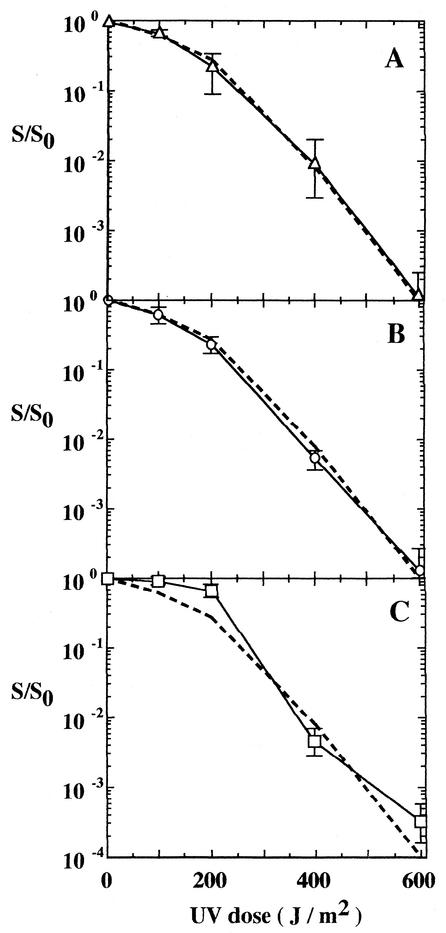
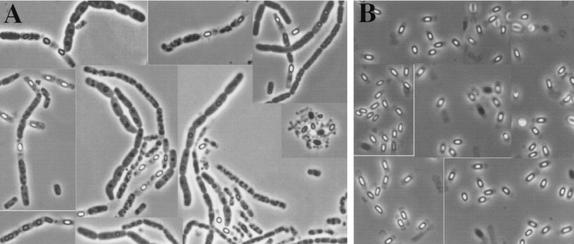
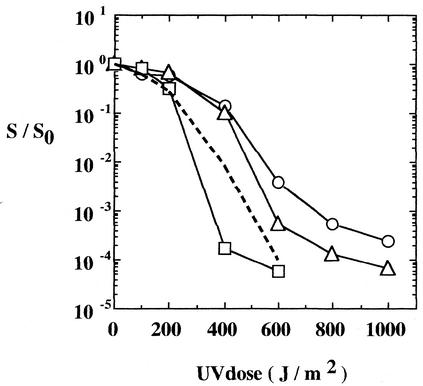
Recent bioterrorism concerns have prompted renewed efforts towards understanding the biology of bacterial spore resistance to radiation with a special emphasis on the spores of Bacillus anthracis. A review of the literature revealed that B. anthracis Sterne spores may be three to four times more resistant to 254-nm-wavelength UV than are spores of commonly used indicator strains of Bacillus subtilis. To test this notion, B. anthracis Sterne spores were purified and their UV inactivation kinetics were determined in parallel with those of the spores of two indicator strains of B. subtilis, strains WN624 and ATCC 6633. When prepared and assayed under identical conditions, the spores of all three strains exhibited essentially identical UV inactivation kinetics. The data indicate that standard UV treatments that are effective against B. subtilis spores are likely also sufficient to inactivate B. anthracis spores and that the spores of standard B. subtilis strains could reliably be used as a biodosimetry model for the UV inactivation of B. anthracis spores.
Figures
References
-
- Banrud, H., and J. Moan. 1999. The use of short wave ultraviolet radiation for disinfection in operating rooms. Tidsskr. Nor. Laegeforen. 119:2670-2673. - PubMed
-
- Bolton, J. R. 2000. Terms and definitions in ultraviolet disinfection, 1-16. In Proceedings of “Disinfection 2000.” Water Environment Federation, Alexandria, Va. .
-
- Cundith, C. J., C. R. Kerth, W. R. Jones, T. A. McCaskey, and D. L. Kuhlers. 2002. Air-cleaning system effectiveness for control of airborne microbes in a meat-processing plant. J. Food Sci. 67:1170-1174.
-
- Gardner, D. W. M., and G. Shama. 1998. The kinetics of Bacillus subtilis spore inactivation on filter paper by u.v. light and u.v. light in combination with hydrogen peroxide. J. Appl. Microbiol. 84:633-641.
-
- Hoyer, O. 2000. The status of UV technology in Europe. IUVA News 2:22-27.
Publication types
MeSH terms
LinkOut - more resources
Full Text Sources
Other Literature Sources
