


Multiple patterns of resistance to fluconazole in Candida glabrata isolates from a patient with oropharyngeal candidiasis receiving head and neck radiation
- PMID: 12574256
- PMCID: PMC149712
- DOI: 10.1128/JCM.41.2.619-622.2003
Multiple patterns of resistance to fluconazole in Candida glabrata isolates from a patient with oropharyngeal candidiasis receiving head and neck radiation
Abstract
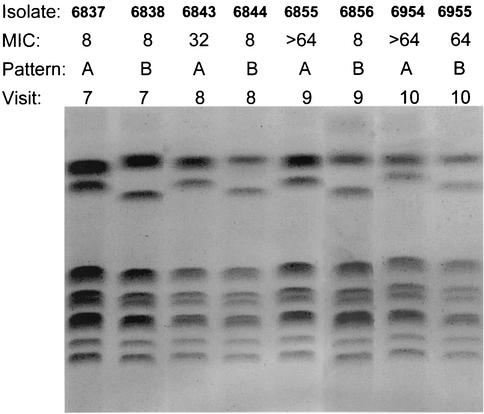
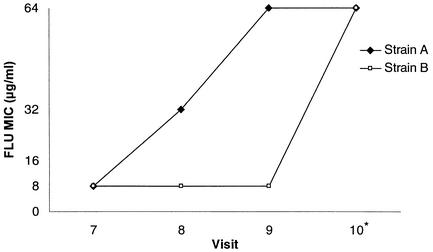
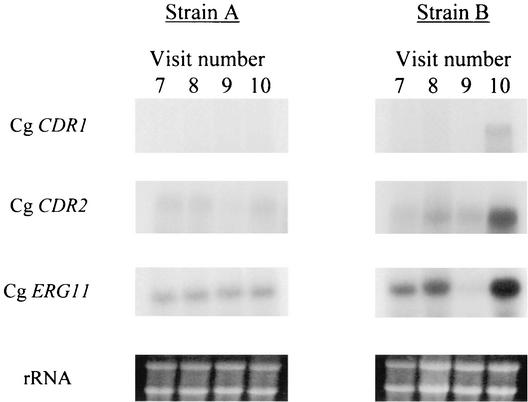
Candida glabrata has emerged in recent years as a significant cause of systemic fungal infection. We have previously reported on the first three patients receiving radiation for head and neck cancer to develop oropharyngeal candidiasis due to C. glabrata. The goal of this study was to track the development of increased fluconazole resistance in C. glabrata isolates and to evaluate previously described genetic mechanisms associated with this resistance from one of these three patients. The patient was a 52-year-old man with squamous cell carcinoma treated with radiation. At week 7 of his radiation, he developed oropharyngeal candidiasis, which was treated with 200 mg of fluconazole daily for 2 weeks. Serial cultures from this and three subsequent time points yielded C. glabrata. Isolates from these cultures were subjected to antifungal susceptibility testing, DNA karyotyping, and evaluation of the expression of genes previously associated with C. glabrata resistance to fluconazole, CgCDR1, CgCDR2, and CgERG11. Two strains (A and B) of C. glabrata were identified and found to display different patterns of resistance development and gene expression. Strain A developed resistance over a 2-week period and showed no overexpression of these genes. In contrast, strain B first showed resistance 6 weeks after fluconazole therapy was discontinued but showed overexpression of all three genes. In conclusion, development of resistance to fluconazole by C. glabrata is a highly varied process involving multiple molecular mechanisms.
Figures
References
-
- Barchiesi, F., L. Di Francesco, D. Arzeni, F. Caselli, D. Gallo, and G. Scalise. 1999. Electrophoretic karyotyping and triazole susceptibility of Candida glabrata clinical isolates. Eur. J. Microbiol. Infect. Dis. 18:184-187. - PubMed
-
- Canuto, M. M., F. G. Rodero, V. O. Ducasse, I. H. Aguado, C. M. Gonzalez, A. S. Sevillano, and A. M. Hildalgo. 2000. Determinants for the development of oropharyngeal colonization or infection by fluconazole-resistant Candida strains in HIV-infected patients. Eur. J. Clin. Microbiol. Infect. Dis. 19:593-601. - PubMed
-
- Di Francesco, L., F. Barchiesi, F. Caselli, O. Cirioni, and G. Scalise. 1999. Comparison of four methods for DNA typing of clinical isolates of Candida glabrata. J. Med. Microbiol. 48:955-963. - PubMed
-
- Doebbling, B. N., R. F. Lehmenn, R. J. Hollis, L. C. Wu, A. F. Widmer, A. Voss, and M. A. Pfaller. 1993. Comparison of pulsed-field gel electrophoresis with isoenzyme profiles as a typing system for Candida tropicalis. Clin. Infect. Dis. 16:377-383. - PubMed
Publication types
MeSH terms
Substances
Grants and funding
LinkOut - more resources
Full Text Sources
Medical
