. 2003 Feb 1;23(3):961-9.
doi: 10.1523/JNEUROSCI.23-03-00961.2003.

Transient and progressive electrophysiological alterations in the corticostriatal pathway in a mouse model of Huntington's disease

Affiliations

Transient and progressive electrophysiological alterations in the corticostriatal pathway in a mouse model of Huntington's disease

Carlos Cepeda et al. J Neurosci. .

Abstract

Alterations in the corticostriatal pathway may precede symptomatology and striatal cell death in Huntington's disease (HD) patients. Here we examined spontaneous EPSCs in striatal medium-sized spiny neurons in slices from a mouse model of HD (R6/2). Spontaneous EPSC frequency was similar in young (3-4 weeks) transgenics and controls but decreased significantly in transgenics when overt behavioral symptoms began (5-7 weeks) and was most pronounced in severely impaired transgenics (11-15 weeks). These differences were maintained after bicuculline or tetrodotoxin, indicating they were specific to glutamatergic input and likely presynaptic in origin. Decreases in presynaptic and postsynaptic protein markers, synaptophysin and postsynaptic density-95, occurred in 11-15 week R6/2 mice, supporting the electrophysiological results. Furthermore, isolated, large-amplitude synaptic events (>100 pA) occurred more frequently in transgenic animals, particularly at 5-7 weeks, suggesting additional dysregulation of cortical inputs. Large events were blocked by tetrodotoxin, indicating a possible cortical origin. Addition of bicuculline and 4-aminopyridine facilitated the occurrence of large events. Riluzole, a compound that decreases glutamate release, reduced these events. Together, these observations indicate that both progressive and transient alterations occur along the corticostriatal pathway in experimental HD. These alterations are likely to contribute to the selective vulnerability of striatal medium-sized spiny neurons.


Figures
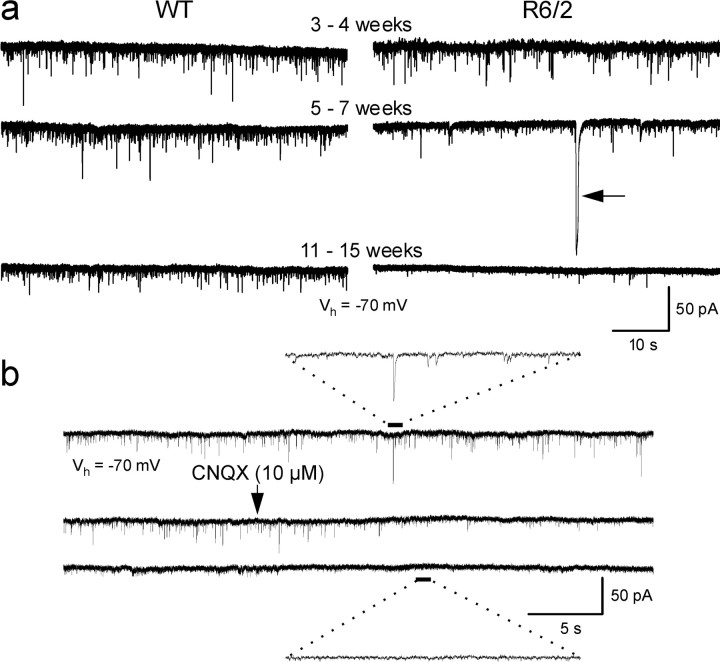
Fig. 1.
Fig. 1.
a, Changes in spontaneous synaptic currents in WT and R6/2 mice from 3–4 weeks to 11–15 weeks. Note the occurrence of the large event in the transgenic at 5–7 weeks (arrow). b, CNQX (applied atarrow) almost completely abolished spontaneous synaptic activity (WT, 81 d). Traces below and abovesolid and dashed lines are magnified to more clearly see the effects of CNQX. In this and other figures, all neurons were held at −70 mV.
Fig. 2.
Fig. 2.
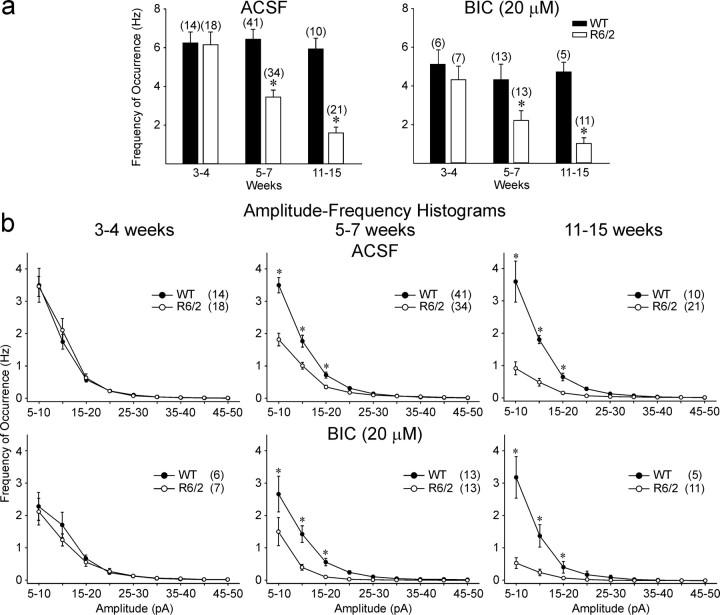
a, Changes in mean frequency of occurrence of total events from WT and R6/2 transgenics in ACSF (left) and in the presence of BIC (right). In this and other figures, error bars are SE, and n values for each group are abovebars or in parentheses. b, Amplitude–frequency histograms for ACSF and BIC indicated that the primary differences in frequency were attributable to a reduction in currents in the 5–20 pA range. Asterisks in this and other figures indicate that differences between WT and R6/2 means were statistically significant.
Fig. 3.
Fig. 3.
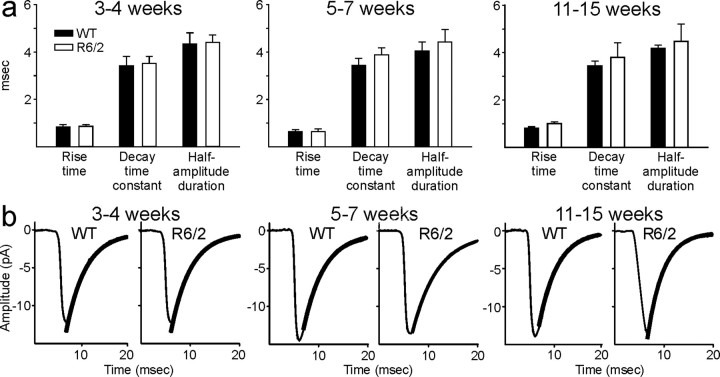
a, Bar graphs showing no differences in kinetic analyses of the average rise times, decay time constants, and half-amplitude durations of spontaneous EPSCs.b, Examples of averaged EPSCs (n = 200 per trace) from WT and R6/2 animals and superimposed decay time exponential fits (thicker black lines).
Fig. 4.
Fig. 4.
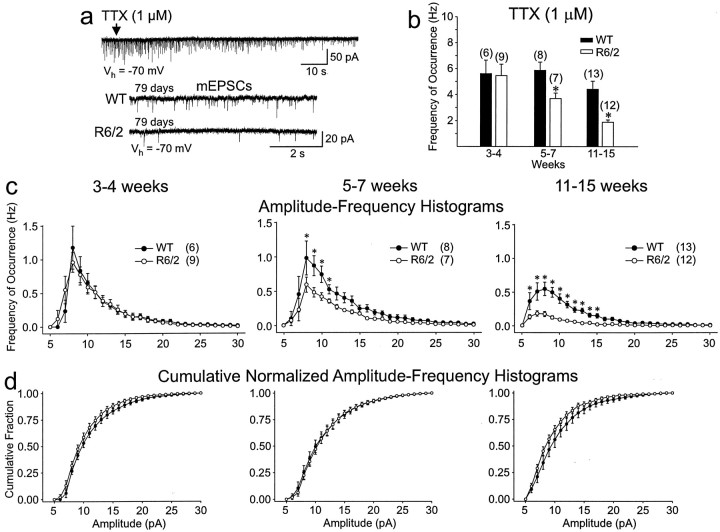
a, TTX (1 μm;top trace at arrow) isolated the mEPSCs.Bottom two traces show comparison of the frequency of mEPSCs between a 79 d WT and R6/2 and demonstrate the marked reduction in frequency of events in the transgenic. b, Significant decreases in mean frequency of mEPSCs occurred in R6/2 transgenics compared with WT at 5–7 and 11–15 weeks.c, Amplitude–frequency histograms show that the reduction in mEPSCs occurred primarily in events of 7–15 pA at 5–7 and 11–15 weeks. d, Cumulative normalized amplitude–frequency histograms show that the relative amplitude distribution was not altered at any age.
Fig. 5.
Fig. 5.
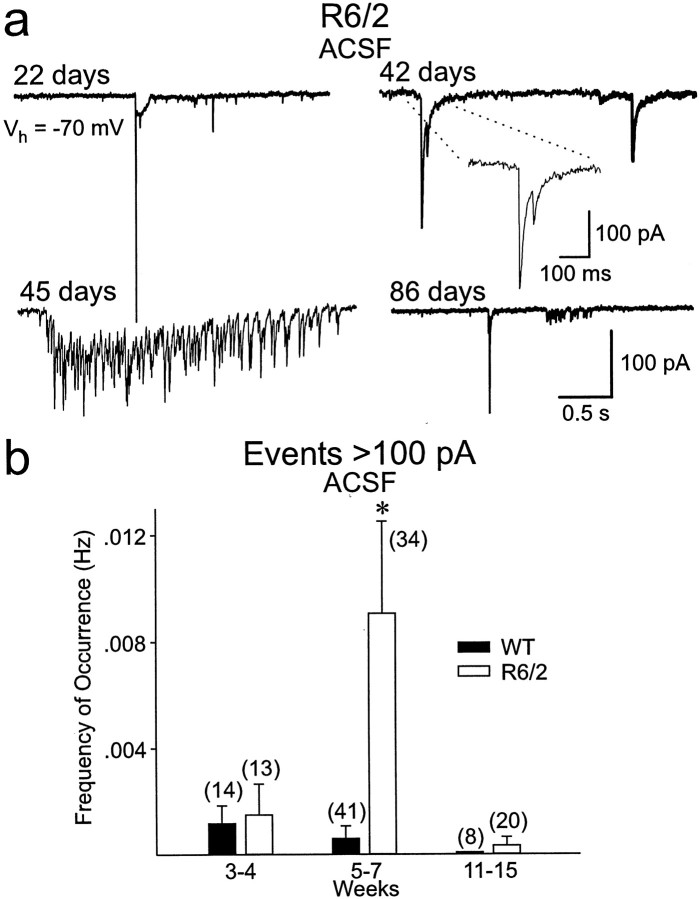
a, Large spontaneous events occurred in a proportion of cells from transgenic animals most frequently at 5–7 weeks. b, Bar graphs show that significantly more large events occurred in the R6/2 transgenics at 5–7 weeks.
Fig. 6.
Fig. 6.
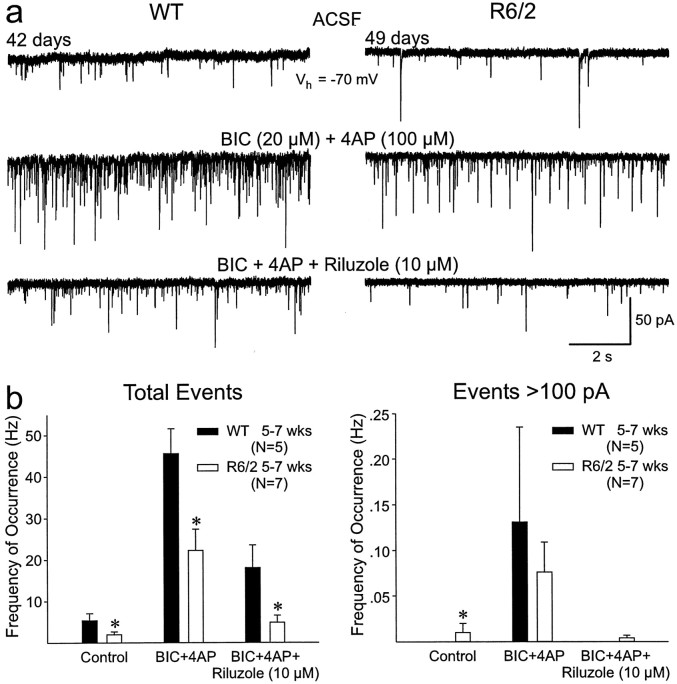
a, Addition of BIC and 4-AP to the ACSF solution increased the frequency and amplitudes of the EPSCs, including the large events in both WT and R6/2 (comparemiddle and top traces). Riluzole reduced the frequency of EPSCs and blocked almost completely the large events (bottom traces). b, Mean frequency of total (left) and large (right) events in ACSF (Control) in BIC and 4-AP and the decrease produced by riluzole. There were statistically significant decreases in the frequency of total events in all age groups of R6/2 transgenics compared with controls. Although BIC and 4-AP also increased the frequency of large events (>100 pA) and riluzole decreased the frequency of these events, only the difference in the control condition was statistically significant.
Fig. 7.
Fig. 7.
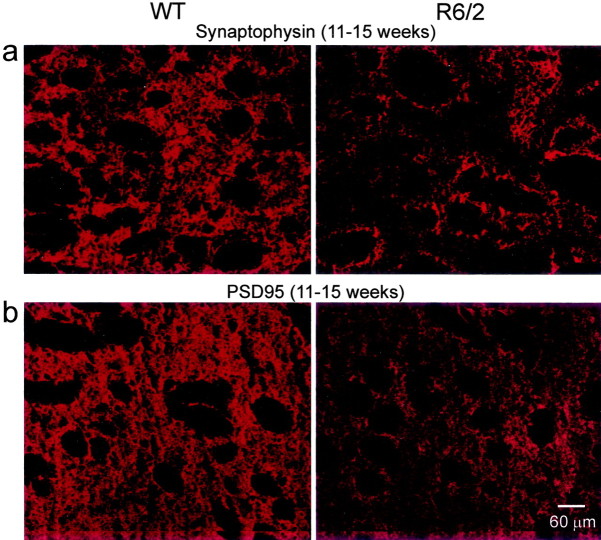
a, Synaptophysin staining was visible throughout the presynaptic cytoplasmic compartments of afferent inputs and locally derived endings in the WT striatum at 11–15 weeks (left) but was attenuated considerably in the R6/2, corresponding to the loss of the presynaptic compartment at 11–15 weeks (right). Fiber bundles that penetrate the striatum appeared as black, nonstained myelinated structures in botha and b. b, Expression of PSD95 was detected within the striatal neuropil of the WT at 11–15 weeks (left) but was reduced substantially at 11–15 weeks in the R6/2 (right). Scale bar refers to allpanels.

References

    1. Ariano MA, Aronin N, DiFiglia M, Tagle DA, Sibley DR, Leavitt BR, Hayden MR, Levine MS. Striatal neurochemical changes in transgenic models of Huntington's disease. J Neurosci Res. 2002;68:716–729. - PubMed
    1. Behrens PF, Franz P, Woodman B, Lindenberg KS, Landwehrmeyer GB. Impaired glutamate transport and glutamate-glutamine cycling: downstream effects of the Huntington mutation. Brain. 2002;125:1908–1922. - PubMed
    1. Biziere K, Coyle JT. Effects of cortical ablation on the neurotoxicity and receptor binding of kainic acid in striatum. J Neurosci Res. 1979;4:383–398. - PubMed
    1. Calabresi P, Picconi B, Saulle E, Centonze D, Hainsworth AH, Bernardi G. Is pharmacological neuroprotection dependent on reduced glutamate release? Stroke. 2000;31:766–772. - PubMed
    1. Calabresi P, Gubellini P, Picconi B, Centonze D, Pisani A, Bonsi P, Greengard P, Hipskind RA, Borrelli E, Bernardi G. Inhibition of mitochondrial complex II induces a long-term potentiation of NMDA-mediated synaptic excitation in the striatum requiring endogenous dopamine. J Neurosci. 2001;21:5110–5120. - PMC - PubMed

Publication types

MeSH terms