


Using temporal context to improve biosurveillance
- PMID: 12574522
- PMCID: PMC149941
- DOI: 10.1073/pnas.0335026100
Using temporal context to improve biosurveillance
Abstract
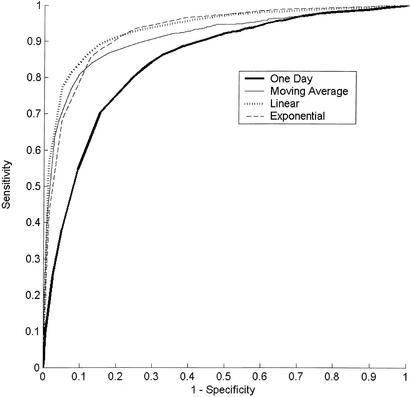
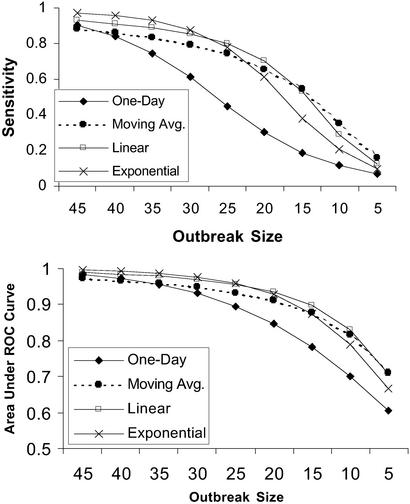
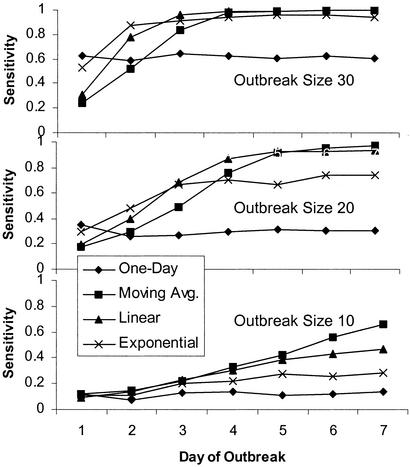
Current efforts to detect covert bioterrorist attacks from increases in hospital visit rates are plagued by the unpredictable nature of these rates. Although many current systems evaluate hospital visit data 1 day at a time, we investigate evaluating multiple days at once to lessen the effects of this unpredictability and to improve both the timeliness and sensitivity of detection. To test this approach, we introduce simulated disease outbreaks of varying shapes, magnitudes, and durations into 10 years of historical daily visit data from a major tertiary-care metropolitan teaching hospital. We then investigate the effectiveness of using multiday temporal filters for detecting these simulated outbreaks within the noisy environment of the historical visit data. Our results show that compared with the standard 1-day approach, the multiday detection approach significantly increases detection sensitivity and decreases latency while maintaining a high specificity. We conclude that current biosurveillance systems should incorporate a wider temporal context to improve their effectiveness. Furthermore, for increased robustness and performance, hybrid systems should be developed to capitalize on the complementary strengths of different types of temporal filters.
Figures
References
-
- Barthell E N, Cordell W H, Moorhead J C, Handler J, Feied C, Smith M S, Cochrane D G, Felton C W, Collins M A. Ann Emerg Med. 2002;39:422–429. - PubMed
-
- Thacker S B, Berkelman R L. Epidemiol Rev. 1998;10:164–190. - PubMed
-
- Inglesby T V, O'Toole T, Henderson D A, Bartlett J G, Ascher M S, Eitzen E, Friedlander A M, Gerberding J, Hauer J, Hughes J, et al. J Am Med Assoc. 2002;287:2236–2252. - PubMed
-
- Brookmeyer R, Blades N. Science. 2002;295:1861. - PubMed
Publication types
MeSH terms
Grants and funding
LinkOut - more resources
Full Text Sources
Medical
