. 2003 Feb 15;31(4):e17.
doi: 10.1093/nar/gng017.

Detection and analysis of spliced chimeric mRNAs in sequence databanks

Affiliations

Detection and analysis of spliced chimeric mRNAs in sequence databanks

Antonello Romani et al. Nucleic Acids Res. .

Abstract

We have developed a databank screening procedure, the In Silico Trans-splicing Retrieval System (ISTReS), to identify heterologous, spliced mRNAs with potential origin from chromosomal translocations, mRNA trans-splicing and multi-locus transcription. A parsing algorithm to screen cDNA versus genome Blast outputs was implemented. Key filtering criteria were Blast scores of > or =300, match lengths of > or =95% of the query sequences, junction of the two partners at exon-exon borders and concordant 'sense/sense' reading orientation. ISTReS was validated by the successful identification of bona fide chromosomal translocation-derived fusion transcripts in the HGI and RefSeq databanks. The performance of ISTReS was verified against recently identified chimeric antisense transcripts, where it revealed essentially no independent proof of antisense transcription and absence of exon-exon borders at the chimeric join, consistent with an artefactual origin. Analysis of the UNIGENE database revealed 21 742 chimeric sequences overall that correspond to approximately 1% of the database transcripts. Novel FOP-Rho GAP and methionyl tRNA synthetase-advillin chimeric mRNAs with the canonical features of heterologous-genes spliced-transcripts were identified among 246 chimeras from the RefSeq databank. This suggests a frequency of canonically-spliced chimeras of approximately 1% of all the hybrid sequences in current databanks. These findings demonstrate the efficiency of ISTReS and the overall feasibility of sequence/structure-based strategies to search for chimeric mRNAs candidate to derive from the splicing of heterologous transcripts.


Figures

Figure 1
Figure 1
Schematic representation of the ISTReS analysis and retrieval strategy.
Figure 2
Figure 2
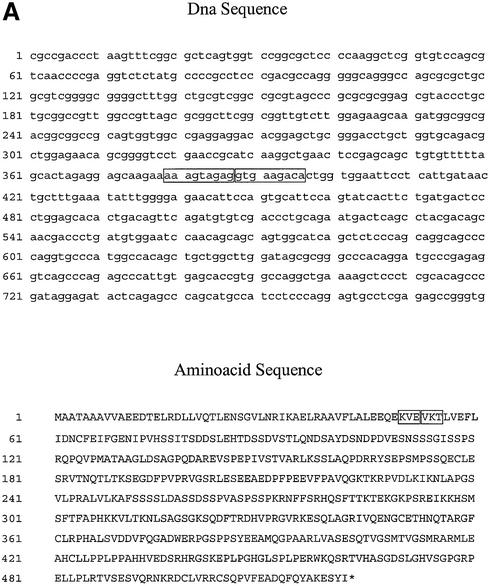
(A) Structure, sequence and translation product of the FOP-Rho GAP chimeric mRNA (Accession number: AF314817) (Table 4). The 5′ partner is FOP (translocated to the FGFR1 oncogene partner), whereas the 3′ partner is T-cell activation Rho GTPase activating protein (GAP). The junction between the two partners is at exon–exon borders (exon II for FOP and exon IX for Rho GAP). The large distance between the two loci (6q27 versus 6q25) suggests a trans-splicing origin. However, as transcription is directed toward the centromere in both transcription units, this is formally consistent also with long, intergenic transcription. (Top) DNA sequence of the first 780 bases of the chimeric mRNA; (bottom) sequence of the encoded chimeric protein. DNA bases and aminoacids surrounding the splice site are boxed. (B) Structure, sequence and translation product of the methionyl tRNA synthetase-advillin chimeric mRNA (Accession number: BC004134) (Table 4). The 5′ partner is the methionyl tRNA synthetase, whereas the 3′ partner is advillin. The junction between the two partners is at exon–exon borders, (exon X for methionyl tRNA synthetase and exon II for advillin). The chromosomal position of methionyl tRNA synthetase is at 12q13.2, whereas that of advillin is at 12q13.1, and might be compatible with intergenic transcription. (Top) DNA sequence flanking the junction of the chimeric mRNA; (bottom) sequence of the encoded chimeric protein. DNA bases and aminoacids surrounding the splice site are boxed.
Figure 2
Figure 2
(A) Structure, sequence and translation product of the FOP-Rho GAP chimeric mRNA (Accession number: AF314817) (Table 4). The 5′ partner is FOP (translocated to the FGFR1 oncogene partner), whereas the 3′ partner is T-cell activation Rho GTPase activating protein (GAP). The junction between the two partners is at exon–exon borders (exon II for FOP and exon IX for Rho GAP). The large distance between the two loci (6q27 versus 6q25) suggests a trans-splicing origin. However, as transcription is directed toward the centromere in both transcription units, this is formally consistent also with long, intergenic transcription. (Top) DNA sequence of the first 780 bases of the chimeric mRNA; (bottom) sequence of the encoded chimeric protein. DNA bases and aminoacids surrounding the splice site are boxed. (B) Structure, sequence and translation product of the methionyl tRNA synthetase-advillin chimeric mRNA (Accession number: BC004134) (Table 4). The 5′ partner is the methionyl tRNA synthetase, whereas the 3′ partner is advillin. The junction between the two partners is at exon–exon borders, (exon X for methionyl tRNA synthetase and exon II for advillin). The chromosomal position of methionyl tRNA synthetase is at 12q13.2, whereas that of advillin is at 12q13.1, and might be compatible with intergenic transcription. (Top) DNA sequence flanking the junction of the chimeric mRNA; (bottom) sequence of the encoded chimeric protein. DNA bases and aminoacids surrounding the splice site are boxed.

References

    1. Mitelman F. (2000) Recurrent chromosome aberrations in cancer. Mutat. Res., 462, 247–253. - PubMed
    1. Croce C.M., Erikson,J., ar-Rushdi,A., Aden,D. and Nishikura,K. (1984) Translocated c-myc oncogene of Burkitt lymphoma is transcribed in plasma cells and repressed in lymphoblastoid cells. Proc. Natl Acad. Sci. USA, 81, 3170–3174. - PMC - PubMed
    1. Solnick D. (1985) Trans splicing of mRNA precursors. Cell, 42, 157–164. - PubMed
    1. Konarska M.M., Padgett,R.A. and Sharp,P.A. (1985) Trans splicing of mRNA precursors in vitro. Cell, 42, 165–171. - PubMed
    1. Bonen L. (1993) Trans-splicing of pre-mRNA in plants, animals and protists. FASEB J., 7, 40–46. - PubMed

Publication types