


Origin and evolution of Japanese encephalitis virus in southeast Asia
- PMID: 12584335
- PMCID: PMC149749
- DOI: 10.1128/jvi.77.5.3091-3098.2003
Origin and evolution of Japanese encephalitis virus in southeast Asia
Abstract
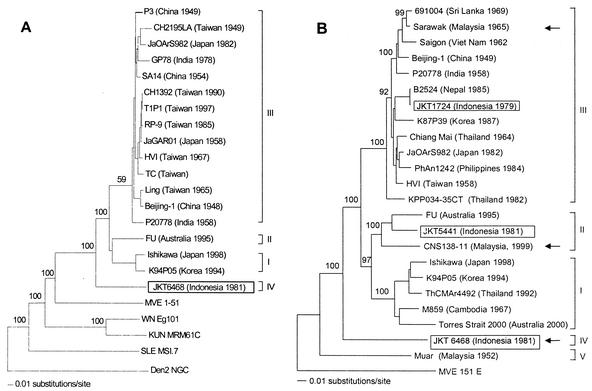
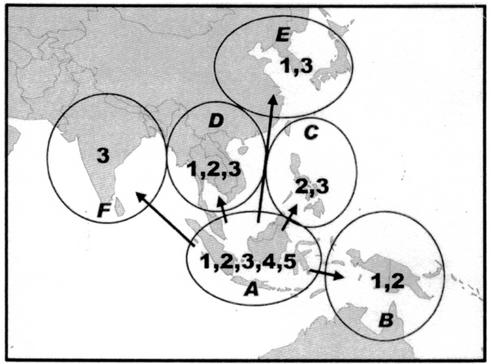
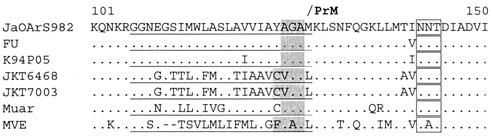
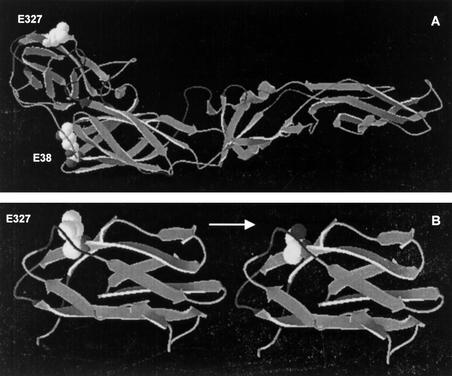
Since it emerged in Japan in the 1870s, Japanese encephalitis has spread across Asia and has become the most important cause of epidemic encephalitis worldwide. Four genotypes of Japanese encephalitis virus (JEV) are presently recognized (representatives of genotypes I to III have been fully sequenced), but its origin is not known. We have determined the complete nucleotide and amino acid sequence of a genotype IV Indonesian isolate (JKT6468) which represents the oldest lineage, compared it with other fully sequenced genomes, and examined the geographical distribution of all known isolates. JKT6468 was the least similar, with nucleotide divergence ranging from 17.4 to 19.6% and amino acid divergence ranging from 4.7 to 6.5%. It included an unusual series of amino acids at the carboxy terminus of the core protein unlike that seen in other JEV strains. Three signature amino acids in the envelope protein (including E327 Leu-->Thr/Ser on the exposed lateral surface of the putative receptor binding domain) distinguished genotype IV strains from more recent genotypes. Analysis of all 290 JEV isolates for which sequence data are available showed that the Indonesia-Malaysia region has all genotypes of JEV circulating, whereas only more recent genotypes circulate in other areas (P < 0.0001). These results suggest that JEV originated from its ancestral virus in the Indonesia-Malaysia region and evolved there into the different genotypes which then spread across Asia. Our data, together with recent evidence on the origins of other emerging viruses, including dengue virus and Nipah virus, imply that tropical southeast Asia may be an important zone for emerging pathogens.
Figures
References
-
- Ali, A., and A. Igarashi. 1997. Antigenic and genetic variations among Japanese encephalitis virus strains belonging to genotype 1. Microbiol. Immunol. 41:241-252. - PubMed
-
- Briese, T., X.-Y. Jia, C. Huang, L. J. Grady, and W. I. Lipkin. 1999. Identification of a Kunjin/West Nile-like flavivirus in brains of patients with New York encephalitis. Lancet 354:1261-1262. - PubMed
-
- Chambers, T. J., C. S. Hahn, R. Galler, and C. M. Rice. 1990. Flavivirus genome organisation, expression and replication. Annu. Rev. Microbiol. 44:649-688. - PubMed
-
- Chen, B. Q., and B. J. Beaty. 1982. Japanese encephalitis vaccine (2-8 strain) and parent (SA 14 strain) viruses in Culex tritaeniorhynchus mosquitoes. Am. J. Trop. Med. Hyg. 31:403-407. - PubMed
-
- Chen, W. R., R. Ricco-Hesse, and R. B. Tesh. 1992. A new genotype of Japanese virus from Indonesia. Am. J. Trop. Med. Hyg. 47:61-69. - PubMed
Publication types
MeSH terms
Associated data
- Actions
- Actions
- Actions
- Actions
Grants and funding
LinkOut - more resources
Full Text Sources
Other Literature Sources
Medical
