The metabolic syndrome: prevalence and associated risk factor findings in the US population from the Third National Health and Nutrition Examination Survey, 1988-1994
- PMID: 12588201
- PMCID: PMC3146257
- DOI: 10.1001/archinte.163.4.427
The metabolic syndrome: prevalence and associated risk factor findings in the US population from the Third National Health and Nutrition Examination Survey, 1988-1994
Abstract
Background: The metabolic syndrome is an important cluster of coronary heart disease risk factors with common insulin resistance. The extent to which the metabolic syndrome is associated with demographic and potentially modifiable lifestyle factors in the US population is unknown.
Methods: Metabolic syndrome-associated factors and prevalence, as defined by Adult Treatment Panel III criteria, were evaluated in a representative US sample of 3305 black, 3477 Mexican American, and 5581 white men and nonpregnant or lactating women aged 20 years and older who participated in the cross-sectional Third National Health and Nutrition Examination Survey.
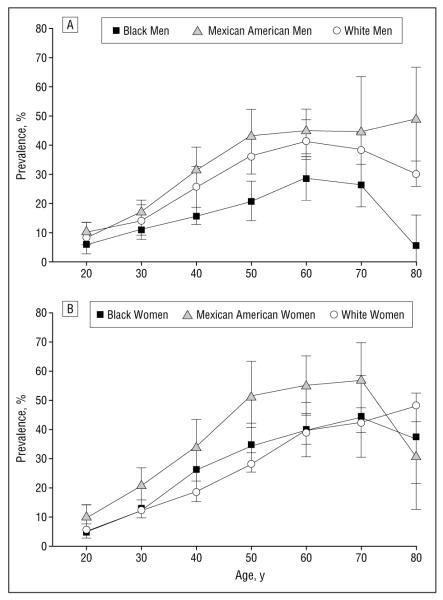
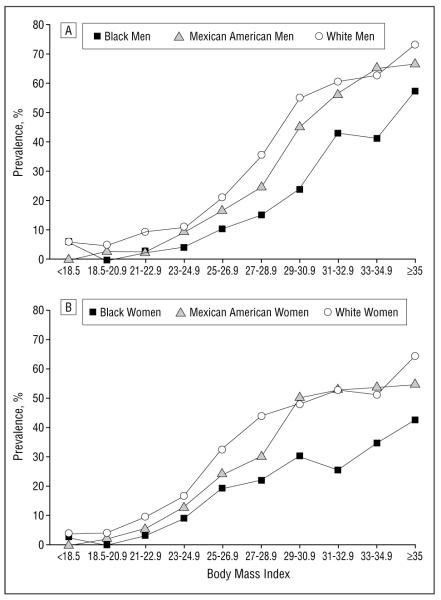
Results: The metabolic syndrome was present in 22.8% and 22.6% of US men and women, respectively (P =.86). The age-specific prevalence was highest in Mexican Americans and lowest in blacks of both sexes. Ethnic differences persisted even after adjusting for age, body mass index, and socioeconomic status. The metabolic syndrome was present in 4.6%, 22.4%, and 59.6% of normal-weight, overweight, and obese men, respectively, and a similar distribution was observed in women. Older age, postmenopausal status, Mexican American ethnicity, higher body mass index, current smoking, low household income, high carbohydrate intake, no alcohol consumption, and physical inactivity were associated with increased odds of the metabolic syndrome.
Conclusions: The metabolic syndrome is present in more than 20% of the US adult population; varies substantially by ethnicity even after adjusting for body mass index, age, socioeconomic status, and other predictor variables; and is associated with several potentially modifiable lifestyle factors. Identification and clinical management of this high-risk group is an important aspect of coronary heart disease prevention.
Figures
Comment in
-
What to do about the metabolic syndrome?Arch Intern Med. 2003 Feb 24;163(4):395-7. doi: 10.1001/archinte.163.4.395. Arch Intern Med. 2003. PMID: 12588197 No abstract available.
-
The metabolic syndrome: all criteria are equal, but some criteria are more equal than others.Arch Intern Med. 2003 Dec 8-22;163(22):2787-8; author reply 2788. doi: 10.1001/archinte.163.22.2787. Arch Intern Med. 2003. PMID: 14662635 No abstract available.
References
-
- American Heart Association . 2001 Heart and Stroke Statistical Update. American Heart Association; Dallas, Tex: 2000.
-
- Wilson PWF, Kannel WB, Silbershatz H, D’Agostino RB. Clustering of metabolic factors and coronary heart disease. Arch Intern Med. 1999;159:1104–1109. - PubMed
-
- Reaven GM. Role of insulin resistance in human disease. Diabetes. 1988;37:1595–1607. - PubMed
-
- Haffner SM, Valdez RA, Hazuda HP, Mitchell BD, Morales PA, Stern MP. Prospective analysis of the insulin resistance syndrome (syndrome X) Diabetes. 1992;41:715–722. - PubMed
-
- Grundy SM. Hypertriglyceridemia, insulin resistance, and the metabolic syndrome. Am J Cardiol. 1999;83:25F–29F. - PubMed
Publication types
MeSH terms
Grants and funding
LinkOut - more resources
Full Text Sources
Other Literature Sources
Medical