Case Reports
Stiff guide technique: technical report and illustrative case
Affiliations
- PMID: 12591648
- PMCID: PMC7974131
Item in Clipboard
Case Reports
Stiff guide technique: technical report and illustrative case
AJNR Am J Neuroradiol.
2003 Feb.
Abstract
Endovascular techniques are gaining wider acceptance in the treatment of intracranial lesions. Tortuous vasculature is a common reason for failure to treat an intracranial lesion, especially when balloon catheters or stents are used. In these cases, the guiding catheter often buckles into the aorta during an attempt to place the balloon or stent. In our experience, a stiff wire can be used to support the guiding catheter, allowing the balloon catheter or stent to more readily navigate tortuous vessels.
Figures
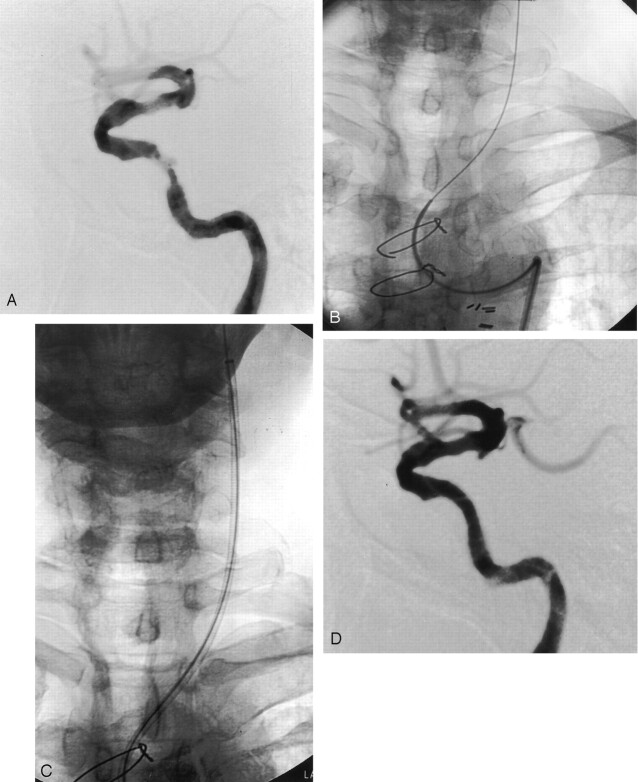
Images from the case of a 60-year-old man with a history of transient ischemic attacks consisting of left-sided amaurosis fugax and slurred speech. A, Angiogram of the left ICA shows severe stenosis of third and fourth portions of the left cavernous carotid artery with ulceration. B, Image shows buckling of the sheath into the aorta with a standard glide wire in place as a stiffening wire. C, Left carotid artery sheath with Stiff Shaft glide wire, balloon/stent catheter, and Agility wire. (Balloon/stent catheter and Agility wire were radiolucent except at the tip and are therefore not visualized on this image.) D, Angiogram of the left ICA, obtained after stent placement. Minimal residual stenosis is seen. The previously seen ulceration is no longer seen. Improved flow in the anterior cerebral artery and some filling of the posterior cerebral artery are shown.
References
-
- Aletich V, Debrun G, Misra M, Charbel F, Ausman J. The remodeling technique of balloon-assisted Guglielmi detachable coil placement in wide-necked aneurysms: experience at the University of Illinois at Chicago. J Neurosurg 2000;93:388–396 - PubMed
-
- Terada T, Nakai E, Tsuura M, Nakai K, Itakura T. Combined surgery and endovascular stenting for basilar artery stenosis refractory to balloon angioplasty: technical case report. Acta Neurochir (Wien) 2001;143:511–516 - PubMed
Publication types
MeSH terms
LinkOut - more resources
Full Text Sources
Medical