


Conjugative transfer of p42a from rhizobium etli CFN42, which is required for mobilization of the symbiotic plasmid, is regulated by quorum sensing
- PMID: 12591886
- PMCID: PMC148057
- DOI: 10.1128/JB.185.5.1681-1692.2003
Conjugative transfer of p42a from rhizobium etli CFN42, which is required for mobilization of the symbiotic plasmid, is regulated by quorum sensing
Abstract
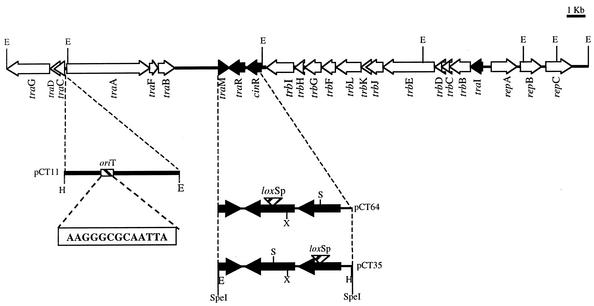
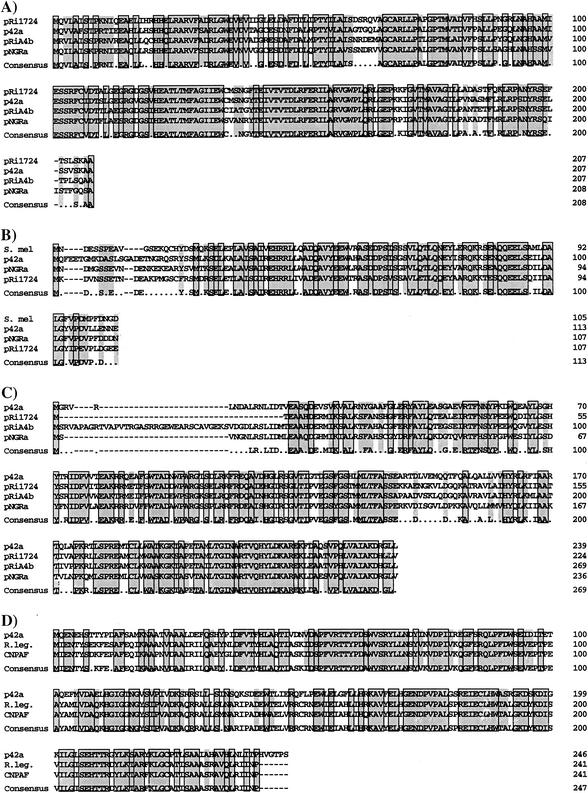
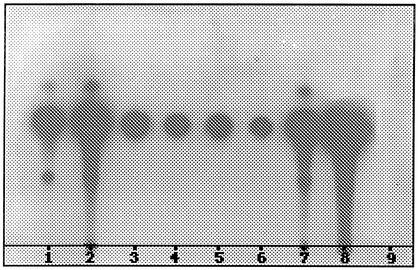
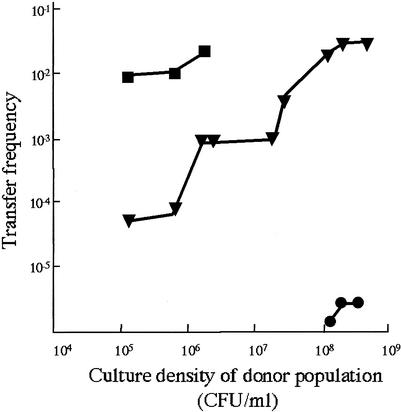
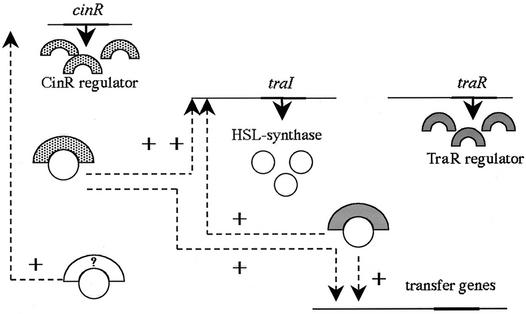
Rhizobium etli CFN42 contains six plasmids. Only one of them, p42a, is self-conjugative at high frequency. This plasmid is strictly required for mobilization of the symbiotic plasmid (pSym). To study the transfer mechanism of p42a, a self-transmissible cosmid clone containing its transfer region was isolated. Its sequence showed that most of the tra genes are highly similar to genes of Agrobacterium tumefaciens pTiC58 and other related plasmids. Four putative regulatory genes were identified; three of these (traI, traR, and cinR) belong to the LuxR-LuxI family. Mutagenesis of these genes confirmed their requirement for p42a transfer. We found that the conjugative transfer of p42a is dependent on quorum sensing, and consequently pSym transfer also was found to be similarly regulated, establishing a complex link between environmental conditions and pSym transfer. Although R. etli has been shown to produce different N-acyl-homoserine lactones, only one of them, a 3-oxo-C(8)-homoserine lactone encoded by the traI gene described here, was involved in transfer. Mutagenesis of the fourth regulatory gene, traM, had no effect on transfer. Analysis of transcriptional fusions of the regulatory genes to a reporter gene suggests a complex regulation scheme for p42a conjugative transfer. Conjugal transfer gene expression was found to be directly upregulated by TraR and the 3-oxo-C(8)-homoserine lactone synthesized by TraI. The traI gene was autoregulated by these elements and positively regulated by CinR, while cinR expression required traI. Finally, we did not detect expression of traM, indicating that in p42a TraM may be expressed so weakly that it cannot inhibit conjugal transfer, leading to the unrepressed transfer of p42a.
Figures
References
-
- Bittinger, M. A., J. A. Gross, J. Widom, J. Clardy, and J. Handelsman. 2000. Rhizobium etli CE3 carries vir gene homologs on a self-transmissible plasmid. Mol. Plant-Microbe Interact. 13:1019-1021. - PubMed
-
- Brom, S., A. García de los Santos, L. Cervantes, R. Palacios, and D. Romero. 2000. In Rhizobium etli symbiotic plasmid transfer, nodulation competitivity and cellular growth require interaction among different replicons. Plasmid 44:34-43. - PubMed
Publication types
MeSH terms
Substances
Associated data
- Actions
LinkOut - more resources
Full Text Sources
Other Literature Sources
Molecular Biology Databases
