. 2003 Mar 4;100(5):2695-9.
doi: 10.1073/pnas.0434905100. Epub 2003 Feb 19.

Bacterial enterotoxins are associated with resistance to colon cancer

Affiliations

Bacterial enterotoxins are associated with resistance to colon cancer

G M Pitari et al. Proc Natl Acad Sci U S A. .

Abstract

One half million patients suffer from colorectal cancer in industrialized nations, yet this disease exhibits a low incidence in under-developed countries. This geographic imbalance suggests an environmental contribution to the resistance of endemic populations to intestinal neoplasia. A common epidemiological characteristic of these colon cancer-spared regions is the prevalence of enterotoxigenic bacteria associated with diarrheal disease. Here, a bacterial heat-stable enterotoxin was demonstrated to suppress colon cancer cell proliferation by a guanylyl cyclase C-mediated signaling cascade. The heat-stable enterotoxin suppressed proliferation by increasing intracellular cGMP, an effect mimicked by the cell-permeant analog 8-br-cGMP. The antiproliferative effects of the enterotoxin and 8-br-cGMP were reversed by L-cis-diltiazem, a cyclic nucleotide-gated channel inhibitor, as well as by removal of extracellular Ca(2+), or chelation of intracellular Ca(2+). In fact, both the enterotoxin and 8-br-cGMP induced an L-cis-diltiazem-sensitive conductance, promoting Ca(2+) influx and inhibition of DNA synthesis in colon cancer cells. Induction of this previously unrecognized antiproliferative signaling pathway by bacterial enterotoxin could contribute to the resistance of endemic populations to intestinal neoplasia, and offers a paradigm for targeted prevention and therapy of primary and metastatic colorectal cancer.


Figures
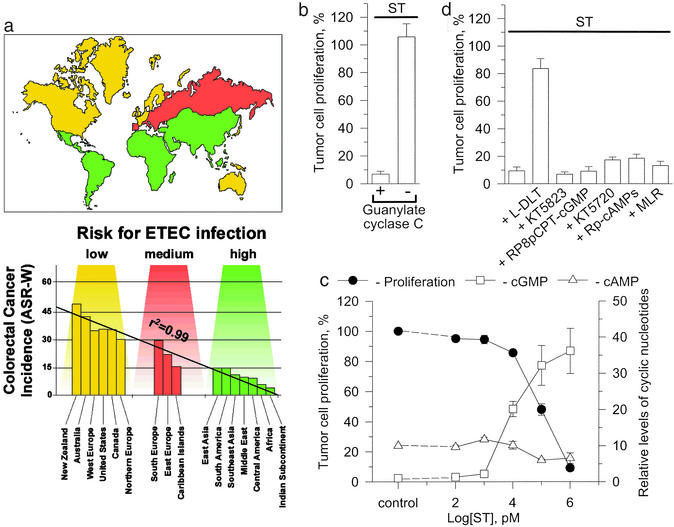
Figure 1
Figure 1
The geographic imbalance between colorectal cancer and infections with ETEC which produce enterotoxins that suppress human colon carcinoma cell proliferation. (a) Worldwide geographic distribution of ST-producing ETEC infections and the incidence of colorectal cancer. The risk of infection with ST-producing ETEC was estimated from the risk of travelers' diarrhea. The incidence of colorectal cancer is represented as the age-adjusted rate using the World Standard Population (ASR-W) and is expressed per 100,000. Linear regression analysis was generated to fit the mean values for each risk category. (b) ST (1 μM) inhibits DNA synthesis in colon cancer cells expressing GC-C [T84 cells; P < 0.01 for control vs. Student's t test (ST)] but not in those cells that do not express GC-C (SW480 cells). Tumor cell proliferation, % (y axis) is defined as the amount of DNA synthesis in treated cells as a percentage of the amount of DNA synthesis in parallel control cultures. (c) In T84 cells, the antiproliferative effects of ST correlate with [cGMP]i but not intracellular cAMP accumulation. (d) Inhibitors of downstream effectors of cGMP, including PKG (1 μM KT5823, 50 μM RP8pCPT-cGMP), cAMP-dependent protein kinase (0.5 μM KT5720, 50 μM RP-cAMPs), and cGMP-regulated phosphodiesterase 3 [10 μM milrinone (MRL)], did not alter the inhibition of proliferation induced by ST. In contrast, an inhibitor of CNG channels, L-DLT (200 μM), blocked the effect of ST on proliferation (P > 0.1 for control vs. L-DLT, Student's t test). The concentrations of inhibitors used are those that selectively and completely inhibit their target enzymes: PKG-I and –II (KT5823: Ki = 234 nM; RP8pCPT-cGMP: Ki = 500 nM; refs. , , and 49), cAMP-dependent protein kinase I and II (KT5720: Ki = 56 nM; RP-cAMPs: Ki = 10 μM; refs. and 51), and phosphodiesterase 3 (milrinone: Ki = 300 nM; ref. 52). The concentration of L-DLT used abolished ST-induced 45Ca2+ influx in the rat colon (40). Data are the mean ± SEM of a representative experiment performed in triplicate.
Figure 2
Figure 2
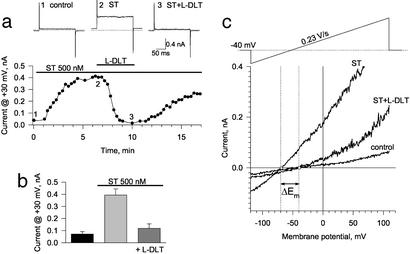
ST induces an L-DLT-sensitive current in human colon carcinoma cells. (a) Time-course of steady-state outward current recorded at the end of 200- ms-long depolarizing rectangular pulses from a holding potential of −40 mV to +30 mV. The period of drug application is indicated by corresponding horizontal bars above the data plot. (Top) Original current traces corresponding to specific points along the time course under control conditions (1), following application of 500 nM ST (2), and in the combined presence of ST plus 200 μM L-DLT (3). (b) Average current at +30 mV under control conditions, in the presence of ST, and in the presence of ST plus L-DLT (n = 6, mean ± SEM). (c) Voltage–current relationships obtained at the holding potential of −40 mV in response to 1-s-long ramp pulses from −120 mV to +110 mV under control conditions, in the presence of ST, and in the presence of ST plus L-DLT. ST induced a significant shift of the reversal potential (ΔEm = −27.5 ± 2.6 mV, n = 6, mean ± SEM) that was reversed by L-DLT.
Figure 3
Figure 3
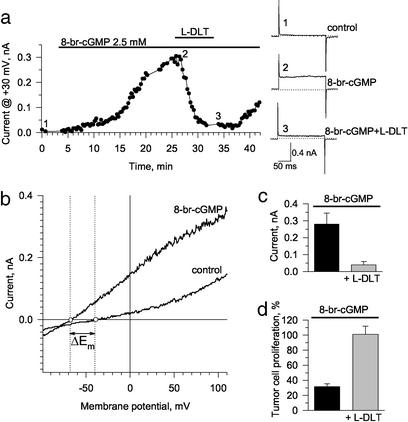
8-Br-cGMP induces an L-DLT-sensitive current in, and inhibits proliferation of, human colon carcinoma cells. (a) [cGMP]i was increased by application of the membrane-permeable analog, 8-br-cGMP (2.5. mM), which, in a time-dependent manner, activated a membrane current sensitive to 200 μM L-DLT. (Right) Original current traces recorded in response to 200-ms depolarizing rectangular pulses from a holding potential of −40 mV to +30 mV correspond to points along the time course under control conditions (1), in the presence of 8-br-cGMP (2), and in the combined presence of 8-br-cGMP plus L-DLT (3). (b) Voltage–current relationships obtained at the holding potential of −40 mV in response to 1-s-long ramp pulses from −100 mV to +110 mV under control conditions and in the presence of 8-br-cGMP. (c) Average current at +30 mV in the presence of 8-br-cGMP and in the presence of 8-br-cGMP plus L-DLT (n = 4, mean ± SEM). (d) Inhibition of cell proliferation by 8-br-cGMP (5 mM) was blocked by 200 μM L-DLT. Data are the mean ± SEM of a representative experiment performed in triplicate.
Figure 4
Figure 4
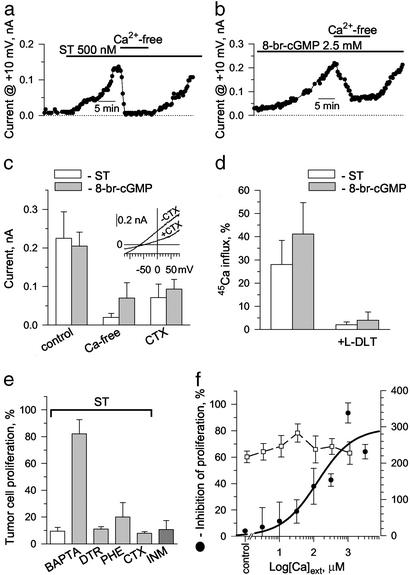
ST and 8-br-cGMP alter the membrane conductance and proliferation of human colon carcinoma cells by inducing CNG channel-mediated calcium influx. (a and b) Currents induced by ST (a) and 8-br-cGMP (b) are reversed in calcium-free solution. Steady-state outward current recorded at the end of 200-ms-long depolarizing rectangular pulses from a holding potential of −40 mV to +10 mV. (c) Average effect of ST (white bars) and 8-br-cGMP (gray bars) in the presence (control; 1.8 mM CaCl2) and absence (Ca-free) of [Ca2+]ext, as well as in the presence of 100 nM charybdotoxin, a specific inhibitor of Kca channels (CTX in the presence of 1.8 mM CaCl2). Data are the mean ± SEM of five separate experiments. (Inset) A representative current–voltage relationship defining the effect of charybdotoxin on ST-induced current obtained in response to 0.25 V/s ramped membrane depolarization. (d) ST (1 μM, 20 min) or 8-br-cGMP (5 mM, 40 min) induced influx of 45Ca2+ into colon cancer cells, which was abolished by pretreatment (30 min) with 250 μM L-DLT. Results are expressed as percent increase over respective controls and are the mean ± SEM of six (ST) or five (8-br-cGMP) experiments performed in duplicate. (e) ST inhibits cell proliferation, an effect abolished by the cytosolic calcium chelator BAPTA-AM (BAPTA, 20 μM). Dantrolene (DTR, 50 μM), which blocks Ca2+ mobilization from the endoplasmic reticulum, and phenamil (PHE, 1 μM), which blocks Na+/Ca2+ exchange as well as CTX (100 nM), did not reverse ST-mediated inhibition of proliferation. Ionomycin (INM, 1 μM), a calcium ionophore, mimicked on its own the effects of ST (1 μM). Results are expressed as percentage of respective controls and are the mean ± SEM of a representative experiment performed in triplicate. (f) ST inhibition of cell proliferation (left scale) depended on [Ca2+]ext, with an EC50 estimated at 127 μM. The inability of ST to inhibit proliferation in the absence of [Ca2+]ext did not reflect failure of ST to bind to GC-C, because induction of [cGMP]i accumulation (right scale) by ST was independent of [Ca2+]ext. Data are the mean ± SEM of a representative experiment performed in triplicate.

Comment in

References

    1. Ferlay J, Bray F, Pisani P, Parkin D M. GLOBOCAN 2000: Cancer Incidence, Mortality and Prevalence Worldwide, Version 1.0. Lyon: International Agency for Research on Cancer; 2001.
    1. Hill D R, Pearson R D. Ann Intern Med. 1988;108:839–852. - PubMed
    1. Centers for Disease Control and Prevention. Health Information for International Travel 1999–2000. Atlanta: Department of Health and Human Services; 2001.
    1. Schulz S, Green C K, Yuen P S, Garbers D L. Cell. 1990;63:941–948. - PubMed
    1. Hughes J M, Murad F, Chang B, Guerrant R L. Nature. 1978;271:755–756. - PubMed

Publication types

MeSH terms