Pilot study of the roles of personality, references, and personal statements in relation to performance over the five years of a medical degree
- PMID: 12595384
- PMCID: PMC163931
- DOI: 10.1136/bmj.326.7386.429
Pilot study of the roles of personality, references, and personal statements in relation to performance over the five years of a medical degree
Abstract
Objectives: To compare the power of three traditional selection procedures (A levels, personal statements, and references) and one non-traditional selection procedure (personality) to predict performance over the five years of a medical degree.
Design: Cohort study over five years.
Setting: Nottingham medical school.
Participants: Entrants in 1995.
Main outcome measures: A level grades, amounts of information contained in teacher's reference and the student's personal statement, and personality scores examined in relation to 18 different assessments.
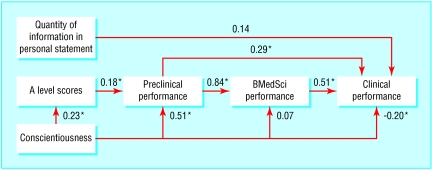
Results: Information in the teacher's reference did not consistently predict performance. Information in the personal statement was predictive of clinical aspects of training, whereas A level grades primarily predicted preclinical performance. The personality domain of conscientiousness was consistently the best predictor across the course. A structural model indicated that conscientiousness was positively related to A level grades and preclinical performance but was negatively related to clinical grades.
Conclusion: A teacher's reference is of no practical use in predicting clinical performance of medical students, in contrast to the amount of information contained in the personal statement. Therefore, simple quantification of the personal statement should aid selection. Personality factors, in particular conscientiousness, need to be considered and integrated into selection procedures.
Figures
Comment in
-
Commentary: How to derive causes from correlations in educational studies.BMJ. 2003 Feb 22;326(7386):429-32. BMJ. 2003. PMID: 12596791 No abstract available.
-
Personality and performance during a medical degree. Selecting for extreme personality types is perilous.BMJ. 2003 May 3;326(7396):986. doi: 10.1136/bmj.326.7396.986/b. BMJ. 2003. PMID: 12727782 Free PMC article. No abstract available.
References
-
- Anderson N, Shackleton V. Successful selection interviewing. Oxford: Blackwell; 1993.
-
- Ferguson E, Sanders A, O'Hehir F, James D. Predictive validity of personal statement and the role of the five factor model of personality in relation to medical training. J Occ Org Psychol. 2000;73:321–344.
-
- Ievens F, Coetsier P, De Fruty F, De Maeseneer J. Medical students' personality characteristics and academic performance: a five-factor model perspective. Med Educ. 2002;36:1050–1056. - PubMed
-
- Patterson F, Ferguson E, Lane P, Norfolk T. A new competency based selection system for general practitioners. Paper presented as part of a symposium on personality and medicine. The 10th international conference of the International Society for the Study of Individual Differences. Edinburgh, Scotland, 7-11 Jul, 2001.
MeSH terms
LinkOut - more resources
Full Text Sources