


Intravenous mouse infection model for studying the pathology of Enterococcus faecalis infections
- PMID: 12595461
- PMCID: PMC148842
- DOI: 10.1128/IAI.71.3.1434-1441.2003
Intravenous mouse infection model for studying the pathology of Enterococcus faecalis infections
Abstract
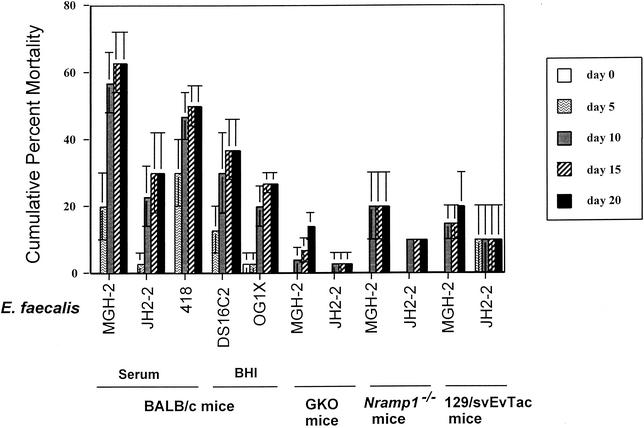
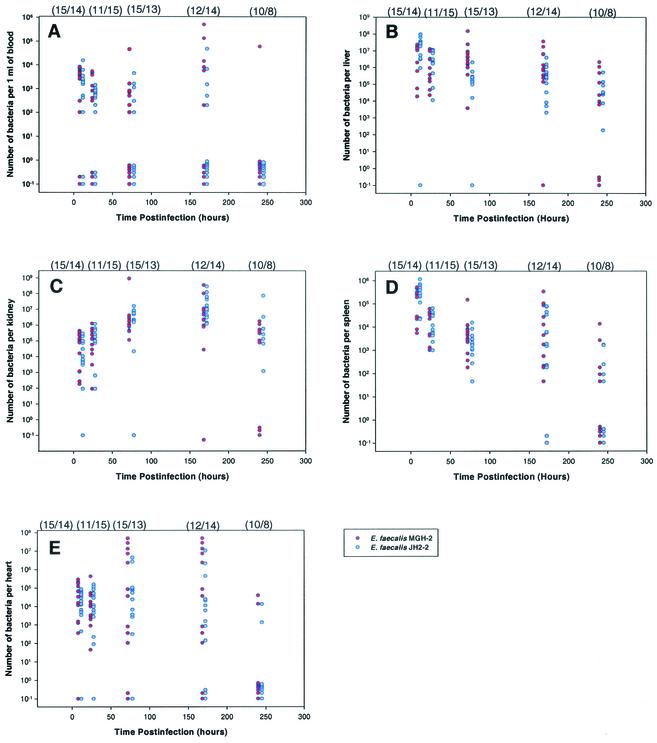
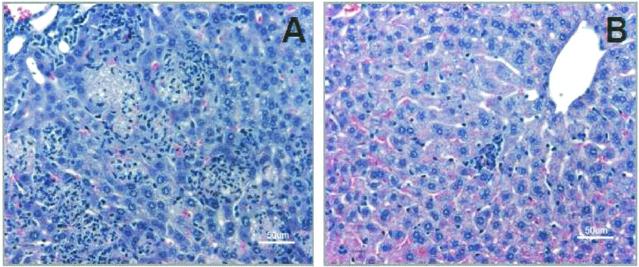
An intravenous mouse infection model was used to compare the virulence of Enterococcus faecalis strains, to study bacterial localization and organ histopathology, and to examine the effects of Nramp1 and gamma interferon (IFN-gamma) on the course of infection. Infection of BALB/c mice with 5 x 10(8) CFU of E. faecalis JH2-2, MGH-2, 418, DS16C2, or OG1X revealed the following virulence ranking (from highest to lowest): MGH-2, 418, DS16C2, JH2-2, and OG1X. Discernible differences in the number of MGH-2 and JH2-2 bacteria were observed at 7 days (168 h) in the blood (P = 0.037), at 72 h in the liver (P = 0.002), and at 8 h in the spleen (P = 0.036). At these time points, the number of MGH-2 bacteria was higher in the blood and liver while the number of JH2-2 bacteria was higher in the spleen. At 72 h, livers from MGH-2-infected mice had higher numbers of coalescing aggregates of leukocytes and a greater degree of caseous necrosis than those from JH2-2-infected mice. These results indicate a correlation between the virulence of the E. faecalis strain, the number of bacteria in the liver, and the degree of histopathology of the liver at 72 h postinfection. IFN-gamma was important in E. faecalis infection, since IFN-gamma gene knockout mice had reduced mortality and massive coagulative necrosis was observed in wild-type mice. The contribution of Nramp1 was unclear, since Nramp1(-/-) mice and the respective control mice were innately resistant to E. faecalis. The mortality of mice in this model is probably due to induction of cytokine release and massive coagulative necrosis.
Figures
References
-
- Antalek, M. D., J. M. Mylotte, A. J. Lesse, and J. A. Sellick, Jr. 1995. Clinical and molecular epidemiology of Enterococcus faecalis bacteremia, with special reference to strains with high-level resistance to gentamicin. Clin. Infect. Dis. 20:103-109. - PubMed
-
- Caballero-Granado, F. J., B. Becerril, J. M. Cisneros, L. Cuberos, I. Moreno, and J. Pachon. 2001. Case-control study of risk factors for the development of enterococcal bacteremia. Eur. J. Clin. Microbiol. Infect. Dis. 20:83-90. - PubMed
-
- Caballero-Granado, F. J., B. Becerril, L. Cuberos, M. Bernabeu, J. M. Cisneros, and J. Pachon. 2001. Attributable mortality rate and duration of hospital stay associated with enterococcal bacteremia. Clin. Infect. Dis. 32:587-594. - PubMed
-
- Caballero-Granado, F. J., J. M. Cisneros, R. Luque, M. Torres-Tortosa, F. Gamboa, F. Diez, J. L. Villanueva, R. Perez-Cano, J. Pasquau, D. Merino, A. Menchero, D. Mora, M. A. Lopez-Ruz, A. Vergara, et al. 1998. Comparative study of bacteremias caused by Enterococcus spp. with and without high-level resistance to gentamicin. J. Clin. Microbiol. 36:520-525. - PMC - PubMed
Publication types
MeSH terms
Substances
Grants and funding
LinkOut - more resources
Full Text Sources
Other Literature Sources
