


doi: 10.1128/IAI.71.3.1574-1579.2003.
Nonhuman primate model for Listeria monocytogenes-induced stillbirths
Affiliations
- PMID: 12595480
- PMCID: PMC148847
- DOI: 10.1128/IAI.71.3.1574-1579.2003
Item in Clipboard
Nonhuman primate model for Listeria monocytogenes-induced stillbirths
Infect Immun.
2003 Mar.
Abstract
Listeria monocytogenes, isolated from outbreaks in either human or nonhuman primate populations, was administered orally at doses ranging from 10(6) to 10(10) CFU. Four of 10 treated animals delivered stillborn infants. L. monocytogenes was isolated from fetal tissue, and the pathology was consistent with L. monocytogenes infection as the cause of pregnancy loss. For all pregnancies resulting in stillbirths, L. monocytogenes was isolated from maternal feces, indicating that L. monocytogenes had survived and had probably colonized the gastrointestinal tract. Antibodies and antigen-specific lymphocyte proliferation against Listeria increased in animals that had stillbirths.
Figures
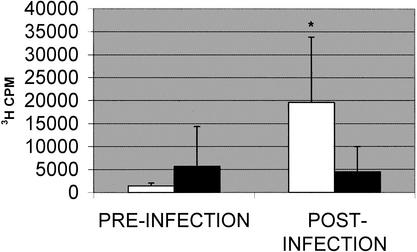
Antigen-induced proliferation of peripheral blood lymphocytes. Proliferative response to heat-killed L. monocytogenes strain 12443 was measured by [3H]thymidine incorporation after 72 h of culture. Bars represent the mean responses ± standard errors of results for animals with normal pregnancy outcomes (filled bars; number of samples, 5) or stillbirths (empty bars; number of samples, 4). Proliferation responses were measured in samples collected immediately prior to infection and approximately 30 days after stillbirth or normal outcome of pregnancy. An asterisk indicates a result that is significantly different from the preinfection level at a P value of <0.05.
References
-
- Anderson, D. C., and H. M. McClure. 1993. Listeriosis, p. 135-141. In T. C. Jones, U. Mohr, and L. D. Hunt (ed.), Nonhuman primates, vol. I. Monograph on pathology of laboratory animals. Springer-Verlag, New York, N.Y.
-
- Bula, C. J., J. Bille, and M. P. Glauser. 1995. An epidemic of food-borne listeriosis in western Switzerland: description of 57 cases involving adults. Clin. Infect. Dis. 20:66-72. - PubMed
-
- Centers for Disease Control and Prevention. 1998. Multistate outbreak of listeriosis—United States, 1998. Morb. Mortal. Wkly. Rep. 47:1085-1086. - PubMed
-
- Chalifoux, L. V., and E. M. Hajema. 1981. Septicemia and meningoencephalitis caused by Listeria monocytogenes in neonatal Macaca fascicularis. J. Med. Primatol. 10:336-339. - PubMed
-
- Cook, L. V. 1998. Isolation and identification of Listeria monocytogenes from red meat, poultry, egg and environmental samples, Sect. 8.1-8.9. In B. P. Dey and C. P. Lattuada (ed.), USDA/FSIS microbiology laboratory guide book. Food Safety and Inspection Service, U.S. Department of Agriculture, Washington, D.C.
Publication types
MeSH terms
Substances
Grants and funding
LinkOut - more resources
Full Text Sources
Medical
