


Active-site residues of Escherichia coli DNA gyrase required in coupling ATP hydrolysis to DNA supercoiling and amino acid substitutions leading to novobiocin resistance
- PMID: 12604539
- PMCID: PMC149296
- DOI: 10.1128/AAC.47.3.1037-1046.2003
Active-site residues of Escherichia coli DNA gyrase required in coupling ATP hydrolysis to DNA supercoiling and amino acid substitutions leading to novobiocin resistance
Abstract
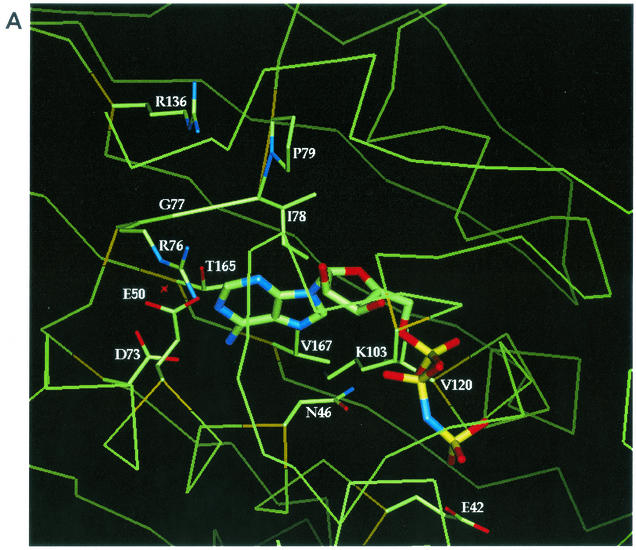
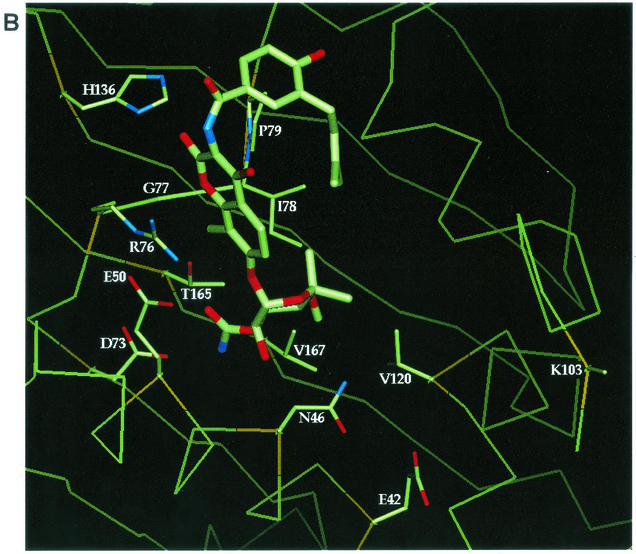
DNA gyrase is a bacterial type II topoisomerase which couples the free energy of ATP hydrolysis to the introduction of negative supercoils into DNA. Amino acids in proximity to bound nonhydrolyzable ATP analog (AMP. PNP) or novobiocin in the gyrase B (GyrB) subunit crystal structures were examined for their roles in enzyme function and novobiocin resistance by site-directed mutagenesis. Purified Escherichia coli GyrB mutant proteins were complexed with the gyrase A subunit to form the functional A(2)B(2) gyrase enzyme. Mutant proteins with alanine substitutions at residues E42, N46, E50, D73, R76, G77, and I78 had reduced or no detectable ATPase activity, indicating a role for these residues in ATP hydrolysis. Interestingly, GyrB proteins with P79A and K103A substitutions retained significant levels of ATPase activity yet demonstrated no DNA supercoiling activity, even with 40-fold more enzyme than the wild-type enzyme, suggesting that these amino acid side chains have a role in the coupling of the two activities. All enzymes relaxed supercoiled DNA to the same extent as the wild-type enzyme did, implying that only ATP-dependent reactions were affected. Mutant genes were examined in vivo for their abilities to complement a temperature-sensitive E. coli gyrB mutant, and the activities correlated well with the in vitro activities. We show that the known R136 novobiocin resistance mutations bestow a significant loss of inhibitor potency in the ATPase assay. Four new residues (D73, G77, I78, and T165) that, when changed to the appropriate amino acid, result in both significant levels of novobiocin resistance and maintain in vivo function were identified in E. coli.
Figures
References
-
- Akasaka, T., M. Tanaka, A. Yamaguchi, and K. Sato. 2001. Type II topoisomerase mutation in fluoroquinolone-resistant clinical strains of Pseudomonas aeruginosa isolated in 1998 and 1999: role of target enzyme in mechanism of fluoroquinolone resistance. Antimicrob. Agents Chemother. 45:2263-2268. - PMC - PubMed
-
- Ali, J. A., A. P. Jackson, A. J. Howells, and A. Maxwell. 1993. The 43-kilodalton N-terminal fragment of the DNA gyrase B protein hydrolyzes ATP and binds coumarin drugs. Biochemistry 32:2717-2724. - PubMed
-
- Brino, L., A. Urzhumtsev, M. Mousli, C. Bronner, A. Mitschler, P. Oudet, and D. Moras. 2000. Dimerization of Escherichia coli DNA-gyrase B provides a structural mechanism for activating the ATPase catalytic center. J. Biol. Chem. 275:9468-9475. - PubMed
-
- Contreras, A., and A. Maxwell. 1992. GyrB mutations which confer coumarin resistance also affect DNA supercoiling and ATP hydrolysis by Escherichia coli DNA gyrase. Mol. Microbiol. 6:1617-1624. - PubMed
MeSH terms
Substances
LinkOut - more resources
Full Text Sources
Medical
Miscellaneous
