


doi: 10.1128/AAC.47.3.1169-1172.2003.
A new sulfonamide resistance gene (sul3) in Escherichia coli is widespread in the pig population of Switzerland
Affiliations
- PMID: 12604565
- PMCID: PMC149312
- DOI: 10.1128/AAC.47.3.1169-1172.2003
Item in Clipboard
A new sulfonamide resistance gene (sul3) in Escherichia coli is widespread in the pig population of Switzerland
Antimicrob Agents Chemother.
2003 Mar.
Abstract
A new gene, sul3, which specifies a 263-amino-acid protein similar to a dihydropteroate synthase encoded by the 54-kb conjugative plasmid pVP440 from Escherichia coli was characterized. Expression of the cloned sul3 gene conferred resistance to sulfamethoxazole on E. coli. Two copies of the insertion element IS15Delta/26 flanked the region containing sul3. The sul3 gene was detected in one-third of the sulfonamide-resistant pathogenic E. coli isolates from pigs in Switzerland.
Figures
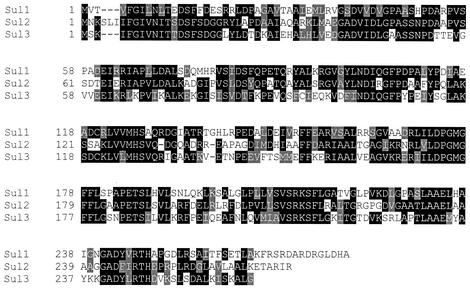
Alignment of the amino acid sequence of the DHPSs Sul1, Sul2, and Sul3, conferring sulfonamide resistance. Sul1, DHPS of E. coli plasmid R388 (GenBank accession no. AF071413); Sul2, DHPS of S. enterica subsp. enterica plasmid pHCM1 (AL513383); Sul3, DHPS of E. coli plasmid pVP440 (AJ459418). The identical and similar amino acids are shaded black and gray, respectively.
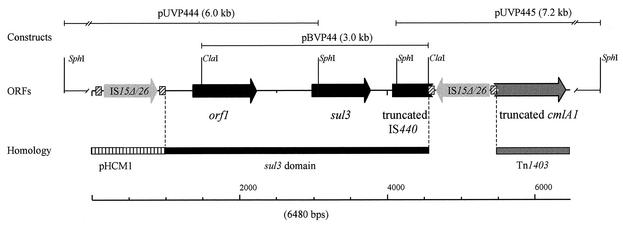
Organization of the region from plasmid pVP440 containing the sulfonamide resistance gene sul3. The sul3 domain and the pHCM1-like and Tn1403-like sequences are labeled; the different domains are separated with vertical dotted lines. The open reading frames (ORFs) of the sul3 domain are represented by black arrows (orf1, putative oxidoreductase gene; sul3, sulfonamide-resistant DHPS gene, IS440, truncated putative insertion element) and the ORF of the truncated cmlA1 gene (chloramphenicol efflux gene) is represented by a gray arrow. The two copies of the insertion sequence IS15Δ/26 are represented by gray arrows, with inverted repeats indicated by hatched squares. The fragments of pVP440 that were cloned into pUC19 (pUVP444 and pUVP445) and into pBluescript II SK(−) (pBVP44) and used for sequence analysis are depicted by narrow lines.
References
-
- George, A. M., and R. M. Hall. 2002. Efflux of chloramphenicol by the CmlA1 protein. FEMS Microbiol. Lett. 209:209-213. - PubMed
-
- Huang, X., and W. Miller. 1991. A time-efficient, linear-space local similarity algorithm. Adv. Appl. Math. 12:337-357.
-
- Huovinen, P. 2001. Resistance to trimethoprim-sulfamethoxazole. Clin. Infect. Dis. 32:1608-1614. - PubMed
Publication types
MeSH terms
Substances
Associated data
- Actions
- Actions
- Actions
- Actions
LinkOut - more resources
Full Text Sources
Other Literature Sources
Medical
