. 2003 Apr 1;118A(1):35-42.
doi: 10.1002/ajmg.a.10011.

Novel missense mutations and a 288-bp exonic insertion in PAX9 in families with autosomal dominant hypodontia

Affiliations

Novel missense mutations and a 288-bp exonic insertion in PAX9 in families with autosomal dominant hypodontia

Parimal Das et al. Am J Med Genet A. .

Abstract

We describe the molecular analysis of three families with hypodontia involving primarily molar teeth and report two novel mutational mechanisms. Linkage analysis of two large families revealed that the hypodontia was linked to the PAX9 locus. These two families revealed missense mutations consisting of a glutamic acid substitution for lysine and a proline substitution for leucine within the paired domain of PAX9. A pair of identical twins affected with hypodontia in a third family demonstrated a 288-bp insertion within exon 2 that resulted in a putative frameshift mutation and a premature stop codon. The insertion was associated with the loss of 7-bp from exon 2. A block of 256-bp of sequence within the insertion was completely identical to downstream sequence from the second intron of the PAX9 gene. These studies extend the spectrum of mutations in PAX9 associated with hypodontia to include heretofore undescribed categories, including missense mutations.


Figures

Fig. 1.
Fig. 1.
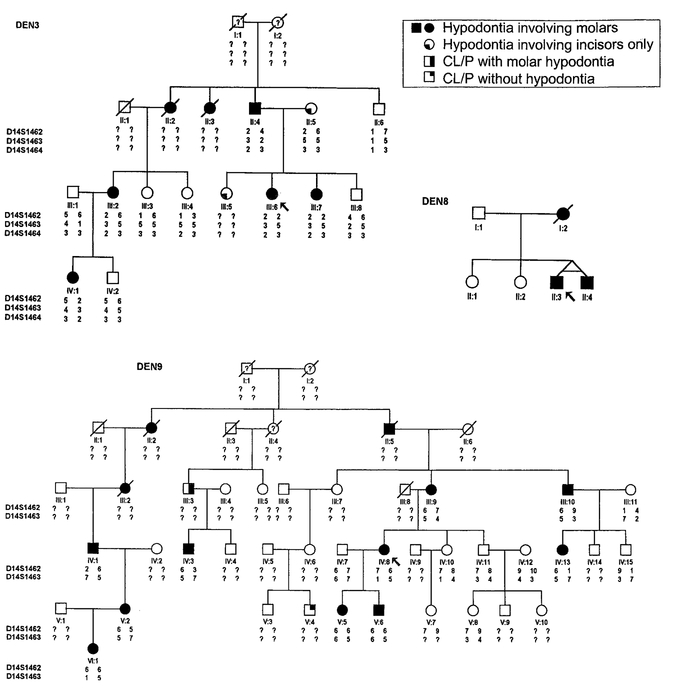
Pedigrees of hypodontia kindreds DEN3, DEN8, and DEN9 with haplotypes for markers linked to the PAX9 locus. Note that individuals II:5 and III:5 in family DEN3 are missing incisors, which represent a different class of hypodontia. CL/P: cleft lip with cleft palette.
Fig. 2.
Fig. 2.
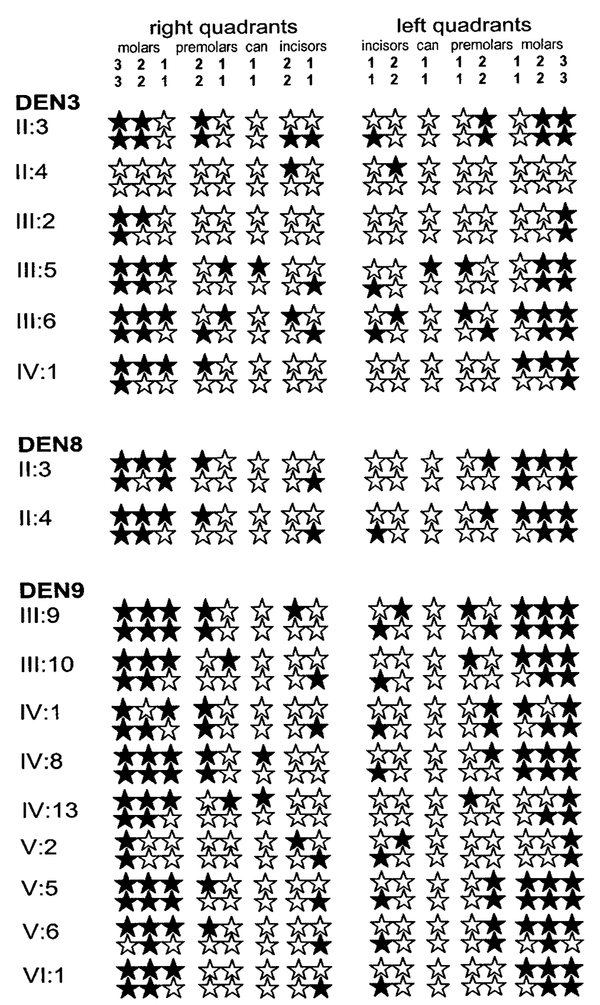
Clinical phenotypes of affected individuals in pedigrees DEN3, DEN8, and DEN9. Filled stars represent congenitally missing teeth.
Fig. 3.
Fig. 3.
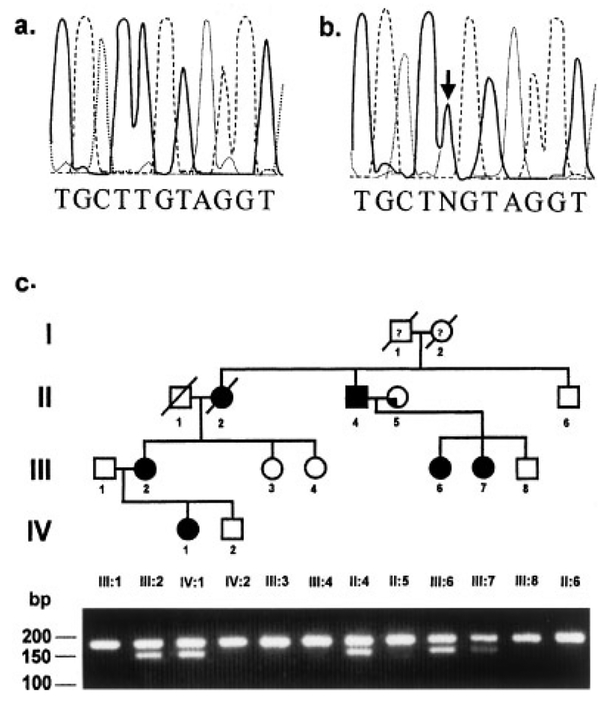
DNA sequence chromatograms from a control (a) and an affected individual (b) from pedigree DEN3 showing the point mutation in exon 2 of the PAX9 gene on the non-coding strand. c: Segregation of the mutation in family DEN3. An allele-specific PCR test was developed by substituting a C for a T 4-bp upstream from the mutation in the forward primer, hPAX9K91EF. This mutation in combination with the mutation in DEN3 created a cleavage site for BsrBI. The primers hPAX9K91EF and hPAX9K91ER were used to amplify a 179-bp product containing the mutation. Digestion with BsrBI resulted in a 149-bp fragment and a 30-bp fragment (not visible) in addition to a 179-bp fragment representing the wild-type allele in affected individuals.
Fig. 4.
Fig. 4.
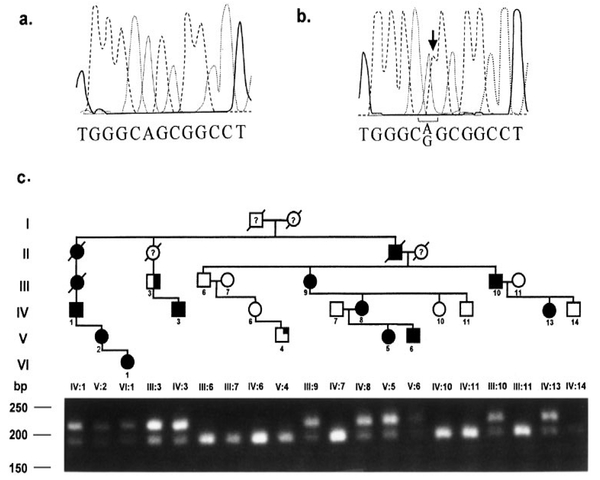
DNA sequence chromatograms from a control (a) and an affected individual (b) from pedigree DEN9 showing the point mutation in exon 2 of the PAX9 gene on the non-coding strand. c: Segregation of the mutation in DEN9. The mutation in DEN9 destroyed a cleavage site for MspA1. Amplification of a 214-bp PCR product with primers hPAX9ex2a2F and hPAX9ex2a1R was followed by digestion with MspA1. Digestion of the product with MspA1 resulted in a 189-bp product and a 25-bp product (not visible) in unaffected individuals.
Fig. 5.
Fig. 5.
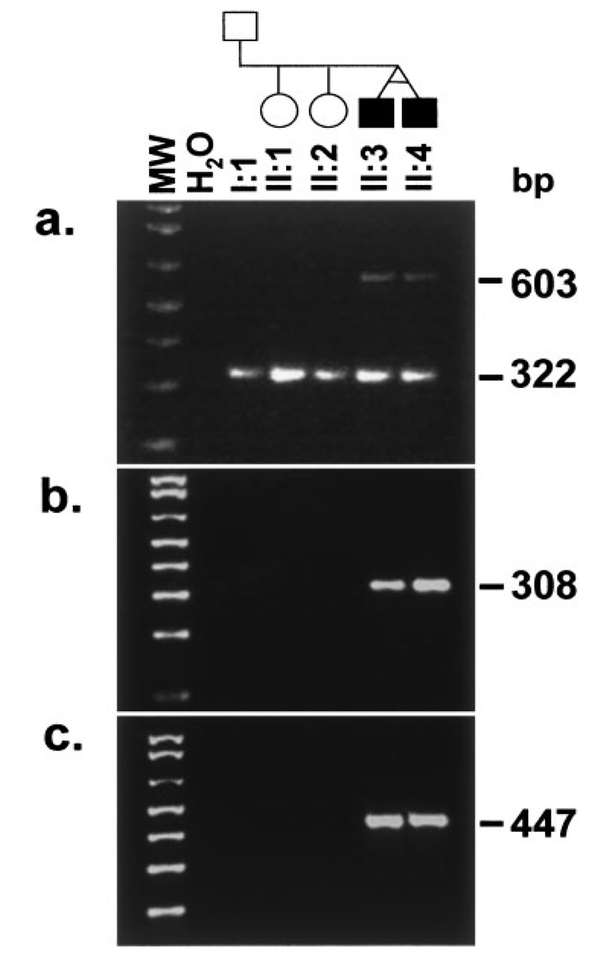
An insertion within exon 2 in family DEN8. a: Amplification of a subfragment of exon 2 with primers hPAX9ex2a2F and hPAX9ex2a1R resulted in the expected 322-bp fragment and a novel 603-bp additional fragment only in the affected twin brothers II:3 and II:4 in family DEN8. b: The large fragment was sequenced and a 288-bp insertion detected (see Fig. 6). Primers, hPAX9InsF1 and hPAX9InsR, were designed to span the 5′and 3′ junctions of the insertion. Amplification with these primers resulted in a 308-bp fragment only in the affected brothers. c: Amplification with hPAX9ex2a2F and hPAX9InsR resulted in a 447-bp fragment only in II;3 and II:4.
Fig. 6.
Fig. 6.
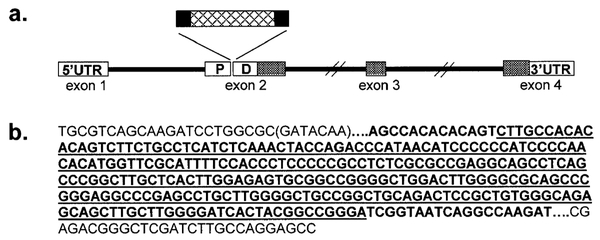
a: Schematic diagram showing the insertion within the sequence of the paired domain (PD) of PAX9 in family DEN8. The hatched region within the insertion depicts sequence that has complete homology with sequence from intron 2. b: Sequence of a portion of PAX9 exon 2 showing the inserted sequence. The exonic sequence is in plain type and the inserted sequence is in bold. The exonic sequence deleted during the insertion process is in parentheses. The junctions are identified by a series of dots. The underlined 256-bp sequence bore sequence homology to sequence from the second intron.
Fig. 7.
Fig. 7.
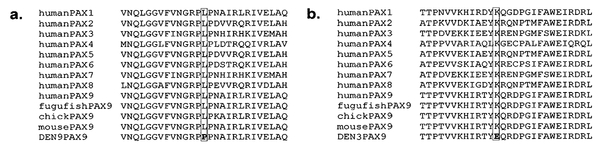
Comparison of the sequence of a portion of the paired domain region from all human PAX family of proteins and PAX9 proteins from various species with the PAX9 mutant sequence from family DEN9 (a) and family DEN3 (b).

References

    1. Arte S, Nieminen P, Pirinen S, Thesleff I, Peltonen L. 1996. Gene defect in hypodontia: Exclusion of EGF, EGFR, and FGF-3 as candidate genes. J Dent Res 76:1346–1352. - PubMed
    1. Cottingham RW, Idury RM, Schaffer AA. 1993. Faster sequential genetic linkage computations. Am J Hum Genet 53:252–263. - PMC - PubMed
    1. Das P, Stockton DW, Bauer C, Shaffer LG, D’Souza RN, Wright JT, Patel PI. 2002. Haploinsufficiency of PAX9 is associated with autosomal dominant hypodontia. Hum Genet 110:371–376. - PubMed
    1. Frazier-Bowers SA, Guo DC, Cavender A, Xue L, Evans B, King T, Milewicz D, D’Souza RN. 2002. A novel mutation in human PAX9 causes molar oligodontia. J Dent Res 81:129–133. - PubMed
    1. Jumlongras D, Bei M, Stimson JM, Wang WF, DePalma SR, Seidman CE, Felbor U, Maas R, Seidman JG, Olsen BR. 2001. A nonsense mutation in MSX1 causes Witkop syndrome. Am J Hum Genet 69:67–74. - PMC - PubMed

Publication types

LinkOut - more resources