. 2003 Mar 4;100(5):2501-6.
doi: 10.1073/pnas.0538029100. Epub 2003 Feb 26.

Lineage-restricted retention of a primitive immunoglobulin heavy chain isotype within the Dipnoi reveals an evolutionary paradox

Affiliations

Lineage-restricted retention of a primitive immunoglobulin heavy chain isotype within the Dipnoi reveals an evolutionary paradox

Tatsuya Ota et al. Proc Natl Acad Sci U S A. .

Abstract

The lineage leading to lungfishes is one of the few major jawed vertebrate groups in which Ig heavy chain isotype structure has not been investigated at the genetic level. In this study, we have characterized three different Ig heavy chain isotypes of the African lungfish, Protopterus aethiopicus, including an IgM-type heavy chain and short and long forms of non-IgM heavy chains. Northern blot analysis as well as patterns of V(H) utilization suggest that the IgM and non-IgM isotypes are likely encoded in separate loci. The two non-IgM isotypes identified in Protopterus share structural features with the short and long forms of IgX/W/NARC (referred to hereafter as IgW), which were previously considered to be restricted to the cartilaginous fish. It seems that the IgW isotype has a far broader phylogenetic distribution than considered originally and raises questions with regard to the origin and evolutionary divergence of IgM and IgW. Moreover, its absence in other gnathostome lineages implies paradoxically that the IgW-type genes were lost from teleost and tetrapod lineages.


Figures
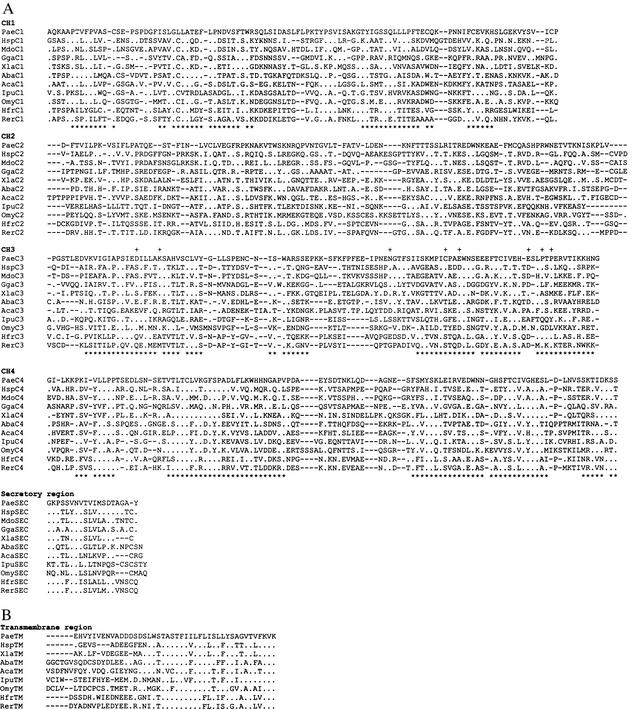
Figure 1
Figure 1
(A) Amino acid alignment of 11 vertebrate Cμ secretory sequences. Sequences were from GenBank: African lungfish (Pae), P. aethiopicus (this study, clone 27); human (Hsp), Homo sapiens (X57086); short-tailed opossum (Mdo), Monodelphis domestica (AF108226); chicken (Gga), Gallus gallus (X01613); African clawed frog (Xla), Xenopus laevis (M20484); sturgeon (Aba), Acipenser baeri (Y13253); bowfin (Aca), Amia calva (U12456); channel catfish (Ipu), Ictalurus punctatus (M27230); rainbow trout (Omy), Oncorhynchus mykiss (S63348); horned shark (Hfr), Heterodontus francisci (X07784); little skate (Rer), Raja erinacea (M29679). Periods indicate identical residue with African lungfish residue; dashes indicate gaps. +, residues important for complement activation. *, Residues used for subsequent phylogenetic analyses. (B) Amino acid sequences of eight vertebrate Cμ transmembrane regions: Pae (this study, clone 24), Hsp (PIR, S14683), Xla (X90768), Aba (AJ245364), Ipu (X52617), Omy (U04616), Hfr (X07785), and Rer (M29678). The sequence for Amia calva was taken from Wilson et al. (35). The transmembrane regions of human, lungfish, shark, and skate IgM heavy chain are anchored at the end of the CH4 domain, whereas those of channel catfish and rainbow trout are anchored at the end of the CH3 domain. The transmembrane region of bowfin IgH heavy chain can be anchored at the end of CH4, the end of CH3, or the middle of the CH3 domain, whereas the sturgeon transmembrane region seems to be anchored at the end of either the CH1 (AJ245363) or the CH4 (AJ245362) domain.
Figure 2
Figure 2
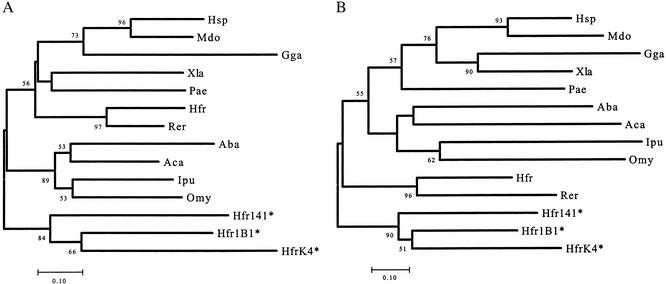
(A) Neighbor-joining tree for CH4 domains of IgM heavy chain. Pairwise genetic distances were obtained by Poisson correction. Three horn shark light chain sequences (HfrK4, Hfr1B1, Hfr141; ref. and references therein) were used as outgroups and are indicated by asterisks. The number given in each branch is a bootstrap value; bootstrap values <50% are not shown. The branch lengths are measured in terms of the number of amino acid substitutions, with the scale given below the tree. (B) Neighbor-joining tree for IgM heavy chain CH3 domains. Abbreviations for the taxa are given in Fig. 1.
Figure 3
Figure 3
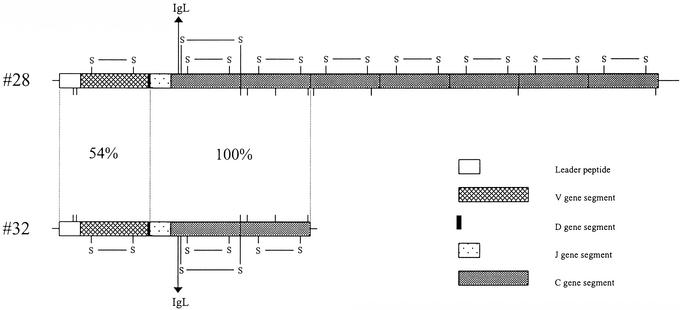
Long form (clone 28) and short form (clone 32) of IgW-like heavy chains. Vertical lines indicate sulfhydryl groups of cysteine residues, which can form interchain disulfide bridges. Potential intrachain disulfide bridges are indicated by S–S bridges. The numbers shown are the proportions of nucleotide identity at the V–D region and the J–C region.
Figure 4
Figure 4
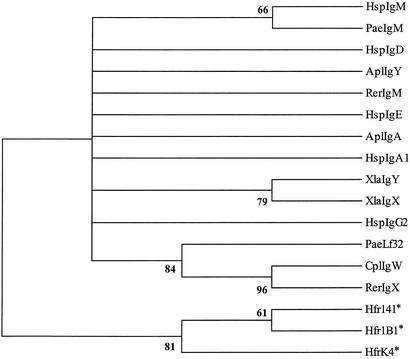
Bootstrap consensus tree for CH1 domains of IgH. Pairwise genetic distances were estimated by Poisson correction, and the phylogenetic tree was constructed by the neighbor-joining method. Sequences were from GenBank or the Protein Information Resource: human (Hsp), H. sapiens IgA1(J00220), IgD (PIR:AAB21246), IgE (J00222), IgG2 (J00230), and IgM (X57086), duck (Apl), Anas platyrhyncos IgY (X65219) and IgA (U27222); African clawed frog (Xla), X. laevis IgX (PIR:S03186) and IgY (X15114); African lungfish (Pae), Protopterus aethiopicus IgM (this study, clone 27) and Lf32 (this study, clone 32); carcharhine shark (Cpl), Carcharhinus plumbeus (U40560); and little skate (Rer), R. erinacea (PIR:S12839). Three horn shark light chain sequences (HfrK4, Hfr1B1, and Hfr141) (ref. and references therein) were used as outgroups and are denoted by asterisks.
Figure 5
Figure 5
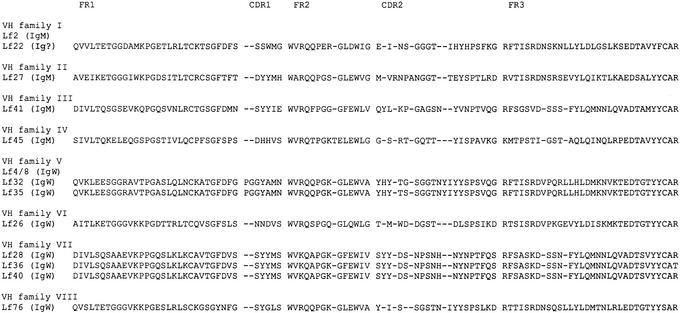
Inferred amino acid sequences of the VH regions of P. aethiopicus clones. FR, framework region; CDR, complementarity-determining region. VH regions of clone 2 were designated VHI; clones 4 and 8 were designated VHV. IgH-type was confirmed by success/failure of PCR with using CH1 primers unique to IgM or IgW isotypes. The isotype designation of clone 22 was not of the IgM or IgW type (unpublished data).
Figure 6
Figure 6
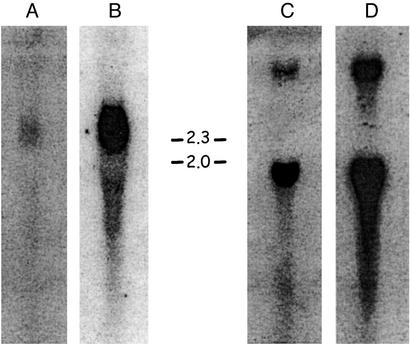
Northern blot analysis of two different isotypes suggests differential usage of VH and CH genes. Probes complementing the VH and CH regions of clones 2 (IgM-type) and 8 (IgW-type) were hybridized as described. (A) Hybridization of VH of clone 2. (B) Hybridization of CH of clone 2. (C) Hybridization of VH of clone 8. (D) Hybridization of CH of clone 8. Sizes are in kb.

References

    1. Carroll R L. Vertebrate Paleontology and Evolution. New York: Freeman; 1988.
    1. Helfman G S, Collette B B, Facey D E. The Diversity of Fishes. Oxford: Blackwell; 1997.
    1. Meyer A, Wilson A C. J Mol Evol. 1990;31:359–364. - PubMed
    1. Meyer A, Dolven S I. J Mol Evol. 1992;35:102–113. - PubMed
    1. Marshall C, Schultze H P. J Mol Evol. 1992;35:93–101. - PubMed

Publication types

LinkOut - more resources