


Potential role for CD63 in CCR5-mediated human immunodeficiency virus type 1 infection of macrophages
- PMID: 12610138
- PMCID: PMC149503
- DOI: 10.1128/jvi.77.6.3624-3633.2003
Potential role for CD63 in CCR5-mediated human immunodeficiency virus type 1 infection of macrophages
Abstract
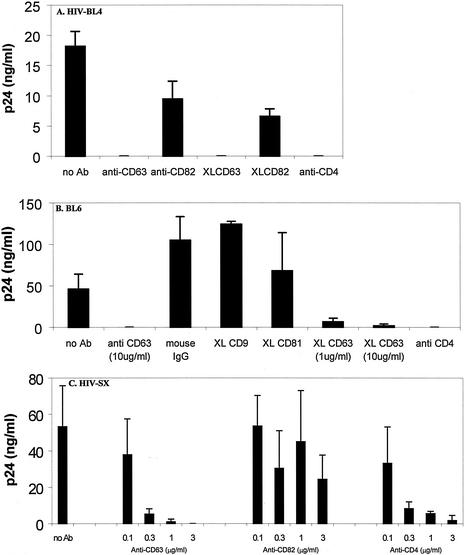
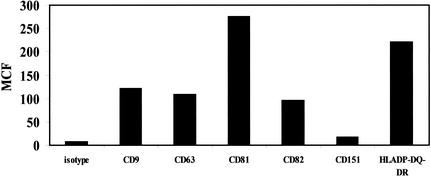
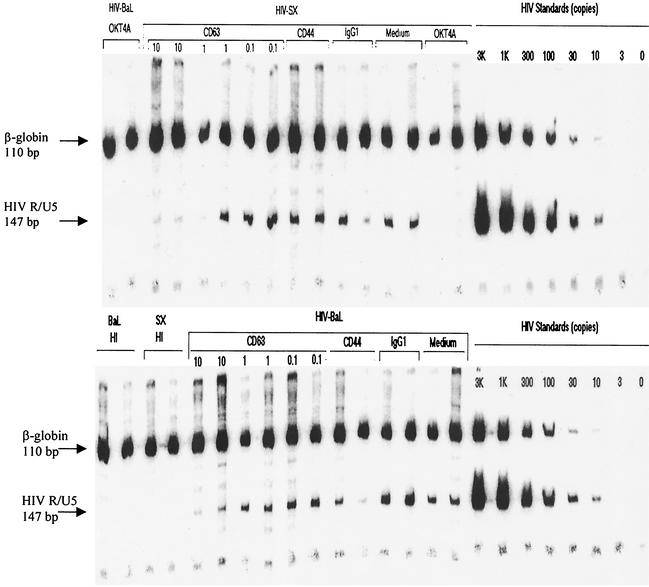
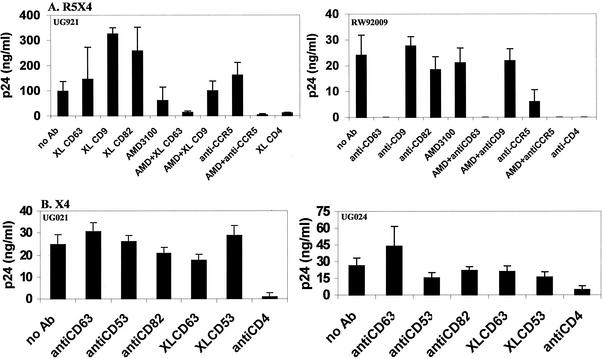
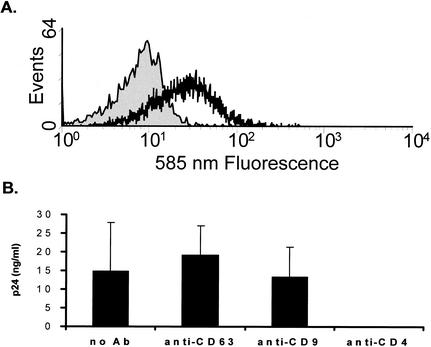
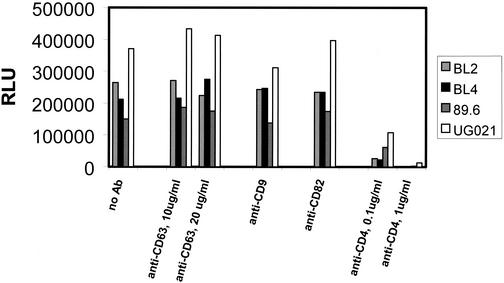
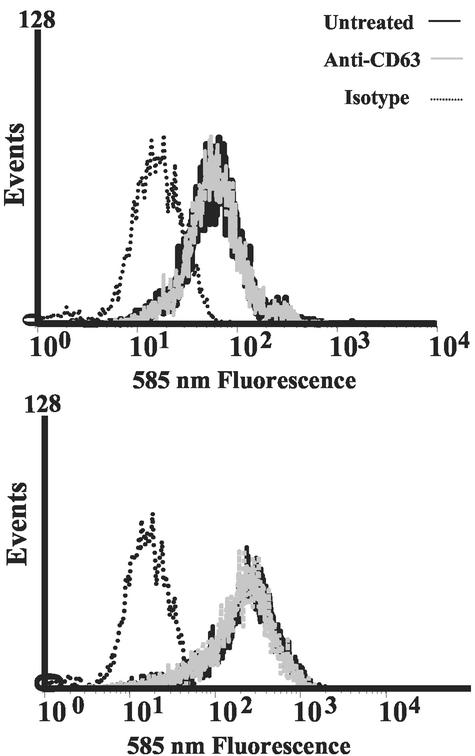
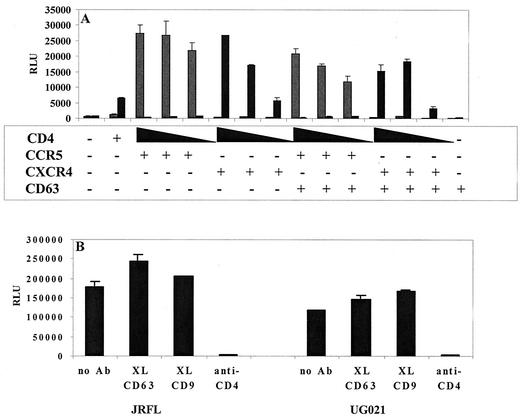
Macrophages and CD4(+) lymphocytes are the principal target cells for human immunodeficiency virus type 1 (HIV-1) infection, but the molecular details of infection may differ between these cell types. During studies to identify cellular molecules that could be involved in macrophage infection, we observed inhibition of HIV-1 infection of macrophages by monoclonal antibody (MAb) to the tetraspan transmembrane glycoprotein CD63. Pretreatment of primary macrophages with anti-CD63 MAb, but not MAbs to other macrophage cell surface tetraspanins (CD9, CD81, and CD82), was shown to inhibit infection by several R5 and dualtropic strains, but not by X4 isolates. The block to productive infection was postfusion, as assessed by macrophage cell-cell fusion assays, but was prior to reverse transcription, as determined by quantitative PCR assay for new viral DNA formation. The inhibitory effects of anti-CD63 in primary macrophages could not be explained by changes in the levels of CD4, CCR5, or beta-chemokines. Infections of peripheral blood lymphocytes and certain cell lines were unaffected by treatment with anti-CD63, suggesting that the role of CD63 in HIV-1 infection may be specific for macrophages.
Figures
Similar articles
-
Recombinant extracellular domains of tetraspanin proteins are potent inhibitors of the infection of macrophages by human immunodeficiency virus type 1.J Virol. 2006 Jul;80(13):6487-96. doi: 10.1128/JVI.02539-05. J Virol. 2006. PMID: 16775336 Free PMC article.
-
CD63 is not required for production of infectious human immunodeficiency virus type 1 in human macrophages.J Virol. 2008 May;82(10):4751-61. doi: 10.1128/JVI.02320-07. Epub 2008 Mar 5. J Virol. 2008. PMID: 18321974 Free PMC article.
-
A post-entry role for CD63 in early HIV-1 replication.Virology. 2011 Apr 10;412(2):315-24. doi: 10.1016/j.virol.2011.01.017. Epub 2011 Feb 26. Virology. 2011. PMID: 21315401 Free PMC article.
-
Biological parameters of HIV-1 infection in primary intestinal lymphocytes and macrophages.J Leukoc Biol. 2000 Sep;68(3):360-5. J Leukoc Biol. 2000. PMID: 10985252 Review.
-
The role of viral coreceptors and enhanced macrophage tropism in human immunodeficiency virus type 1 disease progression.Sex Health. 2004;1(1):23-34. doi: 10.1071/sh03006. Sex Health. 2004. PMID: 16335478 Review.
Cited by
-
Infectious HIV-1 assembles in late endosomes in primary macrophages.J Cell Biol. 2003 Aug 4;162(3):443-55. doi: 10.1083/jcb.200304008. Epub 2003 Jul 28. J Cell Biol. 2003. PMID: 12885763 Free PMC article.
-
Recombinant extracellular domains of tetraspanin proteins are potent inhibitors of the infection of macrophages by human immunodeficiency virus type 1.J Virol. 2006 Jul;80(13):6487-96. doi: 10.1128/JVI.02539-05. J Virol. 2006. PMID: 16775336 Free PMC article.
-
Gamma-interferon-inducible, lysosome/endosome-localized thiolreductase, GILT, has anti-retroviral activity and its expression is counteracted by HIV-1.Oncotarget. 2016 Nov 1;7(44):71255-71273. doi: 10.18632/oncotarget.12104. Oncotarget. 2016. PMID: 27655726 Free PMC article.
-
Tetraspanins in viral infections: a fundamental role in viral biology?J Virol. 2005 Sep;79(17):10839-51. doi: 10.1128/JVI.79.17.10839-10851.2005. J Virol. 2005. PMID: 16103137 Free PMC article. Review. No abstract available.
-
Formation of syncytia is repressed by tetraspanins in human immunodeficiency virus type 1-producing cells.J Virol. 2009 Aug;83(15):7467-74. doi: 10.1128/JVI.00163-09. Epub 2009 May 20. J Virol. 2009. PMID: 19458002 Free PMC article.
References
-
- Alkhatib, G., C. Combadiere, C. C. Broder, Y. Feng, P. E. Kennedy, P. M. Murphy, and E. A. Berger. 1996. CC CKR5: a RANTES, MIP-1α, MIP-1β receptor as a fusion cofactor for macrophage-tropic HIV-1. Science 272:1955-1958. - PubMed
-
- Bounou, S., J. E. Leclerc, and M. J. Tremblay. 2002. Presence of host ICAM-1 in laboratory and clinical strains of human immunodeficiency virus type 1 increases virus infectivity and CD4+-T-cell depletion in human lymphoid tissue, a major site of replication in vivo. J. Virol. 76:1004-1014. - PMC - PubMed
-
- Cantin, R., J. F. Fortin, and M. Tremblay. 1996. The amount of host HLA-DR proteins acquired by HIV-1 is virus strain- and cell type-specific. Virology 218:372-381. - PubMed
Publication types
MeSH terms
Substances
Grants and funding
LinkOut - more resources
Full Text Sources
Medical
Research Materials
Miscellaneous
