


doi: 10.1128/jvi.77.6.3846-3850.2003.
Human papillomavirus types 16, 31, and 58 use different endocytosis pathways to enter cells
Affiliations
- PMID: 12610160
- PMCID: PMC149499
- DOI: 10.1128/jvi.77.6.3846-3850.2003
Item in Clipboard
Human papillomavirus types 16, 31, and 58 use different endocytosis pathways to enter cells
J Virol.
2003 Mar.
Abstract
The early steps of the intracellular trafficking of human papillomavirus type 16 (HPV-16), -31, and -58 pseudovirions were studied by investigating the effects of drugs acting at defined points of endocytosis pathways on virus-like particle-mediated pseudoinfection by overexpression of a dominant-negative form of the Eps15 protein to inhibit clathrin-mediated endocytosis and by electron microscopy. The results obtained suggested the involvement of clathrin-mediated endocytosis in HPV-16 and HPV-58 entry and caveola-mediated endocytosis in HPV-31 entry.
Figures
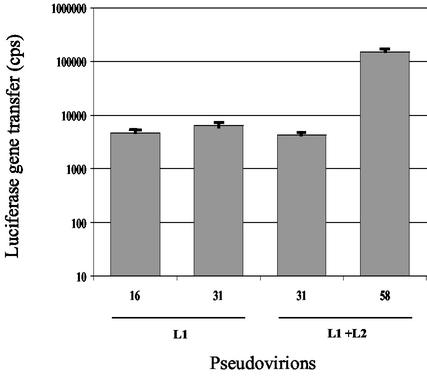
Gene transfer of HPV-16 and -31 L1 pseudovirions and HPV-31 and -58 L1-plus-L2 pseudovirions in COS-7 cells (results obtained using 5 μg of VLPs per well).
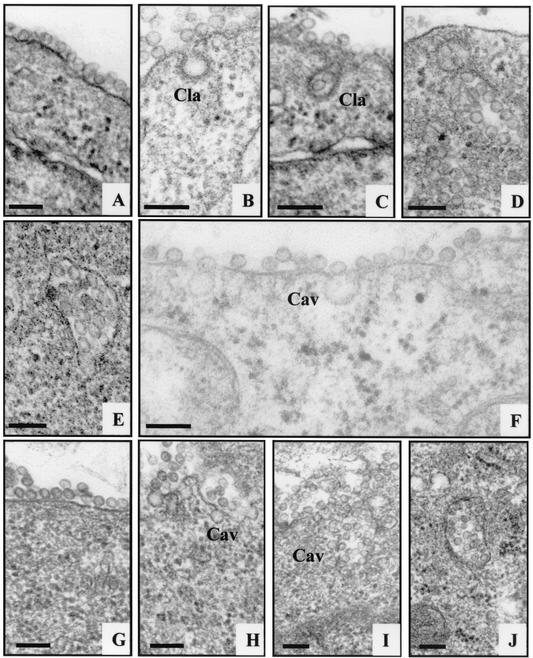
HPV-16 and HPV-31 cell internalization. HPV-16 VLPs (A to E) and HPV-31 VLPs (F to J) are shown. The electron micrographs show cells after incubation with VLPs at 4°C (A and G) and at 37°C for 10 min (B, F, and H), 20 min (C and I), and 1 h (D, E, and J). Bars, 150 nm. Cav, caveolae; Cla, clathrin-coated vesicles.
References
-
- Benmerah, A., M. Bayrou, N. Cerf-Bensussan, and A. Dautry-Varsat. 1999. Inhibition of clathrin-coated pit assembly by an Eps 15 mutant. J. Cell Sci. 112:1303-1311. - PubMed
-
- Combita, A. L., A. Touzé, L. Bousarghin, P.-Y. Sizaret, N. Munoz, and P. Coursaget. 2001. Gene transfer using human papillomavirus pseudovirions varies according to virus genotype and requires cell surface heparan sulfate. FEMS Microbiol. Lett. 204:183-188. - PubMed
Publication types
MeSH terms
Substances
LinkOut - more resources
Full Text Sources
Other Literature Sources
Miscellaneous
