


Linkage analysis of extremely discordant and concordant sibling pairs identifies quantitative-trait loci that influence variation in the human personality trait neuroticism
- PMID: 12612864
- PMCID: PMC1180351
- DOI: 10.1086/374178
Linkage analysis of extremely discordant and concordant sibling pairs identifies quantitative-trait loci that influence variation in the human personality trait neuroticism
Abstract
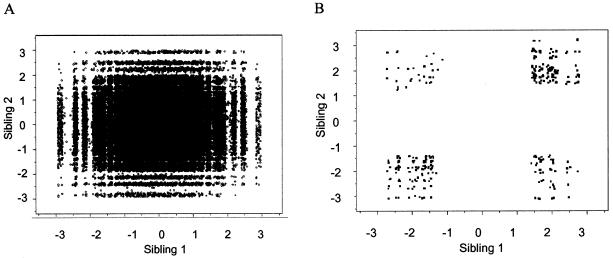
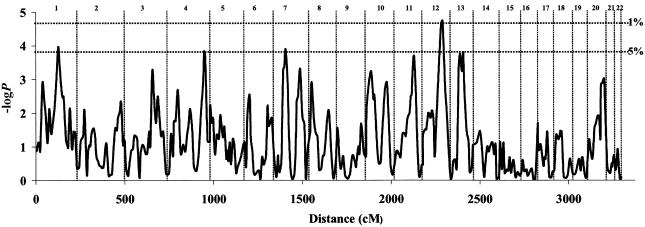
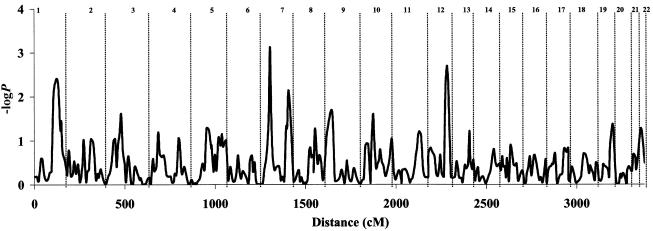
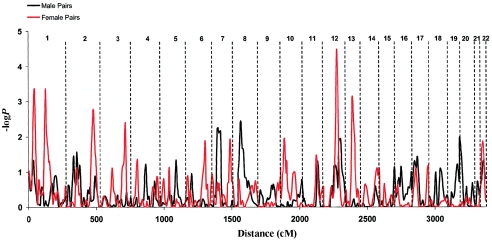
Several theoretical studies have suggested that large samples of randomly ascertained siblings can be used to ascertain phenotypically extreme individuals and thereby increase power to detect genetic linkage in complex traits. Here, we report a genetic linkage scan using extremely discordant and concordant sibling pairs, selected from 34,580 sibling pairs in the southwest of England who completed a personality questionnaire. We performed a genomewide scan for quantitative-trait loci (QTLs) that influence variation in the personality trait of neuroticism, or emotional stability, and we established genomewide empirical significance thresholds by simulation. The maximum pointwise P values, expressed as the negative logarithm (base 10), were found on 1q (3.95), 4q (3.84), 7p (3.90), 12q (4.74), and 13q (3.81). These five loci met or exceeded the 5% genomewide significance threshold of 3.8 (negative logarithm of the P value). QTLs on chromosomes 1, 12, and 13 are likely to be female specific. One locus, on chromosome 1, is syntenic with that reported from QTL mapping of rodent emotionality, an animal model of neuroticism, suggesting that some animal and human QTLs influencing emotional stability may be homologous.
Figures
References
Electronic-Database Information
-
- Jonathan Flint's Web Site, http://www.well.ox.ac.uk/flint/software.shtml (for Perl code)
References
-
- Abecasis GR, Cherny SS, Cookson WO, Cardon LR (2002) Merlin—rapid analysis of dense genetic maps using sparse gene flow trees. Nat Genet 30:97–101 - PubMed
-
- Amos CI, Krushkal J, Thiel TJ, Young A, Zhu DK, Boerwinkle E, de Andrade M (1997) Comparison of model-free linkage mapping strategies for the study of a complex trait. Genet Epidemiol 14:743–748 - PubMed
-
- Beavis WD (1998) QTL analyses: power, precision and accuracy. In: Paterson AH (ed) Molecular analysis of complex traits. CRC Press, Boca Raton, FL, pp 123–150
Publication types
MeSH terms
Substances
Grants and funding
LinkOut - more resources
Full Text Sources
Other Literature Sources
Medical
Research Materials
Miscellaneous
