. 2003 Mar;15(3):666-80.
doi: 10.1105/tpc.007575.

Mutational analysis of the pullulanase-type debranching enzyme of maize indicates multiple functions in starch metabolism

Affiliations

Mutational analysis of the pullulanase-type debranching enzyme of maize indicates multiple functions in starch metabolism

Jason R Dinges et al. Plant Cell. 2003 Mar.

Abstract

Plants contain two types of alpha(1-->6) glucan hydrolase (starch-debranching enzyme [DBE]). Mutations that affect the pullulanase-type DBE have not been described, although defects in isoamylase-type DBE, known in many plant species, indicate a function in starch biosynthesis. We describe a null mutation of a pullulanase-type DBE gene, a Mutator insertion in maize Zpu1. Plants homozygous for the zpu1-204 mutation are impaired in transient and storage starch degradation. Thus, hydrolytic activity of pullulanase-type DBE contributes to starch catabolism. Developing zpu1-204 endosperm accumulates branched maltooligosaccharides not found in the wild type and is deficient in linear maltooligosaccharides, indicating that the pullulanase-type DBE functions in glucan hydrolysis during kernel starch formation. Furthermore, in a background deficient in isoamylase-type DBE, zpu1-204 conditions a significant accumulation of phytoglycogen in the kernel that is not seen in the wild type. Therefore, pullulanase-type DBE partially compensates for the defect in isoamylase-type DBE, suggesting a function during starch synthesis as well as degradation.


Figures
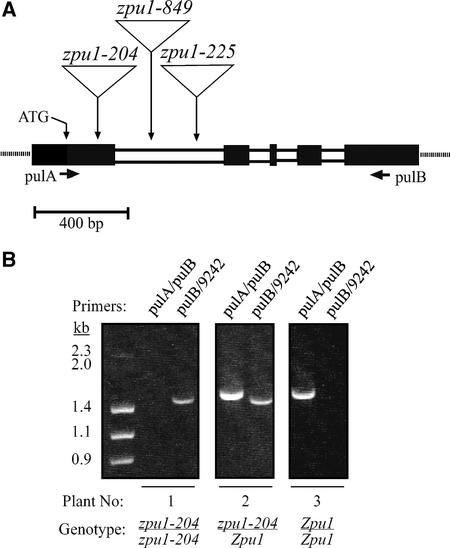
Figure 1.
Figure 1.
Molecular Structure of zpu1 Mutant Alleles. (A) Relative positions of Mu transposable elements within the Zpu1 gene. The allele zpu1-204 contains a Mu element in the first exon of the gene, downstream of the ATG start codon. The alleles zpu1-225 and zpu1-849 contain insertions in the first intron of the gene. The positions of the PCR primers pulA and pulB are indicated by arrows. Exons are indicated by black boxes. (B) Genotypes of plants were determined using PCR. The pulA/pulB primer pair amplifies the wild-type Zpu1 allele from genomic DNA (∼1.6 kb), whereas the pulB/9242 primer pair amplifies the mutant zpu1-204 allele (∼1.4 kb). Data from three representative plants are shown. Plant 1 is homozygous zpu1-204, plant 2 is heterozygous zpu1-204/Zpu1, and plant 3 is homozygous Zpu1.
Figure 2.
Figure 2.
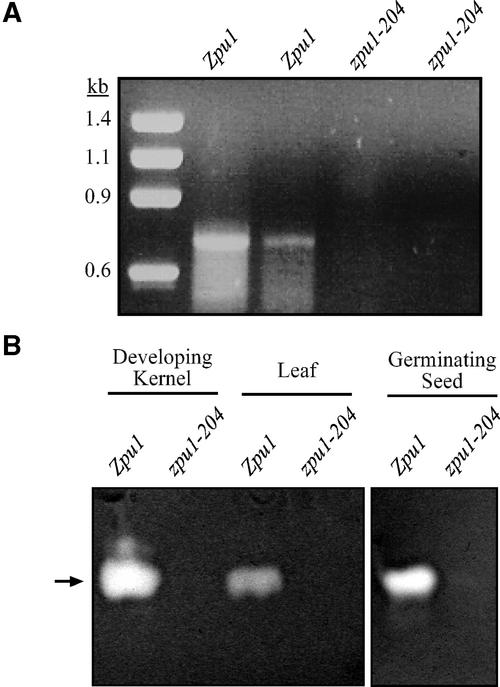
zpu1-204 Is a Null Allele. (A) Reverse transcriptase PCR was performed on total RNA isolated from kernels at 20 DAP using the pulA/pulB primer pair. Two independent samples from the wild type (lanes 1 and 2) and the zpu1-204 mutant (lanes 3 and 4) are shown. (B) Zymogram analysis of wild-type Zpu1 (W64A) and zpu1-204 developing kernels, leaves, and germinating seeds. Pullulanase activity (indicated by the arrow) was visualized by clearing of the pullulan azure substrate. Approximately 50 μg of sample was loaded in all cases, except for Zpu1 (W64A) germinating seeds, for which 25 μg of protein was loaded to reduce the intensity of the band.
Figure 3.
Figure 3.
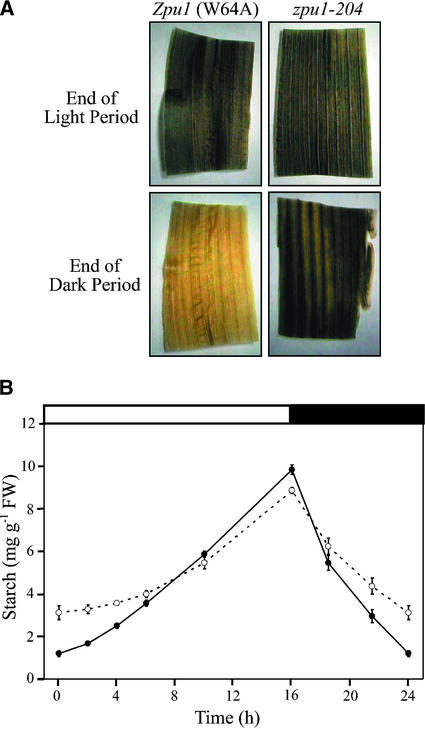
Leaf Starch Content during the Diurnal Cycle. (A) Leaves from Zpu1 (W64A) and the zpu1-204 mutant were harvested at the end of a 16-h light period and the end of an 8-h dark period, decolorized in boiling 80% (v/v) ethanol, and stained with I2/KI solution. A qualitative measure of starch amount is indicated by dark brown staining. (B) Starch was extracted from leaves of individual plants and quantified by measuring the Glc released after complete digestion with amyloglucosidase. Closed circles represent the wild type, and open circles represent zpu1-204. Each point represents the mean ± se of 15 plants. Where absent, error bars are smaller than the symbols. FW, fresh weight.
Figure 4.
Figure 4.
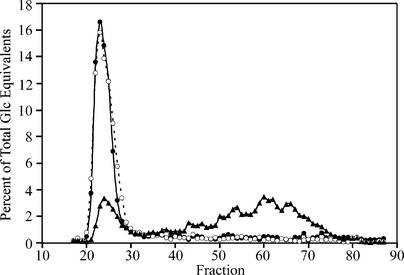
Sepharose CL2B Separation of Leaf Starch. Starch was extracted from leaves of wild-type W64A (closed circles, solid line), zpu1-204 (open circles, dashed line), and sbe2a::Mu (closed triangles, solid line) at the end of the photoperiod and applied to a 100-mL column. Fractions were eluted with 10 mM NaOH. Results shown are averages of two samples from each genotype. The data were normalized by dividing the amount of Glc equivalents in each fraction by the sum total of all fractions.
Figure 5.
Figure 5.
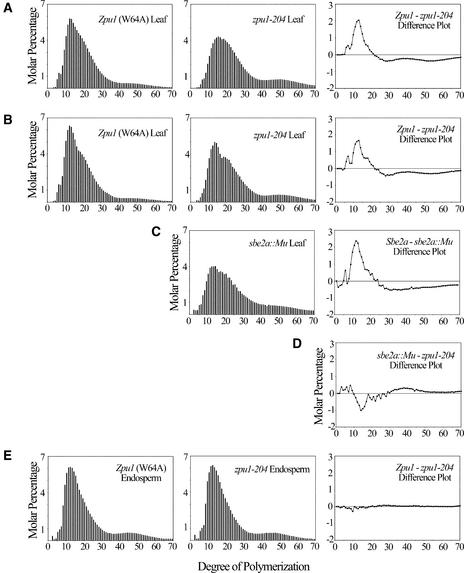
Chain Length Distribution of Amylopectin from Leaves and Endosperm. Amylopectin from pooled Sepharose CL2B chromatography fractions of endosperm and leaf starch was debranched with Pseudomonas amyloderamosa isoamylase. The reducing ends of the linear chains were labeled with the fluorophore 8-amino-1,3,6-pyrenetrisulfonic acid and separated by capillary electrophoresis. Individual chains were normalized to total peak area, and differences in chain lengths are shown in subtraction plots. Results shown are averages of four independent analyses. (A) and (B) Amylopectin from wild-type and zpu1-204 leaves harvested at the end of the photoperiod from growth chamber–grown (A) and field-grown (B) plants. (C) Chain length distribution of sbe2a::Mu leaf amylopectin (compared with the same wild-type profile shown in [B]). (D) Difference plot comparing the chain length distribution of zpu1-204 and sbe2a::Mu. (E) Amylopectin chain length distribution of wild-type and zpu1-204 endosperm at 20 DAP.
Figure 6.
Figure 6.
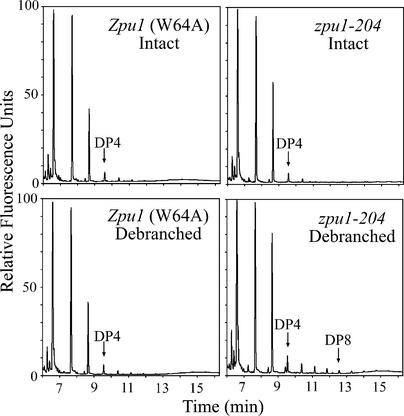
Analysis of WSP from zpu1-204 Endosperm. Water-soluble glucan was labeled with 8-amino-1,3,6-pyrenetrisulfonic acid and subjected to capillary electrophoresis before and after treatment with a mixture of bacterial pullulanase and isoamylase. The profile of Zpu1 WSP did not change significantly after debranching. However, the profile of zpu1-204 WSP showed a relative increase in chains of >3 Glc units, indicating the presence of small, branched polysaccharides. The DP of each peak was assigned by comparing the retention time with that of known standards.
Figure 7.
Figure 7.
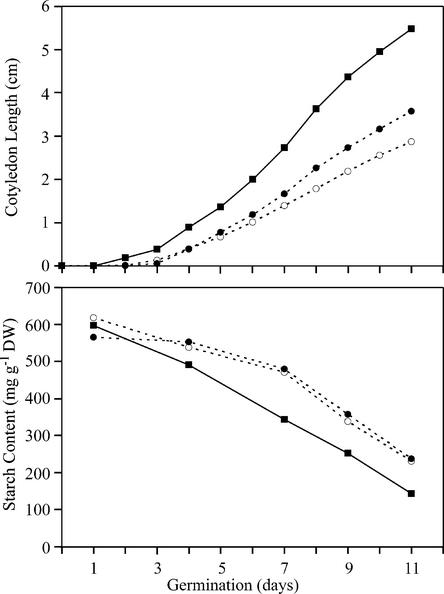
Germination Analysis of zpu1-204 Kernels. Kernels from Zpu1 (squares) and two different zpu1-204 homozygotes (circles) were germinated on moist filter paper at 30°C. The lengths of the cotyledons were measured on successive days during the incubation period (each point represents the mean of 15 cotyledons). Starch content in the germinating endosperm was determined by removing the roots and cotyledons from three kernels at each time point and measuring Glc equivalents of insoluble α-glucan polymer.
Figure 8.
Figure 8.
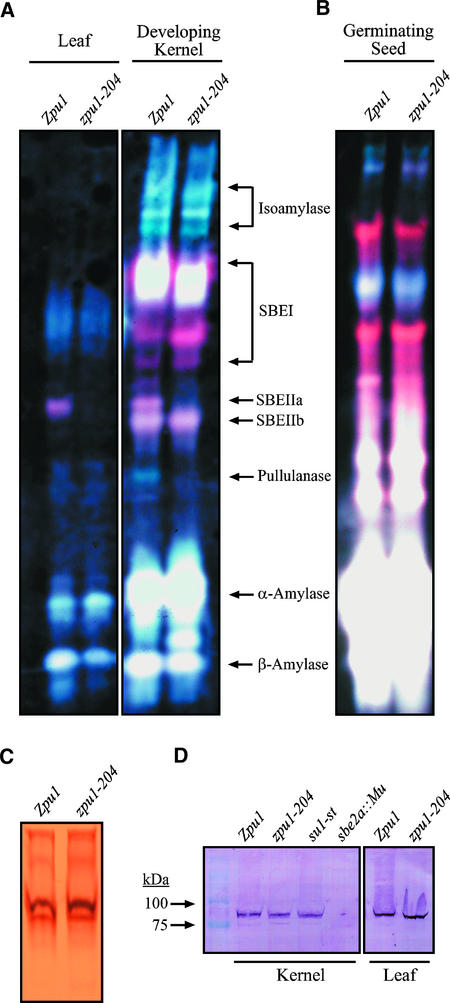
Activity Gel Analysis of Starch-Modifying Enzymes. (A) and (B) Approximately 100 μg of total protein extracts from wild-type W64A and zpu1-204 leaves (A), 20-DAP kernels (A), and germinating seeds (B) was separated on a 15-cm native polyacrylamide gel and electroblotted to a starch-containing gel. Starch-modifying enzyme activities were visualized by staining with I2/KI. (C) To detect starch synthase activities, total leaf extracts were separated on a native gel containing 0.2% glycogen, incubated for 16 h in the presence of ADP-Glc, and stained with iodine. (D) Immunoblot from SDS-PAGE of total protein extracts developed with antiserum against SBEIIa.
Figure 9.
Figure 9.
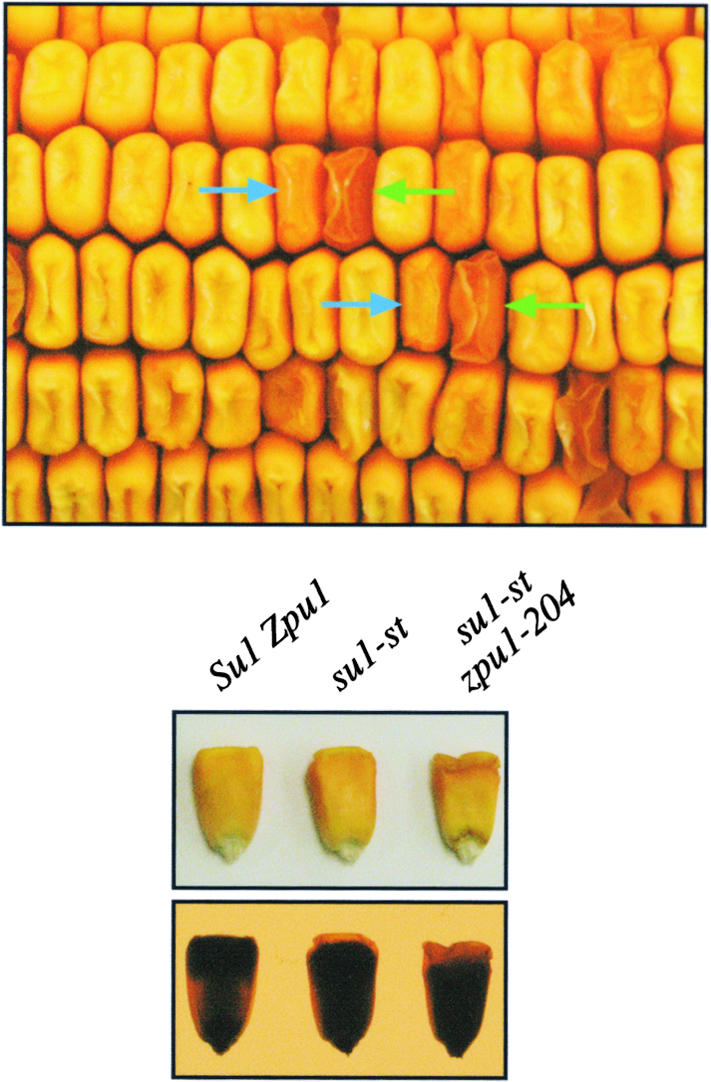
Synthetic Phenotypes of DBE Double Mutants. Crosses were made between zpu1-204 and the isoamylase-type DBE mutant su1-st. A portion of an ear resulting from the self-pollination of the double heterozygote is shown. Approximately three-sixteenths of the kernels possessed the su1-st phenotype (blue arrows), having a slightly wrinkled, translucent crown but an opaque, starchy central and basal region (observed in the side view of the kernels at bottom, as seen with overhead light and on a lightbox). A markedly more severe phenotype appeared in approximately one-sixteenth of the kernels (green arrows). These kernels were characterized by a more severe wrinkling of the crown, extending farther into the central region of the kernel, compared with su1-st homozygotes. PCR genotyping of these kernels indicated that they were homozygous for the zpu1-204 allele, but singly homozygous ears for this allele showed no phenotype.

References

    1. Ball, S., Guan, H.P., James, M., Myers, A., Keeling, P., Mouille, G., Buleon, A., Colonna, P., and Preiss, J. (1996). From glycogen to amylopectin: A model for the biogenesis of the plant starch granule. Cell 86, 349–352. - PubMed
    1. Beatty, M.K., Rahman, A., Cao, H., Woodman, W., Lee, M., Myers, A.M., and James, M.G. (1999). Purification and molecular genetic characterization of ZPU1, a pullulanase-type starch-debranching enzyme from maize. Plant Physiol. 119, 255–266. - PMC - PubMed
    1. Bensen, R.J., Johal, G.S., Crane, V.C., Tossberg, J.T., Schnable, P.S., Meeley, R.B., and Briggs, S.P. (1995). Cloning and characterization of the maize An1 gene. Plant Cell 7, 75–84. - PMC - PubMed
    1. Blauth, S.L., Kim, K.-N., Klucinec, J.D., Shannon, J.C., Thompson, D.B., and Guiltinan, M.J. (2002). Identification of Mutator insertional mutants of starch-branching enzyme 1 (sbe1) in Zea mays L. Plant Mol. Biol. 48, 287–297. - PubMed
    1. Blauth, S.L., Yao, Y., Klucinec, J.D., Shannon, J.C., Thompson, D.B., and Guiltinan, M.J. (2001). Identification of Mutator insertional mutants of starch-branching enzyme 2a (BEIIa) in corn. Plant Physiol. 125, 1396–1405. - PMC - PubMed

Publication types

Associated data

LinkOut - more resources