


Lung recruitment manoeuvres are effective in regaining lung volume and oxygenation after open endotracheal suctioning in acute respiratory distress syndrome
- PMID: 12617741
- PMCID: PMC154111
- DOI: 10.1186/cc1844
Lung recruitment manoeuvres are effective in regaining lung volume and oxygenation after open endotracheal suctioning in acute respiratory distress syndrome
Abstract
Introduction: Lung collapse is a contributory factor in the hypoxaemia that is observed after open endotracheal suctioning (ETS) in patients with acute lung injury and acute respiratory distress syndrome. Lung recruitment (LR) manoeuvres may be effective in rapidly regaining lung volume and improving oxygenation after ETS.
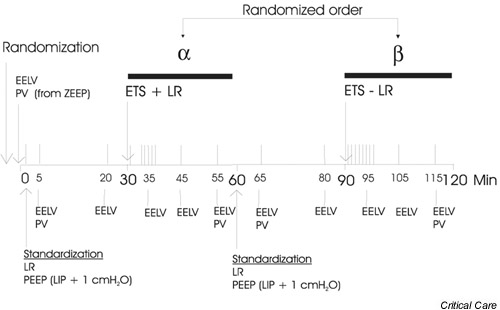
Materials and method: A prospective, randomized, controlled study was conducted in a 15-bed general intensive care unit at a university hospital. Eight consecutive mechanically ventilated patients with acute lung injury or acute respiratory distress syndrome were included. One of two suctioning procedures was performed in each patient. In the first procedure, ETS was performed followed by LR manoeuvre and reconnection to the ventilator with positive end-expiratory pressure set at 1 cmH2O above the lower inflexion point, and after 60 min another ETS (but without LR manoeuvre) was performed followed by reconnection to the ventilator with similar positive end-expiratory pressure; the second procedure was the same as the first but conducted in reverse order. Before (baseline) and over 25 min following each ETS procedure, partial arterial oxygen tension (PaO2) and end-expiratory lung volume were measured.
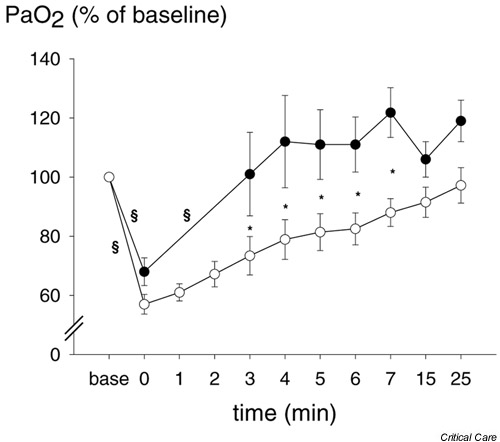
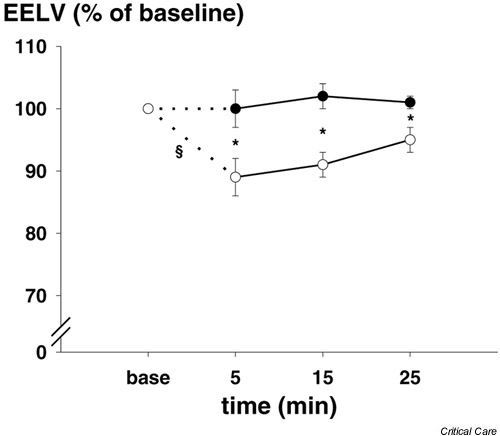
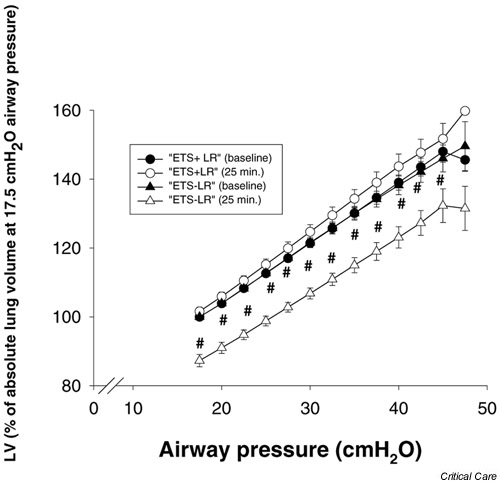
Results: After ETS, PaO2 decreased by 4.3(0.9-9.7)kPa (median and range; P < 0.005). After LR manoeuvre, PaO2 recovered to baseline. Without LR manoeuvre, PaO2 was reduced (P = 0.05) until 7 min after ETS. With LR manoeuvre end-expiratory lung volume was unchanged after ETS, whereas without LR manoeuvre end-expiratory lung volume was still reduced (approximately 10%) at 5 and 15 min after ETS (P = 0.01).
Discussion: A LR manoeuvre immediately following ETS was, as an adjunct to positive end-expiratory pressure, effective in rapidly counteracting the deterioration in PaO2 and lung volume caused by open ETS in ventilator-treated patients with acute lung injury or acute respiratory distress syndrome.
Figures
Comment in
-
Recruitment and retention of lung volume.Crit Care. 2003 Feb;7(1):9-10. doi: 10.1186/cc1857. Epub 2002 Dec 18. Crit Care. 2003. PMID: 12617731 Free PMC article.
References
-
- Neumann P, Berglund JE, Mondejar EF, Magnusson A, Hedenstierna G. Dynamics of lung collapse and recruitment during prolonged breathing in porcine lung injury. J Appl Physiol. 1998;85:1533–1543. - PubMed
-
- Clark AP, Winslow EH, Tyler DO, White KM. Effects of endotracheal suctioning on mixed venous oxygen saturation and heart rate in critically ill adults. Heart Lung. 1990;19:552–557. - PubMed
-
- Grap MJ, Glass C, Corley M, Parks T. Endotracheal suctioning: ventilator vs manual delivery of hyperoxygenation breaths. Am J Crit Care. 1996;5:192–197. - PubMed
-
- Preusser BA, Stone KS, Gonyon DS, Winningham ML, Groch KF, Karl JE. Effects of two methods of preoxygenation on mean arterial pressure, cardiac output, peak airway pressure, and postsuctioning hypoxemia. Heart Lung. 1988;17:290–299. - PubMed
Publication types
MeSH terms
LinkOut - more resources
Full Text Sources
