


Comment
doi: 10.1172/JCI18015.
Soluble VEGF receptor Flt1: the elusive preeclampsia factor discovered?
Affiliations
- PMID: 12618513
- PMCID: PMC151908
- DOI: 10.1172/JCI18015
Item in Clipboard
Comment
Soluble VEGF receptor Flt1: the elusive preeclampsia factor discovered?
J Clin Invest.
2003 Mar.
No abstract available
Figures
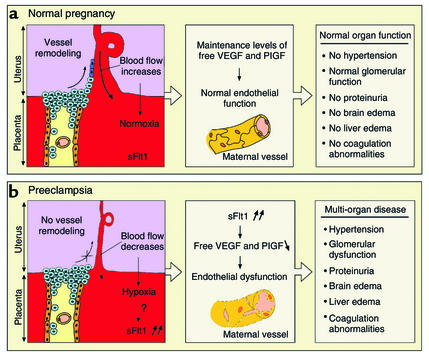
Hypothesis on the role of sFlt1 in preeclampsia. (a) During normal pregnancy, the uterine spiral arteries are infiltrated and remodeled by endovascular invasive trophoblasts, thereby increasing blood flow significantly in order to meet the oxygen and nutrient demands of the fetus. (b) In the placenta of preeclamptic women, trophoblast invasion does not occur and blood flow is reduced, resulting in placental hypoxia. In addition, increased amounts of soluble Flt1 (sFlt1) are produced by the placenta and scavenge VEGF and PlGF, thereby lowering circulating levels of unbound VEGF and PlGF. This altered balance causes generalized endothelial dysfunction, resulting in multi-organ disease. It remains unknown whether hypoxia is the trigger for stimulating sFlt1 secretion in the placenta of preeclamptic mothers and whether the higher sFlt1 levels interfere with trophoblast invasion and spiral artery remodeling.
Comment on
-
Excess placental soluble fms-like tyrosine kinase 1 (sFlt1) may contribute to endothelial dysfunction, hypertension, and proteinuria in preeclampsia.J Clin Invest. 2003 Mar;111(5):649-58. doi: 10.1172/JCI17189. J Clin Invest. 2003. PMID: 12618519 Free PMC article.
-
Glomerular-specific alterations of VEGF-A expression lead to distinct congenital and acquired renal diseases.J Clin Invest. 2003 Mar;111(5):707-16. doi: 10.1172/JCI17423. J Clin Invest. 2003. PMID: 12618525 Free PMC article.
References
-
- Roberts JM, Cooper DW. Pathogenesis and genetics of pre-eclampsia. Lancet. 2001;357:53–56. - PubMed
-
- Pridjian G, Puschett JB. Preeclampsia. Part 1: clinical and pathophysiologic considerations. Obstet. Gynecol. Surv. 2002;57:598–618. - PubMed
-
- Podjarny E, Baylis C, Losonczy G. Animal models of preeclampsia. Semin. Perinatol. 1999;23:2–13. - PubMed
Publication types
MeSH terms
Substances
LinkOut - more resources
Full Text Sources
Other Literature Sources
Medical
