. 2003 Mar;69(3):1695-701.
doi: 10.1128/AEM.69.3.1695-1701.2003.

Early events in the Fusarium verticillioides-maize interaction characterized by using a green fluorescent protein-expressing transgenic isolate

Affiliations

Early events in the Fusarium verticillioides-maize interaction characterized by using a green fluorescent protein-expressing transgenic isolate

Liat Oren et al. Appl Environ Microbiol. 2003 Mar.

Abstract

The infection of maize by Fusarium verticillioides can result in highly variable disease symptoms ranging from asymptomatic plants to severe rotting and wilting. We produced F. verticillioides green fluorescent protein-expressing transgenic isolates and used them to characterize early events in the F. verticillioides-maize interaction that may affect later symptom appearance. Plants grown in F. verticillioides-infested soil were smaller and chlorotic. The fungus colonized all of the underground parts of a plant but was found primarily in lateral roots and mesocotyl tissue. In some mesocotyl cells, conidia were produced within 14 to 21 days after infection. Intercellular mycelium was detected, but additional cells were not infected until 21 days after planting. At 25 to 30 days after planting, the mesocotyl and main roots were heavily infected, and rotting developed in these tissues. Other tissues, including the adventitious roots and the stem, appeared to be healthy and contained only a small number of hyphae. These results imply that asymptomatic systemic infection is characterized by a mode of fungal development that includes infection of certain tissues, intercellular growth of a limited number of fungal hyphae, and reproduction of the fungus in a few cells without invasion of other cells. Development of visibly rotted tissue is associated with massive production of fungal mycelium and much less organized growth.


Figures
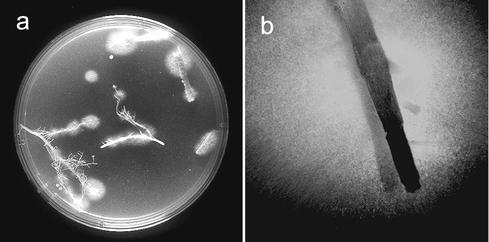
FIG. 1.
FIG. 1.
Isolation of GFP-expressing F. verticillioides from infected maize roots. Seeds were inoculated with the transgenic isolate gf12 and planted in disinfested soil. Roots of 14-day-old plants were excised, rinsed in water, and plated on peptone-PCNB semiselective medium. Colonies emerged after 4 to 6 days (a), and GFP expression was detected with a fluorescence stereoscope (b) (the white halo fluoresces in green).
FIG. 2.
FIG. 2.
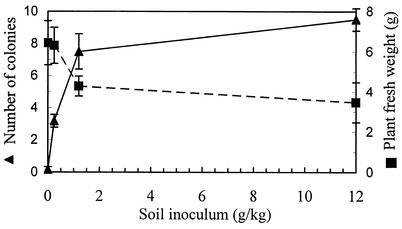
Effect of soil inoculation with F. verticillioides on seedling fresh weight and root colonization. Disinfested soil was inoculated with an F. verticillioides mycelium homogenate. Plant fresh weight and root colonization were determined 20 days after planting. The error bars indicate the standard errors.
FIG. 3.
FIG. 3.
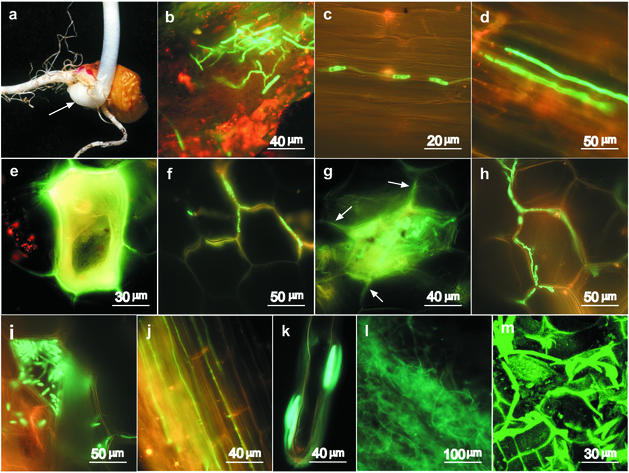
Early events during plant colonization by F. verticillioides. Seeds were planted in soil that was inoculated with a transgenic isolate gf12 mycelium homogenate. The photographs were obtained with a fluorescence microscope unless otherwise indicated. (a) The organs and tissues examined included the root, lateral roots and root hairs, mesocotyl (arrow), seed pericarp, and lower part of the shoot. (b) Adherence of mycelium and direct penetration of the mesocotyl 3 days after planting. (c and d) Hyphae growing on the surface of a lateral root (c) and inside a lateral root (d) 7 days after planting. (e to i) Colonization and reproduction of the fungus in mesocotyl cells. Single cells accumulated fluorescing material after 7 days (e), but fungal growth was restricted to the cell wall spaces (f). After 14 days, conidia started to differentiate (g), and more developed mycelium was detected in the intercellular wall spaces (h). Hyphae grew out of the cells in which conidia were formed, but through specific points of contact with other cells and without rupturing the cells (g, arrows). After 21 days conidia matured (i) but were still retained in the cells in which they were formed. (j) After 21 days, the development of the mycelium on the root intensified, with hyphae growing in the intercellular spaces along the root. (k) Macroconidia attached to the mucilage layer on a root hair 21 days after planting. (l and m) Large amounts of mycelium developed after 30 days and infected the entire mesocotyl tissue (l) and the main root (m) (confocal microscopy).
FIG. 4.
FIG. 4.
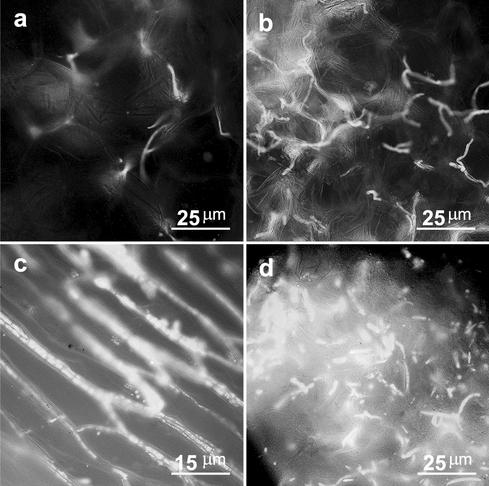
Effects of inoculum levels and light conditions on inoculation of maize plants by F. verticillioides. (a and b) Effect of two levels of inoculum on the amount of mycelium that developed in the mesocotyl 30 days after seeds were planted in inoculated soil. The inocula used were 0.1 g (fresh weight) per kg of soil (a) and 0.6 g (fresh weight) per kg of soil (b). (c and d) Development of mycelium in roots (c) and mesocotyls (d) of plants grown under low-light conditions (20 microeinsteins m−2) 14 days after inoculated seeds were planted in disinfested soil.

References

    1. Bacon, C., R. Bennett, D. Hinton, and K. Voss. 1992. Scanning electron microscopy of Fusarium moniliforme within asymptomatic corn kernels and kernels associated with equine leukoencephalomalacia. Plant Dis. 76:144-148.
    1. Bacon, C. W., and D. M. Hinton. 1996. Symptomless endophytic colonization of maize by Fusarium moniliforme. Can. J. Bot. 74:1195-1202.
    1. Brown, R., T. Cleveland, C. Woloshuk, G. A. Payne, and D. Bhatnagar. 2001. Growth inhibition of a Fusarium verticillioides GUS strain in corn kernels of aflatoxin-resistant genotypes. Appl. Biotechnol. Microbiol. 57:708-711. - PubMed
    1. Burgess, L. W., B. A. Summerell, S. Bullock, K. P. Gott, and D. Backhouse. 1994. Laboratory manual for Fusarium research, 3rd ed. University of Sydney, Sydney, Australia.
    1. Danielsen, S., and D. Jensen. 1998. Relationships between seed germination, fumonisin content, and Fusarium verticillioides infection in selected maize samples from different regions of Costa Rica. Plant Pathol. 47:609-614.

Publication types

Substances

LinkOut - more resources