Comparative Study
. 2003 Mar;69(3):1728-38.
doi: 10.1128/AEM.69.3.1728-1738.2003.

Comparative genomic analyses of the vibrio pathogenicity island and cholera toxin prophage regions in nonepidemic serogroup strains of Vibrio cholerae

Affiliations
Comparative Study

Comparative genomic analyses of the vibrio pathogenicity island and cholera toxin prophage regions in nonepidemic serogroup strains of Vibrio cholerae

Manrong Li et al. Appl Environ Microbiol. 2003 Mar.

Abstract

Two major virulence factors are associated with epidemic strains (O1 and O139 serogroups) of Vibrio cholerae: cholera toxin encoded by the ctxAB genes and toxin-coregulated pilus encoded by the tcpA gene. The ctx genes reside in the genome of a filamentous phage (CTXphi), and the tcpA gene resides in a vibrio pathogenicity island (VPI) which has also been proposed to be a filamentous phage designated VPIphi. In order to determine the prevalence of horizontal transfer of VPI and CTXphi among nonepidemic (non-O1 and non-O139 serogroups) V. cholerae, 300 strains of both clinical and environmental origin were screened for the presence of tcpA and ctxAB. In this paper, we present the comparative genetic analyses of 11 nonepidemic serogroup strains which carry the VPI cluster. Seven of the 11 VPI(+) strains have also acquired the CTXphi. Multilocus sequence typing and restriction fragment length polymorphism analyses of the VPI and CTXphi prophage regions revealed that the non-O1 and non-O139 strains were genetically diverse and clustered in lineages distinct from that of the epidemic strains. The left end of the VPI in the non-O1 and non-O139 strains exhibited extensive DNA rearrangements. In addition, several CTXphi prophage types characterized by novel repressor (rstR) and ctxAB genes and VPIs with novel tcpA genes were found in these strains. These data suggest that the potentially pathogenic, nonepidemic, non-O1 and non-O139 strains identified in our study most likely evolved by sequential horizontal acquisition of the VPI and CTXphi independently rather than by exchange of O-antigen biosynthesis regions in an existing epidemic strain.


Figures
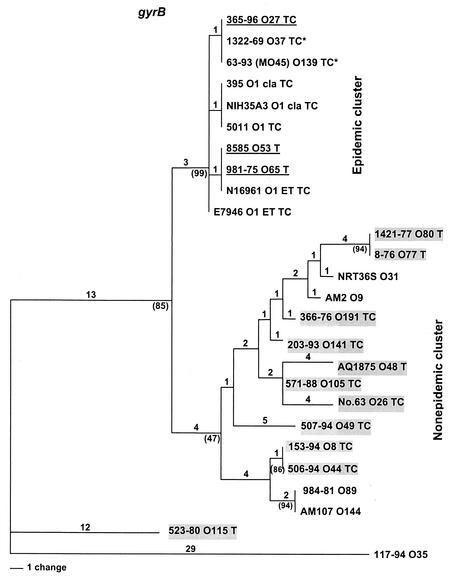
FIG. 1.
FIG. 1.
Neighbor-joining tree constructed by the maximum-parsimony method with the nucleotide sequences of gyrB gene fragments of V. cholerae strains. Labels at the branch tips represent strain designation, serogroup, and the virulence gene (T for tcpA and C for ctxAB), if present. The horizontal length represents the genetic distance, and the vertical lengths are not meaningful. The numbers above the branch lines represent the number of changes, and the numbers in parentheses below the branch lines at the branch node are the bootstrap values. Strains for which O-antigen switching is the proposed mechanism are underlined, and strains in which O-antigen switching is supported by sequence evidence are indicated by asterisks. Strains which appear to have acquired VPI and CTXφ or pre-CTXφ by independent horizontal gene transfer are highlighted.
FIG. 2.
FIG. 2.
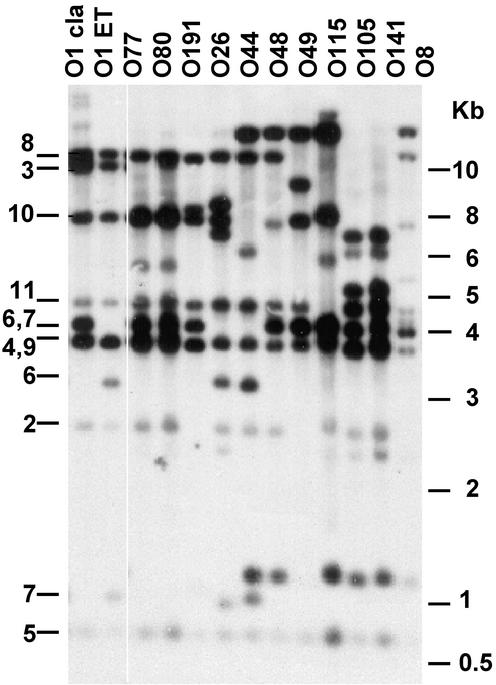
RFLP analysis of the VPI region in various V. cholerae strains. Southern analysis of the XmnI-digested genomic DNAs of the indicated strains was done by simultaneous hybridization with multiple probes. The probes used were b, d, e, g, h, and i, as shown in Fig. 3. The corresponding restriction fragments (shown in Fig. 3) of the El Tor (ET) VPI detected by these probes are indicated by the numbers on the left side of the figure. The size markers (in kilobases) are indicated on the right side of the figure. cla, classical.
FIG. 3.
FIG. 3.
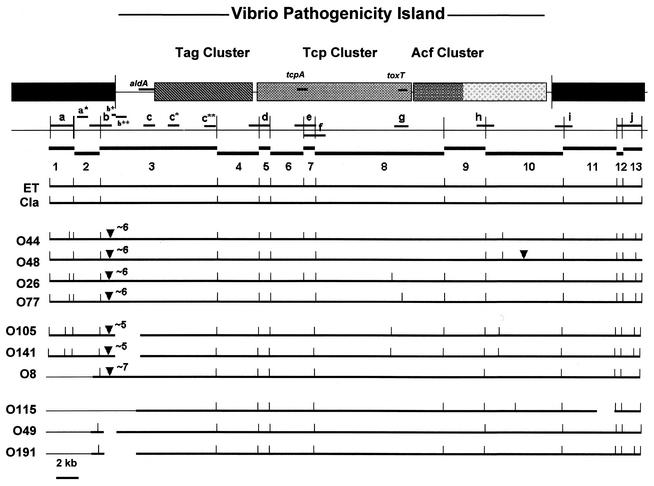
Genetic organization of the VPI cluster. A schematic diagram of the VPI region in an O1 El Tor strain, based on the V. cholerae (16) genome sequence, is shown. The top bar represents the various subclusters within the VPI region, the filled bar indicates the junction segments of the VPI region, and the vertical lines mark the ends of the VPI cluster. The various probes are indicated in the second row (a through j). The predicted XmnI fragments of the VPI region of the El Tor chromosome (numbered 1 to 13) are indicated in the third row. The observed XmnI fragments of the VPI region deduced from hybridization analyses and the resulting genetic maps of the El Tor (ET), classical (Cla), and various non-O1 and non-O139 strains of V. cholerae are shown below. DNA insertions and their sizes in kilobases are indicated by triangles and the numbers above the triangles, broken lines represent deletions, and thin lines indicate the adjoining sequences on the chromosome. The El Tor type included the O53, O65, and O139 serogroups, the classical type included the O37 serogroup, and the O77 type included the O80 serogroup.
FIG. 4.
FIG. 4.
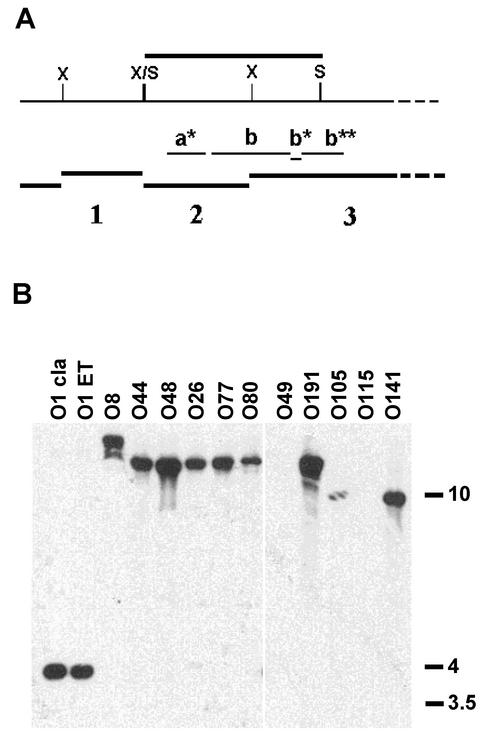
RFLP analysis of the left end of the VPI region in V. cholerae strains. The schematic diagram of the left end of the VPI region and the expected SalI- and XmnI-generated fragments 1 to 3 as shown in Fig. 3 are indicated at the top (A). SalI-digested genomic DNAs were hybridized with the b* probe (B). Strains of serogroups O49 and O115 have a deletion in the region of the probe. ET, El Tor; cla, classical.
FIG. 5.
FIG. 5.
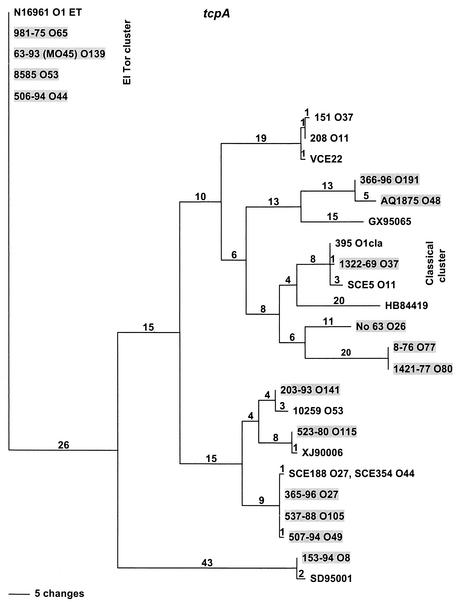
Neighbor-joining tree constructed by the maximum-parsimony method with the amino acid sequences of the tcpA gene fragments of V. cholerae strains. The labels at the branch tips represent the strain designation and serogroup, if known. A total of 28 tcpA sequences, which included alleles described in this study (highlighted) and in previously published studies, were used for the analysis. The strain designations of published sequences are as follows (serogroups, if known, and GenBank accession numbers are in parentheses): N16961-ET (O1, AF325734), 395 classical (O1, AF325733), 151 (O37, AF030546), 208 (O11, AF030309), VCE22 (AF414371), SCE5 (O11, AB012946), 10259 (O53, AF139626), SCE188, SCE354 (O27, O44, AF208385), GX95065 (AY056618), HB84419 (AY052830), XJ90006 (AY056619), SD95001, (AY052831), and 365-96 (O27, AF390571). The strain designations of novel alleles reported in this paper are as follows (serogroups, if known, and GenBank accession numbers are in parentheses): 366-96 (O191, AF452580), AQ1875 (O48, AF452573), 1322-69 (O37), No. 63 (O26, AF452571), 8-76 (O77, AF452575), 203-93 (O141, AF452579), 523-80 (O115, AF452578), 507-94 (O49, AF452574), 153-94 (O8, AF452570), 571-88 (AF452577), 1421-77 (O80, AF452576), and 506-94 (O44, AF452572). ET, El Tor; cla, classical.
FIG. 6.
FIG. 6.
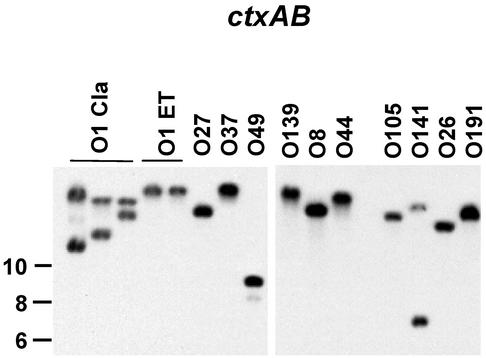
Analysis of the CTXφ prophage in V. cholerae strains. Southern blot analysis of EcoRI-digested genomic DNAs probed with the ctxAB gene probes is shown; each band represents one copy of the CTXφ prophage genome. ET, El Tor; Cla, classical.
FIG.7.
FIG.7.
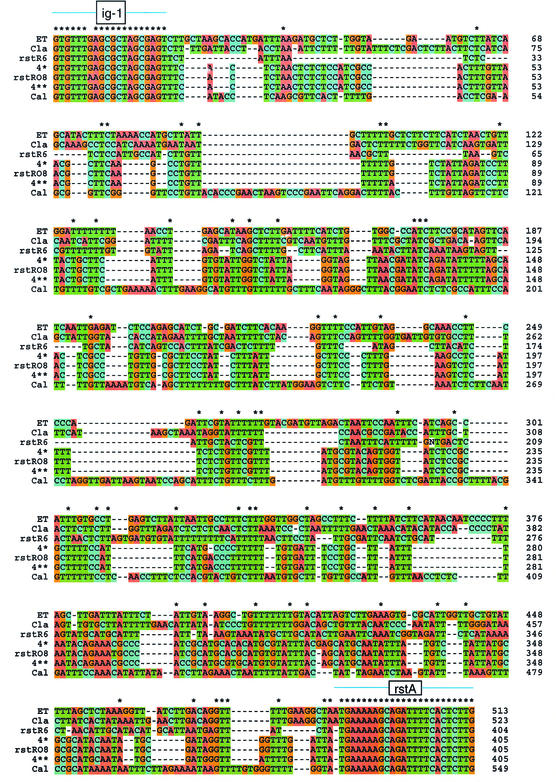
Clustal-X alignment of rstR sequences. A total of 24 rstR sequences available in the GenBank database, which included alleles described in this study, were used for the analysis. Only the rstR type sequences that encode different RstR proteins (5 type sequences, i.e., El Tor [ET], classical [Cla], Calcutta [Cal], rstR4**, and rstR6) and two variants are shown in the figure. One sequence (accession number AF133308, designated rstR5 from strain SCE264) of the Calcutta type shows extensive variations, its RstR protein exhibited the least similarity to all of the other alleles (28), and hence, it was not included in the alignment. The strain designations of the published sequences are as follows (the serogroup [if known] and the GenBank accession numbers are in parentheses: El Tor (ET) type, E7946 (O1 ET, U83795), E7946 (O1 ET, U83796), SC8511 (O1 ET, AF511000), N16961 (O1 ET, AE004224), and JS9803 (O139, AY101180); classical (Cla) type, O39 (O1 Cla, AF262318), SC9773 (O1 ET, AF510999), 569B (O1 Cla, AF05890), and 86015 (O1 ET, AF220606); Calcutta (Cal) type, AS207 (O139, AF110029), SCE188 (O44, AF133310), FJ98352 (O139, AF511001), and SCE264 (O42, AF133308); rstR4** type, SCE223 (O27, AF133307), 365-96 (O27, AF390570), JX94484 (O139, AF511001), VCE22 (O36, AY145124), VCE228 (O27, AY145125), VCE232 (O4, AY145126), VCE233 (O27, AY145127), 153-94 (O8, AF452585), and SCE263 (O10, AF133309); Novel type, 506-94 (O44, AF452586) and 9803 (O139, AF302794). Nucleotides CT and AG are in green and red, respectively. ig-1, intergenic region 1; rstA, the 5′ end of the rstA gene. Nucleotides that are identical in all sequences are indicated by asterisks.
FIG. 8.
FIG. 8.
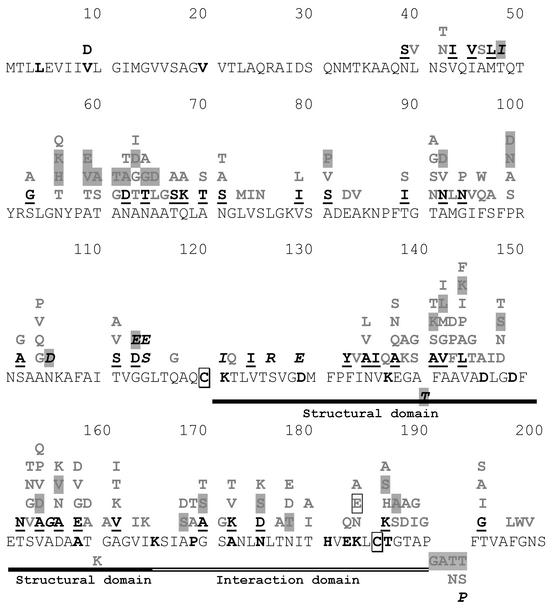
Domain structure of TcpA. The primary amino acid sequence of the El Tor TcpA is shown. The residues shown to have functional significance, based on site-directed mutagenesis (10, 23, 41), are indicated in boldface type, the two cysteine residues predicted to be essential for the structure and function of TcpA pilin are indicated by boxes, and the proposed domains are indicated by bars (10, 23, 41). The variations in the amino acid residues found in various tcpA alleles described in other studies (9, 15, 28-30) and in this work (highlighted) are indicated above the primary sequences. The variations seen in the classical allele are underlined. The changes unique to a single strain are indicated in italics. The O37 serogroup has a classical TcpA with a single change (K184 to E) indicated by a shaded box.

References

    1. Albert, M. J., M. Ansaruzzaman, P. K. Bardhan, A. S. G. Faruque, S. M. Faruque, M. S. Islam, D. Mahalanabis, R. B. Sack, M. A. Salam, A. K. Siddique, M. D. Yunus, and K. Zaman. 1993. Large epidemic of cholera-like disease in Bangladesh caused by Vibrio cholerae O139 synonym Bengal. Lancet 342:387-390. - PubMed
    1. Aldova, E., K. Laznickova, E. Stepankova, and J. Lietava. 1968. Isolation of nonagglutinable vibrios from an enteritis outbreak in Czechoslovakia. J. Infect. Dis. 118:25-31. - PubMed
    1. Berche, P., C. Poyart, E. Abachin, H. Lelievre, J. Vandepitte, A. Dodin, and J.-M. Fournier. 1994. The novel epidemic strain O139 is closely related to pandemic strain O1 of Vibrio cholerae. J. Infect. Dis. 170:701-704. - PubMed
    1. Bhattacharya, S. K., M. K. Bhattacharya, G. B. Nair, D. Dutta, A. Deb, T. Ramamurthy, S. Garg, P. K. Saha, P. Dutta, A. Moitra, B. K. Mandel, T. Shimada, Y. Takeda, and B. C. Deb. 1993. Clinical profile of acute diarrhoea cases infected with the new epidemic strain of V. cholerae O139: designation of disease as cholera. J. Infect. Dis. 27:11-15. - PubMed
    1. Bik, M., R. D. Gouw, and F. R. Mooi. 1996. DNA fingerprinting of Vibrio cholerae strains with a novel insertion sequence element: a tool to identify epidemic strains. J. Clin. Microbiol. 34:1453-1461. - PMC - PubMed

Publication types

MeSH terms

Associated data

LinkOut - more resources