


CCR5 expression and beta-chemokine production during placental neonatal monocyte differentiation
- PMID: 12621126
- PMCID: PMC4009693
- DOI: 10.1203/01.PDR.0000059749.82140.4A
CCR5 expression and beta-chemokine production during placental neonatal monocyte differentiation
Abstract
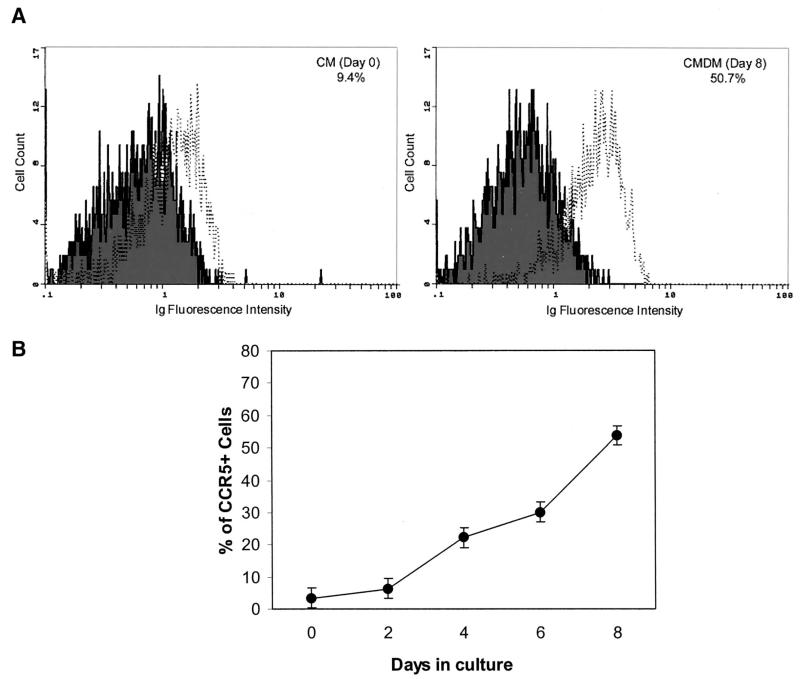
The stage of maturation of monocytes affects their susceptibility to HIV infection. The beta-chemokines and their receptor CCR5 play a crucial role in inflammatory reactions and HIV infection. We therefore examined the correlation between the expression of CCR5 and beta-chemokine production and the susceptibility to HIV infection during cord monocyte (CM) differentiation into macrophages. CM and CM-derived macrophages (CMDM) were examined for beta-chemokine and CCR5 expression. The susceptibility of the CM cultured in vitro at different time points to HIV infection was also determined. Although the levels of CCR5 mRNA expression in freshly isolated CM are comparable to those in CMDM, CM had significantly lower levels of CCR5 protein on the cell surface than CMDM did. Steady increase of CCR5 protein expression on the cell surface was observed during CM differentiation into macrophages. The CCR5 expression correlated with the increased susceptibility to HIV infection by CMDM. Although there was no significant difference in endogenous beta-chemokine production between CM and CMDM, HIV infection of CMDM significantly enhanced production of macrophage inflammatory protein-1alpha and -1beta. CCR5 receptor plays a critical role in HIV infection of neonatal blood monocyte/macrophages.
Figures


References
-
- Ho WZ, Cherukuri R, Douglas SD. The macrophage and HIV-1. In: Zwilling BS, Eisenstein TK, editors. Macrophage-Pathogen Interactions. Immunol Ser. Marcel Dekker; New York: 1994. pp. 569–587. - PubMed
-
- Alkhatib G, Combadiere C, Broder CC, Feng Y, Kennedy PE, Murphy PM, Berger EA. CC CKR5: a RANTES, MIP-1alpha, MIP-1beta receptor as a fusion cofactor for macrophage-tropic HIV-1. Science. 1996;272:1955–1958. - PubMed
-
- Deng H, Liu R, Ellmeier W, Choe S, Unutmaz D, Burkhart M, Di Marzio P, Marmon S, Sutton RE, Hill CM, Davis CB, Peiper SC, Schall TJ, Littman DR, Landau NR. Identification of a major co-receptor for primary isolates of HIV-1. Nature. 1996;381:661–666. - PubMed
-
- Dragic T, Litwin V, Allaway GP, Martin SR, Huang Y, Nagashima KA, Cayanan C, Maddon PJ, Koup RA, Moore JP, Paxton WA. HIV-1 entry into CD4+ cells is mediated by the chemokine receptor CC-CKR-5. Nature. 1996;381:667–673. - PubMed
Publication types
MeSH terms
Substances
Grants and funding
LinkOut - more resources
Full Text Sources
