. 2003 Mar 18;100(6):3455-60.
doi: 10.1073/pnas.0530276100. Epub 2003 Mar 7.

Gene-environment interaction modulated by allelic heterogeneity in inflammatory diseases

Affiliations

Gene-environment interaction modulated by allelic heterogeneity in inflammatory diseases

Mathias Chamaillard et al. Proc Natl Acad Sci U S A. .

Abstract

CARD15 is a major susceptibility gene for a frequent multifactorial chronic inflammatory bowel disorder, Crohn disease (CD). By using NF-kappaB activation assays, the cytosolic CARD15 was shown to efficiently detect bacterial peptidoglycan (PGN), reminiscent of the PGN recognition protein surveillance mechanism in Drosophila. The 3 CD-associated variants and 13 additional variants carried by CD patients demonstrated impaired PGN-dependent response revealing null, hypomorphic, or dominant-negative properties. Quantitative parametrization of this response, computed from the patients' CARD15 genotypes, was predictive of several variable CD manifestations. In contrast, CARD15 alleles associated with Blau's syndrome promoted PGN-independent NF-kappaB activation, an observation that accounts for the minimal microbial input in the etiology of this dominant, monogenic inflammatory disorder affecting solely aseptic sites.


Figures
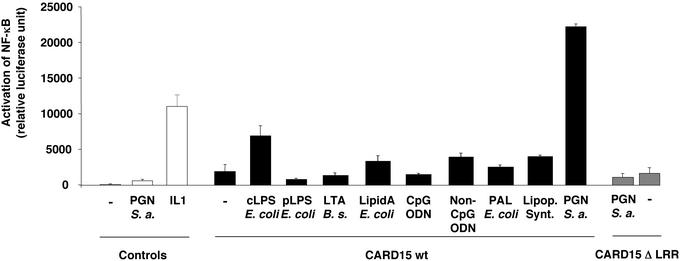
Figure 1
Figure 1
Differential sensing of cytosolic PAMP by CARD15. Briefly, a minimal amount (30 ng) of CARD15- or CARD15ΔLRR-encoding vector was used for reliable detection of the NF-κB activation by the WT allele. Values are noted in relative luciferase units (RLU) after standardization with the pnull-Renilla system (Promega). Means and SEM are shown for at least three independent experiments, each performed in duplicate. For positive control stimulation, HEK 293 cells were treated with 10 ng/ml IL-1 for 4 h. After transfection, HEK 293 cells were either not exposed (−) or exposed to 10 μg/ml of each of the following PAMP: the most active tested commercial LPS (from serotype O111:B4 E. coli, labeled cLPS E. coli), hexaacylated protein-free purified from E. coli F515 (pLPS E. coli), lipoteichoic acid from B. subtilis (LTA B. s.), lipid A from E. coli (LipidA E. coli), PGN-associated lipoprotein from E. coli (PAL E. coli), PAM3-CysOH synthetic bacterial lipopeptides (Lipop. Synt.) purchased from Novabiochem, and PGN from S. aureus (PGN S. a.). Cells were also exposed to 5 μM CpG oligodeoxyribonucleic acids (CpG ODN) and non-CpG oligodeoxyribonucleic acids (non-CpG ODN). In addition to PGN or IL-1, vector-transfected cells were exposed to all tested PAMPs, and the NF-κB pathway was shown to be nonactivated (data not shown).
Figure 2
Figure 2
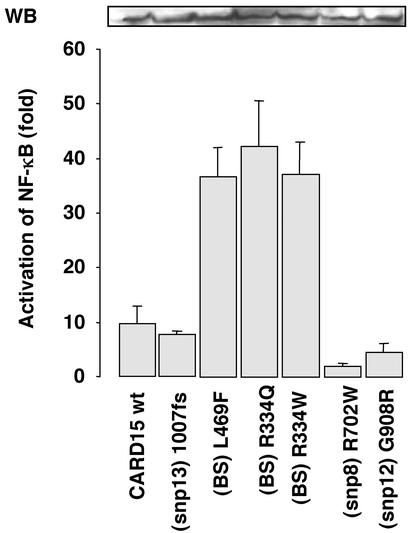
PGN-independent NF-κB activation potential of CARD15 variants associated with CD and BS. The WT reference CARD15 construct and six derived constructs, each carrying a single mutation associated with either BS (L469F, R334Q, and R334W) or CD susceptibility (R702W-SNP8, G908R-SNP12, and 1007fs-SNP13), were transiently cotransfected in HEK 293 cells with a minimal amount of DNA (30 ng). (Upper) A typical CARD15 immunoblot (WB) of the transfected HEK 293 cells revealing comparable levels of exogenous protein expression. Means and SEM of at least five independent duplicate experiments are shown.
Figure 3
Figure 3
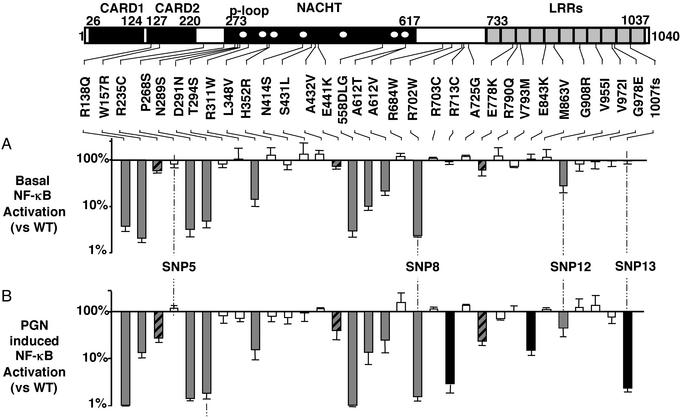
In vitro functional analysis of CARD15 variants. From its N terminus to its C terminus, CARD15 is composed of two caspase recruitment domains (CARD), a centrally placed NACHT domain with seven highly conserved regions (white dots), including a p loop (9), and 11 LRR (10). Locations of the 32 tested amino acid changes/deletions observed in CD patients are shown. In a test using minimal amounts of DNA, such as the one reported in Fig. 2, none of these mutations demonstrated increased basal activity comparable to that observed for the BS mutants. (A) Ratio of the basal NF-κB activity measured after transient transfection of 500 ng of CARD15-variant expression vector DNA in HEK 293 cells over that observed with the WT construct (log scale). The latter was 80-fold that observed in mock-transfected cells. (B) Ratio of the NF-κB activity measured after transient transfection of 30 ng of CARD15-variant expression vector DNA in HEK 293 cells and after a 24-h incubation in the presence of PGN (10 μg/ml) over that observed with the WT construct under the same conditions (log scale). The latter was 110-fold that observed in mock-transfected cells. White, gray, and black bars correspond to prototypes I, II, and III, respectively, as described in Results. Hatched bars correspond to the variants with borderline behavior between prototypes II and III.
Figure 4
Figure 4
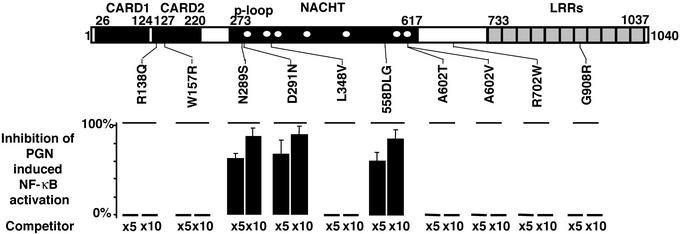
Search for in vitro dominant-negative properties among the prototype II CARD15 variants observed in inflammatory bowel disorder patients. Inhibition (%) of the CARD15 response to PGN (10 μg/ml) in cotransfection experiments using the WT allele (30 ng) and 5× or 10× molar excess of the mutant construct (competitor) is reported. In all cases, means ± SEM of at least three independent duplicate experiments are reported.
Figure 5
Figure 5
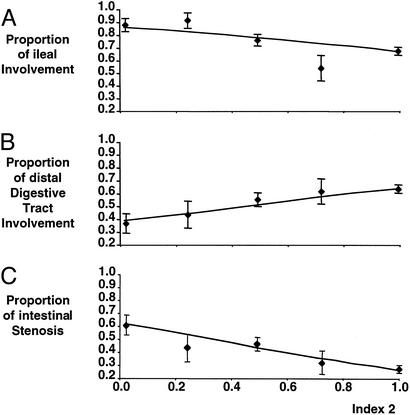
Clinical consequences of the CARD15 deficiency in PGN-induced NF-κB activation. The data of the series described by Lesage et al. (15) were used. For each CD patient not carrying an in vitro dominant-negative allele, a parameter Ind2 reflecting the CARD15 ability of PGN sensing was defined as the average of the relative in vitro activities of each of his/her two CARD15 alleles compared with the WT allele. The relative activities associated with each allele are taken from Fig. 3B [e.g., Ind2 for a patient who is a compound heterozygote (SNP12/SNP13) is computed as the mean of the residual PGN-dependent activity of SNP12, i.e., 0.45, and that of SNP13, 0.02, resulting in Ind2 = 0.235]. Patients were classified into five groups according to their Ind2 indexes: group 1 (Ind2 < 0.2, 41 patients), group 2 (0.2–0.4, 23 patients), group 3 (0.4–0.6, 87 patients), group 4 (0.6–0.8, 26 patients), and group 5 (Ind2 > 0.8; 222 patients). The proportion of patients and its estimated SE (binomial distribution) with a given clinical manifestation are plotted as a function of the average Ind2 in each group. The line shows the fit of the ungrouped clinical data to the linear regression model. (A) Proportion of patients with ileal involvement at presentation. (B) Proportion of patients with distal digestive tract (from transverse colon to rectum) involvement at presentation. (C) Proportion of patients with intestinal stenosis.

References

    1. Shanahan F. Lancet. 2002;359:62–69. - PubMed
    1. Swidsinski A, Ladhoff A, Pernthaler A, Swidsinski S, Loening-Baucke V, Ortner M, Weber J, Hoffmann U, Schreiber S, Dietel M, Lochs H. Gastroenterology. 2002;122:44–54. - PubMed
    1. Schultsz C, Van Den Berg F M, Ten Kate F W, Tytgat G N, Dankert J. Gastroenterology. 1999;117:1089–1097. - PubMed
    1. Darfeuille-Michaud A, Neut C, Barnich N, Lederman E, Di Martino P, Desreumaux P, Gambiez L, Joly B, Cortot A, Colombel J F. Gastroenterology. 1998;115:1405–1413. - PubMed
    1. Liu Y, van Kruiningen H J, West A B, Cartun R W, Cortot A, Colombel J F. Gastroenterology. 1995;108:1396–1404. - PMC - PubMed

Publication types