


Mechanics of DNA packaging in viruses
- PMID: 12629206
- PMCID: PMC404299
- DOI: 10.1073/pnas.0737893100
Mechanics of DNA packaging in viruses
Abstract
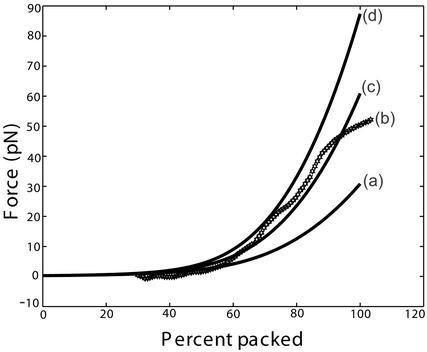
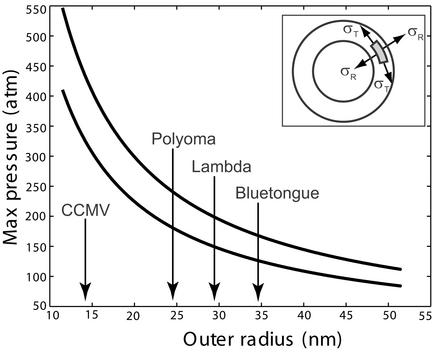
A new generation of single-molecule experiments has opened up the possibility of reexamining many of the fundamental processes of biochemistry and molecular biology from a unique and quantitative perspective. One technique producing a host of intriguing results is the use of optical tweezers to measure the mechanical forces exerted by molecular motors during key processes such as the transcription of DNA or the packing of a viral genome into its capsid. The objective of the current article is to respond to such measurements on viruses and to use the theory of elasticity and a simple model of charge and hydration forces to derive the force required to pack DNA into a viral capsid as a function of the fraction of the viral genome that has been packed. The results are found to be in excellent accord with recent measurements and complement previous theoretical work. Because the packing of DNA in viral capsids occurs under circumstances of high internal pressure, we also compute how much pressure a capsid can sustain without rupture.
Figures
References
-
- Kanamaru S., Leiman, P. G., Kostyuchenko, V. A., Chipman, P. R., Mesyanzhinov, V. M., Arisaka, F. & Rossmann, M. G. (2002) Nature 415, 553-557. - PubMed
-
- Wikoff W. R. & Johnson, J. E. (1999) Curr. Biol. 9, R296-R300. - PubMed
-
- Richards K. E., Williams, R. C. & Calendar, R. (1973) J. Mol. Biol. 78, 255-259. - PubMed
-
- Cerritelli M. E., Cheng, N., Rosenberg, A. H., McPherson, C. E., Booy, F. P. & Steven, A. C. (1997) Cell 91, 271-280. - PubMed
Publication types
MeSH terms
Substances
LinkOut - more resources
Full Text Sources
Other Literature Sources
